
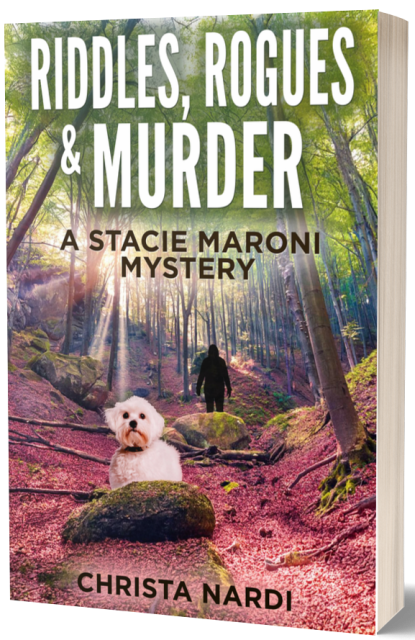
Christa Nardi, author of Riddles, Rogues and Murder, a Stacie Maroni mystery, is visiting Ascroft, eh? today to share with us what makes a cozy mystery.
Welcome, Christa. I’ll turn the floor over to you –
An author friend of mine (C.B. Wilson) once described the cozy mystery as a Hallmark movie on steroids. I’d agree with the broad description and obviously so does Hallmark as more and more cozy authors’ books have been made into movies and are on the Hallmark Mystery channel. For example, some of Joanne Fluke’s Hannah Swensen mysteries, Kate Collins’ Flower Shop mysteries, and Charlaine Harriss’ Aurora TeaGarden mysteries have been adapted and are available to watch.
What are the key elements that differentiate a cozy mystery from a traditional mystery or other genres of mystery? What makes them cozy?
First and foremost, the expectation is there is no explicit violence or gore, no graphic sex, and no profanity. Still, if there was a murder, there is some violence. The characters are not chaste, but there’s no description, it sex doesn’t occur on the page, and it’s mostly innuendo. Again, although there might be a “heck” somewhere or “@$%!” to express a reaction, there is generally no profanity.
Part of what sets cozy mysteries apart from traditional mysteries, is that the MC has a job that is not being a detective, PI, or police, but is an amateur or accidental sleuth. What makes it “cozy” is that the mystery unfolds and the amateur sleuth has a regular life in a small town or small microcosm. Cozy mysteries are more character-driven. Unlike a police procedural or traditional mystery, there is more involvement of friends, family, and relationships that support the story. The characters are relatable, living normal lives – well, except for the dead bodies.
Still, the MC doesn’t work alone. Aside from friendships, in many cases, the MC is married to, in a relationship with, or somehow connected to someone in the local police department or similar. The small town feel, and the relationships, add warmth to the story. That it’s cozy, however, doesn’t preclude surprises, twists and turns, action, and suspense.
Across cozy mysteries, there are many sub-genres – faith-based cozies, paranormal cozies, culinary cozies, pet and animal cozies, book/library cozies, craft and hobby cozies, garden and nature cozies, travel cozies, senior and retirement cozies, and of course, seasonal cozies. I’ve also enjoyed a few cozies related to wineries, though I’m not sure which category those would fit in. Some are much lighter than others, though all include some element of humor and romance, but not as the main focus. Some contemporary cozies may have an edgy feel, reflecting some social issue.
Needless to say, the MCs vary in age (i.e., the senior sleuths), potentially tapping a different target audience and with characters facing different challenges. Others, may be focused more on middle age, though how that is defined seems to vary. For the Stacie Maroni mysteries, Stacie and her friends are in their thirties to forties, though some characters are younger and some are older.
The motive varies and in contemporary cozies, many of the motives reflect issues people face everywhere – betrayal, infidelity, money issues – not too much different than other variations. Another difference is that you even though you may be into the story and keep reading to the end, it’s not likely you’ll have nightmares. Cozy mysteries tend to be lighter than other genres. Regardless, the “HEA” is that the bad guys always get caught and the good guys always win. Enjoy your next cozy mystery!
Thank you for sharing this with us, Christa, and good luck with Riddles, Rogues and Murder, the latest book in the Stacie Maroni mystery series. Readers can learn more about Christa Nardi by visiting the author’s website and her Facebook, Goodreads, BookBub, Pinterest and Instagram pages. You can also follow her on Twitter/X.
The book is available online at Amazon

About Christa Nardi: Christa is an avid reader with her love of mysteries beginning with Nancy Drew and other teen mysteries. Her protagonists are smart, intelligent women sleuths. She authors four mystery series; Stacie Maroni Mysteries, Izzie Di Sante Mysteries, Sheridan Hendley Mysteries, and Cold Creek Cozy Mysteries. Her writing is best characterized as cozy mysteries with an edge. The stories do address negative issues, but consistent with the cozy genre, there’s no graphic violence or sex on the page, and no profanity. Characters may get knocked down or shot at and there are murders. Christa is a member of Sisters in Crime. When not reading or writing, Christa and her husband live in Texas. Christa enjoys traveling and playing with her dogs and granddaughters. She supports animal rescue and other efforts to help others.

















 dianneascroft.com