
Dotty Sayers from Holly, Baubles and Murder, a Dotty Sayers Antique mystery, is visiting Ascroft, eh? today to tell us a bit about the Yorkshire passion for Wensleydale Cheese and Fruitcake.
Welcome, Dotty. I’ll turn the floor over to you –
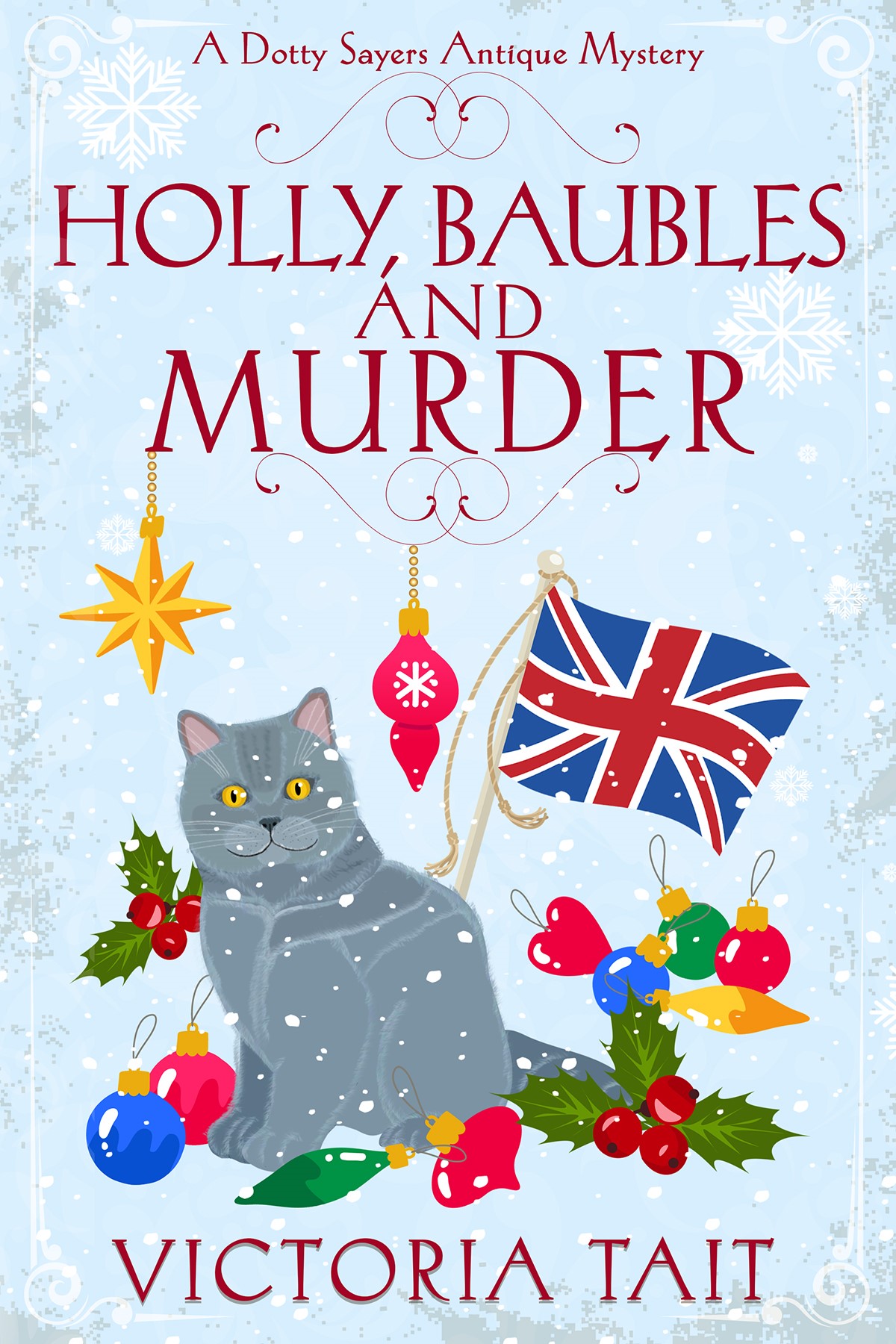
I’ve always enjoyed a variety of cheeses on a cheeseboard, or the tangy, slightly earthy tones of mature cheddar paired with slithers of celery and a tart apple chutney in a sandwich. But I didn’t realise when I drove into the glacial Yorkshire valley of Wensleydale, I’d experience cheese in a completely different way.
I came to Yorkshire to work at Yoredale Hall, the seat and ancestral home of the Earl of Abermarle. The Earl is head of the Fitzhenry family, which is very old and can trace its roots back to 1066 and the Norman invasion of Britain. The family originally built a castle, but this was demolished in the eighteenth century and a large, U-shaped country house was built on the northern side of Wensleydale Valley.
The Rive Ure runs through the valley, providing a plentiful water source for the main agricultural activity of sheep farming. When Cistercian monks arrived from France and set up a monastery in the valley, in 1150, they used milk from the numerous sheep to create cheese. Because of the conditions in which the cheese was made and stored, during the summer months, it naturally ‘blued’, which means it had blue mould in it.
I researched most of the history of Wensleydale cheese from the internet and visiting the Wensleydale Creamery cheese factory, in the local town of Hawes. But I also learnt much of the practical side from Eleanor, a cook at the Hall in the early 1900s who left behind handwritten journals.
When King Henry VIII dissolved the monasteries in 1540, the monks taught the local farmer’s wives how to make cheese, and they continued to produce the blue variety in their farmhouses.
There is still a Wensleydale Blue cheese which I find firmer, crumblier, and more mellow compared to the other blue cheese I’m used to, Stilton.
The first commercial cheese producing operation began in 1897 when a local merchant, Edward Chapman, opened the first creamery in Hawes. Production continued at the site until the 1990s when the creamery was due to be closed. Instead, local businessmen, including, I suspect, the Lord of Abermarle of the time, set up an independent company.
By then, probably because of better production methods and proper chilled rooms, the main cheese was no longer blue, but a creamy white.
The award-winning Wensleydale cheese is crumbly in texture. It is mild and moist, but also has a slightly sharp, acidic taste. I was told at the Wensleydale Creamery that some sheep’s milk is still used, but now cow’s milk is the principal ingredient.
King Charles visited the creamery in 2015, as the Prince of Wales, but many people in the UK were first introduced to it on Christmas Eve, 1995, by animated characters, Wallace and Gromit.
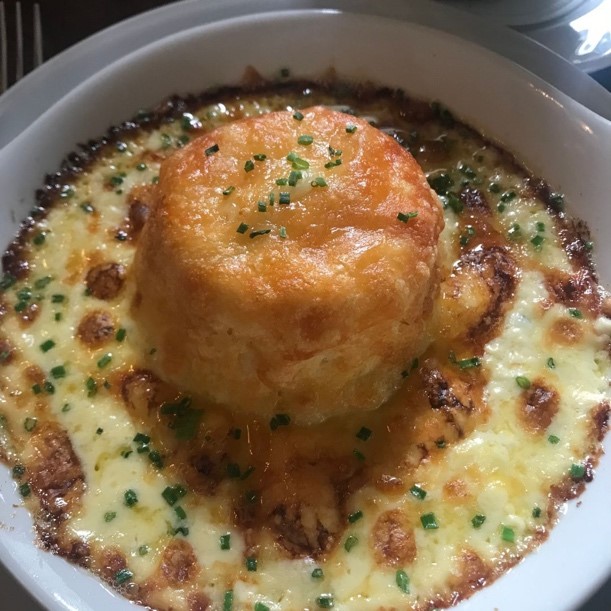
The cheese can be found on local pub and restaurant menus, including a wonderful twice baked souffle I ate at the Blue Lion, served with a cheese and chive sauce.
But I first tasted the cheese at Yoredale Hall when it was served as an afternoon tea treat with the cook, Meg’s, moist, rich fruitcake. Of course, Meg and her family thought this normal and couldn’t understand that I, as ‘a southerner’, had never eaten cheese with fruitcake.
I discovered that it is a Yorkshire custom to pair the moist richness of fruitcake, often with the addition of brandy, with the tart creaminess of Wensleydale cheese. And I found a Victorian writer, Joseph Lucas, made reference to it in 1871, when he wrote that ‘On Christmas Eve one Yule Cake is given to each member of the family, along with a piece of Christmas cheese’.
It was cook Eleanor who explained why it was once known as the Christmas cheese in one of her journals. Sheep produced milk in the spring, which was used to create the cheese, and it reached full maturity by mid-winter.
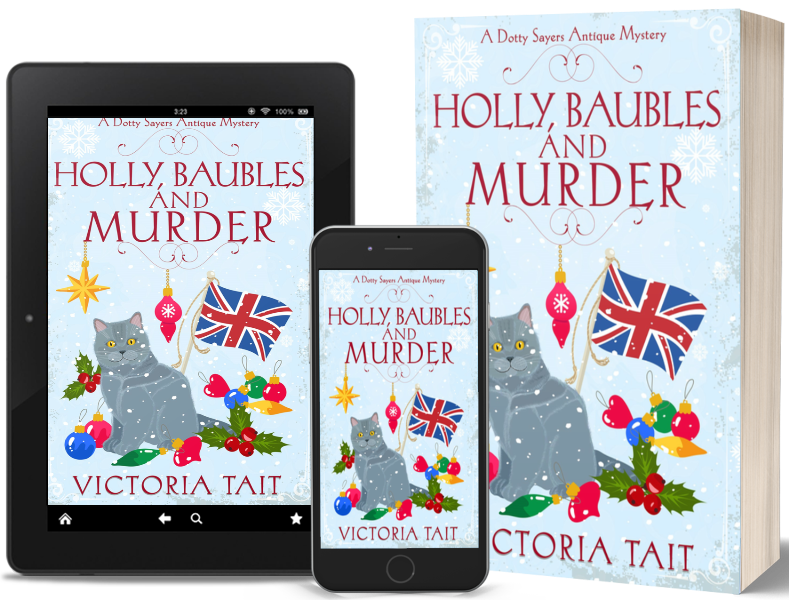
The wonderful Bettys Café in Harrogate still serves its own fruitcake with Wensleydale cheese and, of course, a cup of Yorkshire tea.
Thank you for sharing this with us, Dotty, and good luck with Holly, Baubles and Murder, the latest book in the Dotty Sayers Antique mystery series.
Readers can learn more about Dotty and her author, Victoria Tait, by visiting the author’s website and her Bookbub, Instagram, Pinterest and Goodreads pages.
The book is available online at the following retailers:
About Victoria Tait: Victoria was born and raised in Yorkshire, England. After following her military husband around the world, she drew on her life’s experiences, and a love of Agatha Christie, Father Brown, and Murder She Wrote, to write British-based cozy mysteries.
Her determined female sleuths are joined by colourful and quirky teams of helpers, and her settings are vivid and realistic. As you’re compelled to keep turning the pages, you’ll be irresistibly drawn into a world where you’ll experience surprises, humour, and sometimes, a tug on your heartstrings.





 dianneascroft.com