
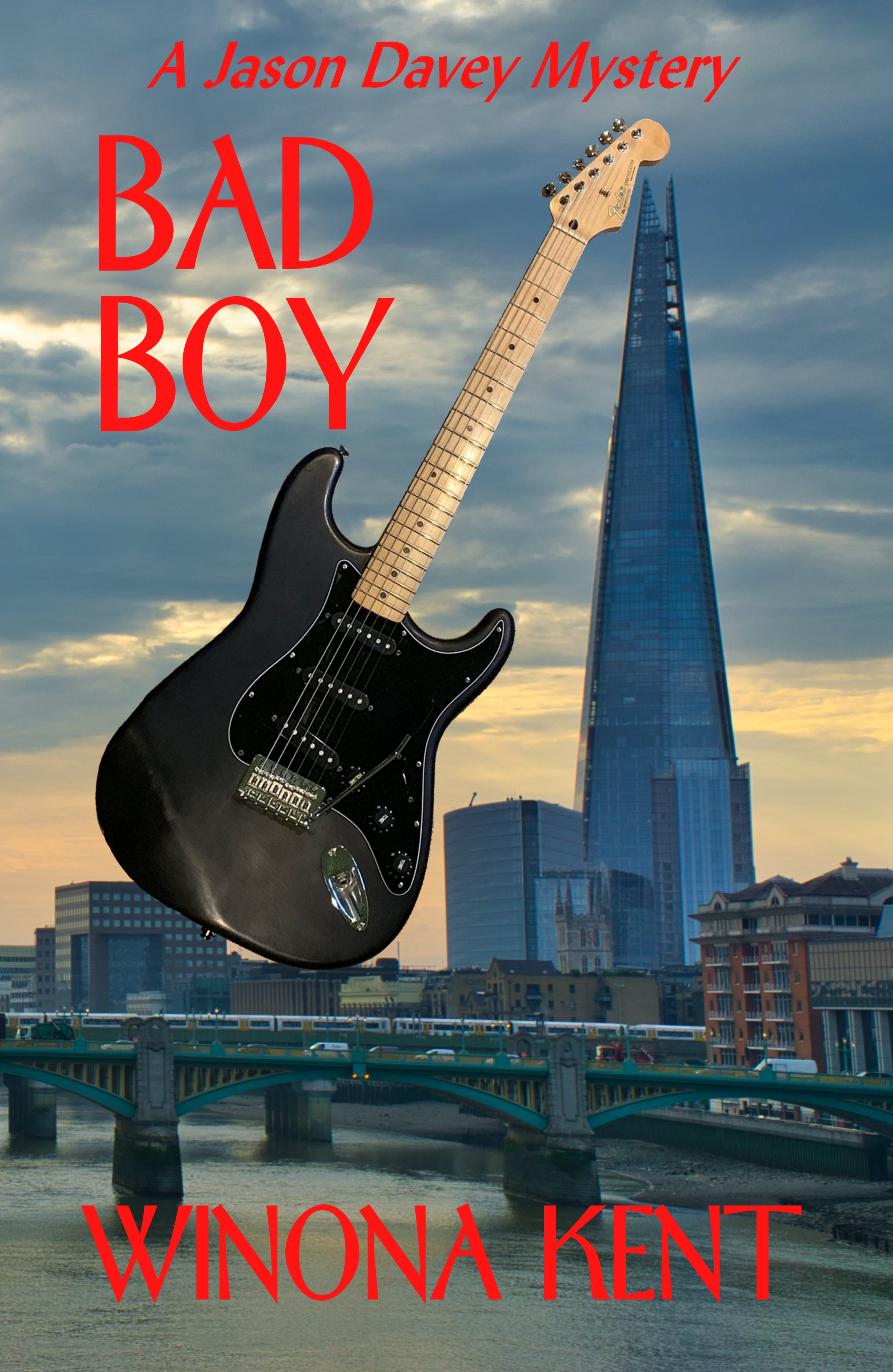
Jason Davey is visiting Ascroft, eh? to tell us about Bad Boy, the latest novel in the Jason Davey mystery series.
Welcome, Jason. Let’s get started, shall we?
Tell us about the novel that you live inside. Is it part of a series? If so, please tell us about the series too.
My name’s Jason Davey and I’m the guy Winona’s decided to write about for the past seven years. She’s created a series of five books called The Jason Davey Mysteries. Actually, she discovered me much earlier than that, in 2012, when I was working as a musician on board a lovely old cruise ship doing the Vancouver to Alaska run. Winona wrote a standalone novel called Cold Play, and allowed me to narrate it. She didn’t think of it as a mystery or a crime story, but really that’s what it was—a nasty passenger from my past came aboard to make life difficult for me.
After I dealt with the troublesome passenger—and a catastrophe involving the ship—and saved a couple of lives in the process—Winona thought she was finished with me. But then, five years later, in 2017, a friend suggested she might want to look into what I was doing now…
I’d landed a permanent gig at a London jazz club, and my film-maker son had convinced me to try and track down a well-known musician who’d gone missing in the wilds of Northern Canada. So off I went—and that novella, Disturbing the Peace, turned into my first sleuthing adventure.
I wasn’t sure I wanted to keep on doing that sort of thing—I certainly didn’t need the work, and I was pretty convinced it was a one-off—but then an old friend from my cruise ship days, Sally Jones (the Captain’s Secretary), showed up, wanting me to look into the theft of quite a lot of money from a locker belonging to an exotic dancer in Soho, literally around the corner from the club where I was working. I agreed to do it, very reluctantly—and that led to a wild ride around Soho’s dark underworld, including some unfortunate run-ins with a notorious crimelord who wasn’t very kind to me. Fortunately, I survived (if a little bit damaged)—and Winona let me tell the tale in Notes on a Missing G-String.
I come from a musical family—my parents were the founding members of a folky-pop band called Figgis Green. My dad died in the 1990s, but my mum stayed active in the business, and in 2018 she decided to organize a 50th Anniversary Tour for the group. She recruited me to take my dad’s place in the band, and we all went off to the a lovely little village on the south coast of England to rehearse. While I was there, I was approached by a keen Figs’ fan who wanted me to look into the disappearance, in the 1970s, of a teenaged girl who was later declared dead—but who’d unaccountably shown up afterwards in a photo taken at a Figs’ gig. Again—somewhat reluctantly—I agreed to get involved. I solved the mystery—but not before I was very nearly killed by assassins AND a bolt of lightning. Winona, of course, was thrilled to bits—and that’s how my third book, Lost Time, came to be.
Evidently, however, Winona wasn’t satisfied with simply following my rehearsals. After we went out on the road, she came up with the brilliant idea of riding along on the tour bus. Which led to all kinds of complications, including a fortune teller who predicted something was going to “drop” on me—followed by a gargoyle nearly decapitating me as it crashed to the ground—and a disgrunted fan out for revenge against me AND my mum. I gave up smoking on that tour, but I wouldn’t recommend the actual method that led up to it, as, once again, it nearly killed me. That book’s called Ticket to Ride, by the way.
Quite frankly, I was happy to finish the tour and get back to my ordinary life, at home in London. But then, I was approached by a guy who wanted me to sign one of our programs. I agreed to meet him at the top of The Shard, which has 72 levels and is the tallest building in London. What happened there sent me off on a brain-twisting journey, first to Derbyshire and then back to London, to track down a collection of manuscripts by well-known British composer Sir Edward Elgar. The manuscripts had been stolen many years earlier, and Marcus Merritt—the guy with the program—wanted me to find them and return them to their rightful owner. Which turned out to be easier said than done—largely because Marcus was obsessed with games and codes and puzzles—much like Elgar himself—and also because two other people were also after the same collection. One of them was a ruthless Russian gangster. The other was Arthur Braskey, the same Soho crimelord I’d crossed paths with in G-String. So that’s what Bad Boy—Winona’s latest mystery—is all about. Since the book’s written from my point of view, I very obviously live to sleuth another day. But I do tend to end up battered and bruised in all of my stories—and Bad Boy’s no exception.
I’m dreading what Winona has planned for the next book.
Does the writer control what happens in the story or do you get a say too?
It’s me. One hundred percent me. I tell her what’s happened and she writes it all down. And then she spends a long time plotting it out to make it into a novel. But because she’s a very conscientious plotter, she’s always aware of places where the narrative might lag a little or the storyline needs a bit of a push. So she makes things up. I’ve spoken to her about this and made her aware of my objections, but she tells me she’s the writer, and I’m just a musician with a sideline in sleuthing who knows very little about storylines and structure. Therefore I need to go away and play my guitar and let her get on with writing the book. And beating me up.
I’ll get my revenge on her in the next novel. It’s about a writer.
How did you evolve as the main character?
When Winona first discovered me in Cold Play, I was completely wrapped up in Twitter. I’d created a “constructed personality” for myself—my handle was @cold_fingers – and I spent a lot of my spare time chatting online with my followers. Mind you, it was 2012 and Twitter (now X) was a totally different kettle of fish back then. I was also a bit cut off from the real world, surrounded by sailors and ship’s officers and passengers, spending my days and nights at sea on a six-month contract.
After I came ashore and got my gig at The Blue Devil (the jazz club in Soho), I was five years older and a good deal wiser. But still quite trusting—I had no idea what kind of serious trouble was waiting for me in northern Canada when I went looking for Ben Quigley, the missing musician, in Disturbing the Peace. I was very nearly welded to death!
A short time later, I was approached by Sally, from the Sapphire, to look into the money that had been stolen from that stripper’s locker. I considered myself a lot wiser by then, a lot less naïve, and a whole lot less trusting. My guard was definitely up. But I was still reluctant to give sleuthing my full attention in G-String—my band and I were chasing down a recording contract and what I really wanted to focus on was our music.
That pie-in-the-sky bubble ended up being burst when we were offered a less-than-stellar gig playing backup on a road tour starring two mediocre has-beens whose main claim to fame was “music for the middle of your mind.” No thanks.
In Lost Time, I was removed from my comfort zone (accessible jazz) and thrust into the spotlight as the lead guitarist and singer in my mum’s folky pop band, Figgis Green. By then, I’d decided to start taking my sleuthing sideline a bit more seriously. I’d done all the courses to qualify as a PI—I just hadn’t got round to writing the final exam. When I was approached to try and find out what had happened to sixteen-year-old Pippa Gladstone in 1974, I was initially sceptical. But because I’d spent time actually learning the trade, I accepted the challenge, and went about solving it methodically and logically. And very carefully. I still wasn’t prepared for what I eventually discovered. And surviving a lightning strike has an odd way of putting your life in perspective. Especially when exactly the same thing killed your dad many years earlier.
In Ticket to Ride, I was wise enough not to accept any paid detective work. I wouldn’t have had time, anyway. Instead, I had to apply my detective skills to sort out who the hell was trying to kill me. And my mum.
A couple of days after the end of that tour, I was back in London, relaxing, trying to get the vibe back for my return to my gig at The Blue Devil, when Marcus Merritt came into my life and turned it upside down. He’d stolen a collection of manuscripts by Sir Edward Elgar and hidden them for safekeeping, and he wanted me to return them to The Elgar Foundation. I couldn’t have used my methodical, logical and careful sleuthing skills even if I’d wanted to. Marcus’s clues were all puzzles and brainteasers. I was tired in Bad Boy, and mostly in shock because of what happened on Level 72 at The Shard. I was seriously thinking of giving up bespoke detective work altogether to focus on my music again. But Marcus has had quite a profound effect on me, so I think I can honestly say that you’ll see me again soon. Quite possibly in Canada.
Do you have any other characters you like sharing the story with? If so, why are you partial to them?
I’ve got an entire family of characters! They don’t always show up in all of the books, but Winona’s been very generous about including them in as many storylines as she can. I’ll start with my mum, Mandy Green—she’s getting on in years now, but she’s still bursting with energy and she has a very droll sense of humour. Of course, she played a major role in both Lost Time and Ticket to Ride. She’s not in Bad Boy, but my younger sister, Angie, who’s married to a former policeman, is. Angie always comes in handy when I need a bit of assistance sorting out clues. It helps that she’s a bestselling author of cozy mysteries. She writes under the name Taylor Feldspar, and her main character’s a catering chef called Jemima Fielding. I’ve also got a son, Dominic, who’s studying Film at university in London. He’s the one who sent me off on my first sleuthing adventure in Disturbing the Peace and he makes a return appearance in Bad Boy. And, in Notes on a Missing G-String, I discovered I actually had a daughter I knew nothing about—she’s a professional photographer who grew up in Canada and her observational skills have helped me immensely. In Bad Boy, she’s away in Vancouver taking pictures of a restaurant opening. And, last, but not least, I have to mention my “independently faithful” girlfriend Katey Shawcross. We originally met aboard the Sapphire in Cold Play. She came back into my life five years later and she’s been in every one of my novels. In Bad Boy, though, she’s off on a cruise sailing through the Panama Canal—so I’ve had to do without her excellent and very helpful advice because the WiFi aboard her ship is atrocious. Katey actually works in the travel industry. I think Winona’s secretly pleased about that, because she used to be a travel agent, too.
What’s the place like where you find yourself in this story?
To be honest, it’s quite a bit different from my previous stories. I’ve just finished a tour, and I’m getting used to living in my ordinary world again. And then Marcus Merritt turns up and destroys my peace and calm. Shock, sleeplessness, anger, grief, confusion…that’s what I’m dealing with in Bad Boy. It’s as if I’m trying to make sense of things through a heavy, drifting haze. Throw in a series of brain-teasers and cryptic clues that supposedly point towards a stolen collection of music. And then the discovery that they also seem to have something to do with the daughter of a notorious Soho crimelord who died in a fire in 1980. I’m definitely not in a happy place at all.
Is there anything else you’d like to tell readers about you and the book?
I confess to a major shortcoming in this story—my inability to solve those ridiculous time and distance problems involving two trains travelling in opposite directions. Other than on Mensa tests, when have you ever had to work something like that out in real life? And yet it’s a crucial clue in Bad Boy. And there’s another series of clues later on involving words ending in IUM. A secret decoder wheel. Bad poetry. Riddles. Snake earrings. A four-hour walking tour of Soho’s lost music venues and a clue left inside the phone booth from a David Bowie album cover. Go on—read the book. At the very least, you’ll find out what the David Bowie phone booth has in common with Michelangelo Antonioni’s film Blow Up.
Thank you for answering my questions, Jason, and good luck to you and your author, Winona Kent, with Bad Boy, the latest book in the Jason Davey mystery series.
Readers can learn more about Jason and his author, Winona Kent by visiting the author’s website and her Facebook and Instagram pages. You can also follow her on Twitter/X.
The novel is available at the following online retailers:
About Winona Kent: Winona is an award-winning author who was born in London, England and grew up in Regina, Saskatchewan, where she completed her BA in English at the University of Regina. After moving to Vancouver, she graduated from UBC with an MFA in Creative Writing and a diploma in Writing for Screen and TV from Vancouver Film School.
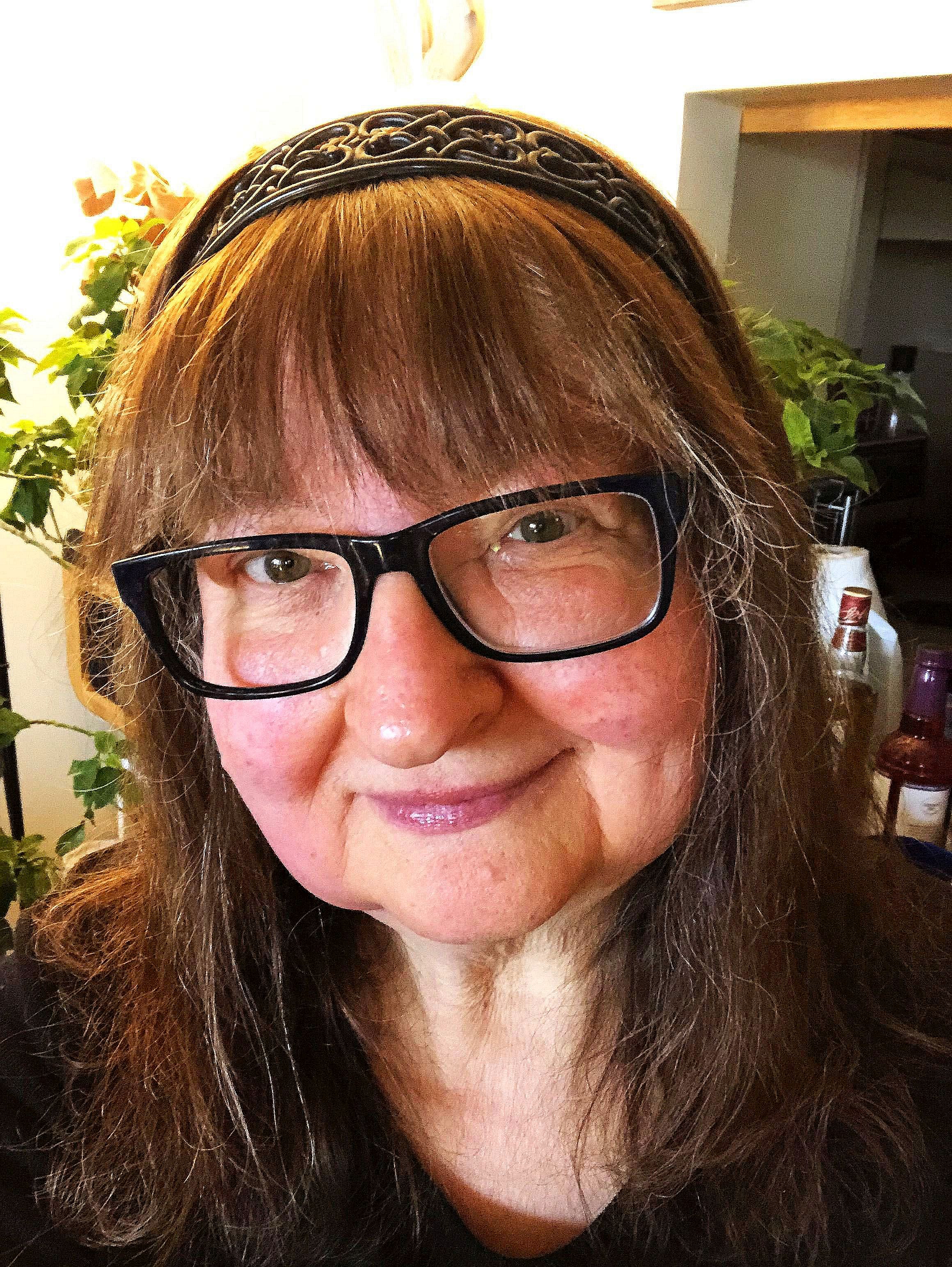
Winona’s writing breakthrough came many years ago when she won First Prize in the Flare Magazine Fiction Contest with her short story about an all-night radio newsman, “Tower of Power”. Her debut novel Skywatcher was a finalist in the Seal Books First Novel Award and was published by Bantam Books in 1989. This was followed by a sequel, The Cilla Rose Affair, and her first mystery, Cold Play, set aboard a cruise ship in Alaska.
After three time-travel romances (Persistence of Memory, In Loving Memory and Marianne’s Memory), Winona returned to mysteries with Disturbing the Peace, a novella, in 2017 and the novel Notes on a Missing G-String in 2019, both featuring the character she first introduced in Cold Play, professional jazz musician / amateur sleuth Jason Davey. The third and fourth books in Winona’s Jason Davey Mystery series, Lost Time and Ticket to Ride, were published in 2020 and 2022. Her fifth Jason Davey Mystery, Bad Boy, was published in 2024.
Winona also writes short fiction. Her story “Salty Dog Blues” appeared in Sisters in Crime-Canada West’s anthology Crime Wave in October 2020 and was nominated as a finalist in Crime Writers of Canada’s Awards of Excellence for Best Crime Novella in April 2021. “Blue Devil Blues” was one of the four entries in the anthology Last Shot, published in June 2021, and “Terminal Lucidity” appeared in the Sisters in Crime-Canada West anthology, Women of a Certain Age (October 2022). “On the Internet, Nobody Knows You’re a Dog”, will appear in the upcoming Sisters in Crime-Canada West anthology, Dangerous Games (October 2024). A collection of Winona’s short stories, Ten Stories That Worried My Mother, was published in 2023.
Winona has been a temporary secretary, a travel agent, a screenwriter and the Managing Editor of a literary magazine. She’s currently the national Vice-Chair and the BC/YT rep for the Crime Writers of Canada and is also an active member of Sisters in Crime – Canada West.









 dianneascroft.com
Jason and I thank you so much for featuring us today, Dianne 🙂 very much appreciated!
Pingback: Great Escapes Virtual Book Tours–Bad Boy – mjbreviewers