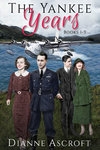
Our Time Will Come

Today Jean Gallant Marcoux is visiting Ascroft, eh? to tell us about his debut historical novel, Our Time Will Come.

Welcome, Jean. Let’s get started, shall we?

What prompted you to write about this historical event?

Years ago, I learned about the two WWII Québec Conferences of 1943 and 1944, where President Roosevelt, Prime Minister Churchill and their military advisers met in Québec City, my hometown, to make plans for D-Day. I even saw newspaper pictures of Churchill touring the city in an open-convertible limousine. At one point, the limo stopped in front of City Hall, and Churchill stood in the car to salute the dignitaries and the immense cheering crowd filling the street. I wondered why the Nazis didn’t use the opportunity to assassinate the British Prime Minister. Or did they try?

Once I retired from practicing medicine, I planned to write a spy novel on the subject, and I read all I could find about the events occurring in Europe and in Québec, just before and during WWII. I also read online, French and Canadian newspapers of the era.

I soon realized that a typical story of a Nazi spy coming by U-boat from Europe to assassinate Churchill during the Québec Conference, didn’t make historical sense. The planning of the Conference was kept secret almost until the day it started, and Churchill was NOT supposed to be exposed to the public. It’s only the Prime Minister’s daredevil nature, coupled with daily hordes of Quebecers in front of the Chateau Frontenac hotel clamoring for Churchill, that produced the last-minute decision of the open-convertible tour.

My spy novel became a love story, and I’m glad it did, because “Our Time Will Come” is a story that fans of historical novels should enjoy, as it explores a Canadian angle on WWII. Romance being a central theme of the book, it should also satisfy readers of that genre.

How closely did you stick to the historical facts?

All the historical facts in Our Time Will Come are accurate as to the date and place they occurred. Several minor characters are real-life figures. When they appear, the situation, incident and dialogue are product of my imagination.

What research did you do for this book?

I read all the books I could find regarding U-boats in Canadian waters, and German spies on Canadian soil during WWII. I also read online, French and Canadian newspapers of the 1938-1943 era to have the historical timeline right, and find out the mind set of the people at the time.

Do you use a mixture of historic and invented characters in the novel? Which is more difficult to write?

All the major and secondary characters in Our Time Will Come are fictitious. Winston Churchill, a minor character in my book was historically where I describe him to be in the book. His letter to my protagonists, however, is the fruit of my imagination.

In a historical novel you must re-create a place and people in a bygone era. How did you bring the place and people you are writing about to life?

The places I describe in Paris and Québec City, haven’t changed much since the 1940s. As mentioned above, reading newspapers of the era gave me a sense of what were Québecers concerns at the time. Conscription of young men, lack of available stuff, and food rationing were top on the list. The crowds gathered in front of the Chateau Frontenac Hotel begging to see Churchill, triggered his unplanned open convertible limo tour of the city.

There often seems to be more scope in historical novels for male characters than female characters. Do you prefer to write one sex or the other? And if so, why?

It is easier for a male to write from a male POV. However, to understand Hans, my German male protagonist’s decision to report to his army unit rather than escape to Canada with Hélène, his love in 1939, I had to go read historical books of the era. I found that ordinary German men, not only Nazis felt it was their duty to fight for the Fatherland.

For my female protagonist, Hélène, I imagined what my mother and aunts, who were her contemporaries, and like her educated by nuns, would have done if placed in her circumstances.

Thanks for answering my questions, Jean, and good luck with Our Time Will Come.

Readers can learn more about Jean Gallant Marcoux  and his writing by visiting his website, his blog and his Facebook page.

Jean Gallant Marcoux will be awarding a $20 Amazon or Barnes and Noble GC to a randomly drawn winner via rafflecopter during the tour. Enter to win a $20 Amazon/BN GC by clicking here.

The novel is available at the following online retailers:

Amazon.comBarnes & NobleIndigo

About Jean Gallant Marcoux: He was born in Quebec City Canada, where he earned an MD degree from Laval University. As a board-certified allergist, he practiced in Quebec City from 1970 to 1977 after which he continued his career in Houston Texas until his retirement in 2007.

Passionate for history, he has published articles for historical society magazines in his native Quebec. This is his debut novel. Dr. Marcoux lives in Houston with his family.
Posted in Archives, August 2020 | Tagged , , , , , | 2 Comments

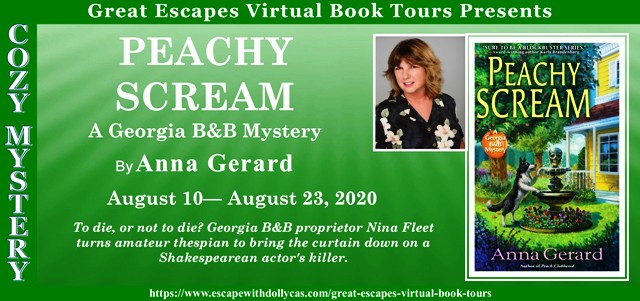
Peachy Scream

Today Anna Gerard is visiting Ascroft, eh? to tell us about Peachy Scream, her latest novel in the Georgia B&B mystery series.

Welcome, Anna. Let’s get started, shall we?

Tell us about your novel. Is it part of a series? If so, please tell us about the series too.

Hello! Yes, Peachy Scream is the second in the Georgia B&B Mystery series from Crooked Lane Books. The stories feature my protagonist, Nina Fleet. Recently divorced and wanting to flee the big city rat race, she moves to Cymbeline, a small Georgia town west and south of Savannah. Nina uses a chunk of her substantial divorce settlement (her ex is a pro golfer) to purchase a lovely Queen Anne home. In book one, Peach Clobbered, she’s somewhat arm-twisted into turning place into a bed and breakfast inn. After hosting a displaced convent’s worth of elderly nuns, she decides she likes her new career and formally commits to being an innkeeper. And the action of Peachy Scream continues from there.

Where did the idea for the mystery that is central to the story come from?

This series actually has been kicking around in my head and on paper for a very long time. With Death in a Shakespeare Garden being its original title, Peachy Scream was supposed to be the first in the series but ended up as book two. And, the series originally was set in East Texas in a fictional town based on a real-life town where I used to go antiquing. But the editor asked for the switch to Georgia, so there you go. I’ve always been fascinated by the theatre and am a big fan of Shakespeare’s work, and for years I’ve been wanting to use both as a backdrop for a book.

Is there a theme or subject that underlies the story? If so, what prompted you to write about it?

Underlying all my cozy mysteries is the theme of the importance of friendship and community. Peachy Scream also focuses on the notion of finding one’s place in the world. To thine own self be true, as Polonius advises in Hamlet. Several of the characters struggle to some degree with their personal truth.

How do you create your characters? Do you have favourite ones? If so, why are you partial to them?

All my protagonists tend to be a version of me (except younger and thinner!). And so by default they become my favorites, although I’m fond of all my characters, particularly the animals. I work hard to make them distinctive people/critters but also want them to be believable. They all have good qualities and not-so-admirable traits, and the occasional quirk, but I prefer not to lapse into parody. Everyone one of these folks is someone you’ve probably met at some time.

How do you bring to life the place you are writing about?

Research, of course, and on-site research when possible. If the latter is not something I can readily do, I reach out to my network of friends and fellow writers for help, particularly if they’ve lived in the place (or a similar place) where my story is set. I find that the tiny details—the colors that the buildings are painted, the regional-typical knickknacks found in a character’s house, the snacks everyone eats—are what truly adds verisimilitude to the story.

What research do you do to provide background information to help you write the novel?

When I switched from writing historical romance and historical mystery to contemporary mystery, I thought research would be a snap. But I find myself looking up facts and verifying information as much or more than for a story with a historical setting. The internet as a tool is invaluable, whether it’s to check the requirements to hold the job of coroner in small-town Georgia or learn what time of the year a particular species of peach tree bears fruit. (Just be sure your vet your sources – for example, Wikipedia isn’t the most accurate font of info, but the entries do tend to have valuable bibliographies for further research). Google maps can be helpful, too.

Is there anything else you’d like to tell readers about the book?

Astute readers will recognize traditional Shakespearean tropes and references in Peachy Scream, and they should be sure to judge the story accordingly – this is not meant as social commentary. Bottom line, I think the story is a fun time, and I hope you will, too.

Thanks for answering my questions, Anna, and good luck with Peachy Scream, the latest book in the Georgia B&B Mystery series.

Readers can learn more about Anna and her writing by visiting her website and her Facebook page.

The novel is available at the following online retailers:

AMAZON     BARNES & NOBLE

About Anna Gerard: DIANE A.S. STUCKART writes as Anna Gerard. She is the New York Times bestselling author of the Black Cat Bookshop Mystery series (writing as Ali Brandon). She’s also the author of the award-winning Leonardo da Vinci historical mysteries, as well as several historical romances and numerous mystery, fantasy, and romance short stories. The first book in her Tarot Cats Mystery series is FOOL’S MOON. Her Georgia B&B Mystery series from Crooked Lane Books launched July 2019 with PEACH CLOBBERED, written as Anna Gerard. Book 2, PEACHY SCREAM is now available.

Diane is a member of Mystery Writers of America and served as the 2018 and 2019 Chapter President of the MWA Florida chapter, receiving the “Flamingo” Chapter Service award in 2019. She’s also a member of Sister in Crime. In addition to her mystery writing affiliations, she’s a member of the Cat Writers’ Association and belongs to the Palm Beach County Beekeepers Association. Diane is a native Texan with a degree in Journalism from the University of Oklahoma, but has been living in the West Palm Beach FL area since 2006. She shares her “almost in the Everglades” home with her husband, dogs, cats, and a few beehives.

Posted in Archives, August 2020 | Tagged , , , , , | 2 Comments

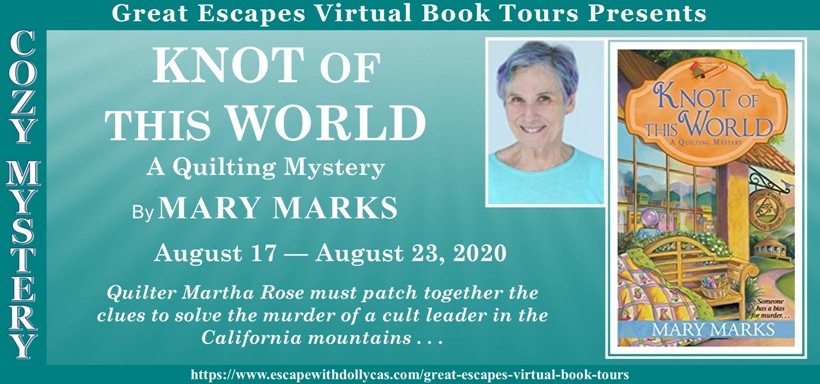
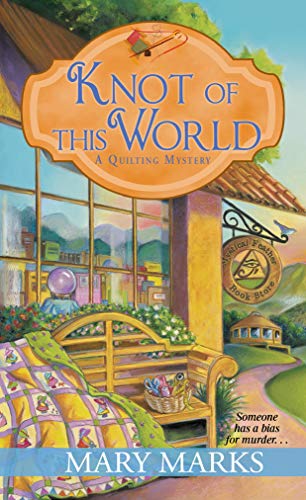
Knot of This World

Today Martha Rose is visiting Ascroft, eh? to tell us about Knot of This World, the latest novel in the Quilting mystery series.

Welcome, Martha. Let’s get started, shall we?

Tell us about the novel that you live inside. Is it part of a series? If so, please tell us about the series too.

I’m Martha Rose, an overweight, divorced quilter with fibromyalgia in my 50s and living in the San Fernando Valley just north of LA. The newest novel in A Quilting Mystery series, Knot Of This World, is about a group of friends trying to keep one of their own from making a huge and dangerous mistake. Much of the story takes place in a clothing optional commune in Ojai, California where a serial killer might be living. Martha and her friends get into some hilarious antics trying to find answers and to protect their own.

Does the writer control what happens in the story or do you get a say too?

Sometimes, when Mary Marks isn’t sure where she wants to go next, she often just sits at the computer and lets her characters talk to each other. That’s when we’ll come up with something she didn’t realize or suspect about the story. So yes, we do have a say.

How did you evolve as the main character?

Face it. I’m a version of the younger Mary Marks. She set me up that way so she could get inside my head (as the main character) more easily. She knows exactly how I would react or what I might say, because I am her. In a way. However, Mary doesn’t stumble over dead bodies the way I do.

Do you have any other characters you like sharing the story with? If so, why are you partial to them?

I love all my friends and family for different reasons. They each have different skills I rely on, and they add such a richness to every scene. My novels are heavily character driven and they are all characters! To give you an example, my half-sister Giselle is sassy, sarcastic and smart. The funniest things can come out of her mouth! I’m so lucky I found her through DNA testing.

What’s the place like where you find yourself in this story?

The Mystical Feather Society is both fascinating and frightening. We were warned about murders and misbehavior there. We found both. In the course of our investigation, we took a fascinating class in Tarot Card reading. It was only one of many significant twists and turns.

Is there anything else you’d like to tell readers about you and the book?

Yes. There’s a blonde in a halter top hidden somewhere in the story. See if you can find her in this book (and the others).

Thank you for answering my questions, Martha, and good luck to you and your author, Mary Marks, with Knot of This World, the latest book in the Quilting mystery series.

Readers can learn more about Martha and her author, Mary Marks by visiting the publisher’s and author’s websites and her Facebook page.

The novel is available at the following online retailers:

 Amazon – B&N – Kobo – Google Play – IndieBound

About Mary Marks: Mary was born and raised in Los Angeles and the San Francisco Bay Area. She earned a B.A. in Anthropology from UCLA and an M.A. in Public Administration from the American Jewish University in Los Angeles. In 2004 she enrolled in the UCLA Extension Writers Program. Her first novel, Forget Me Knot, was a finalist in a national writing competition in 2011. She is currently a reviewer of cozy mysteries for The New York Journal of Books at www.nyjournalofbooks.com.

Posted in Archives, August 2020 | Tagged , , , , , , | 1 Comment

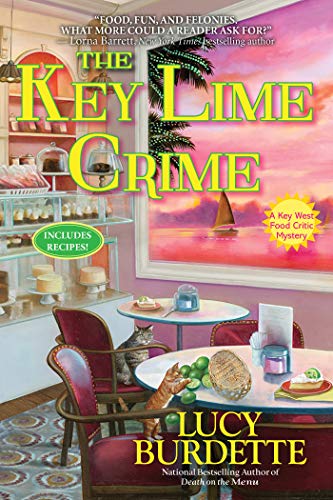
Key Lime Crime

Today Lucy Burdette is visiting Ascroft, eh? to tell us about Key Lime Crime, her latest novel in the Key West Food Critic mystery series.

Welcome, Lucy. Let’s get started, shall we?

Tell us about your novel. Is it part of a series? If so, please tell us about the series too.

THE KEY LIME CRIME is the tenth book in the Key West mystery series featuring food critic Hayley Snow. Newlywed food critic Hayley is facing a super busy  post holiday season, including a Key Lime pie judging contest and an overcommitted detective husband. When her husband’s mother makes an unannounced visit, Hayley must play the dutiful daughter-in-law. She and her pal Miss Gloria offer to escort his mom on the iconic Conch Train Tour of the island’s holiday lights. But it’s not all glittering palm trees and fantastic flamingos–the unlikely trio finds a real body stashed in one of the elaborate displays. Hayley’s new mother-in-law is intent on helping her get to the bottom of this.

When readers ask me if they need to read the books in order, I tell them that while the characters do grow and change over time, I try to write the mystery for each book so it stands alone.

Where did the idea for the mystery that is central to the story come from?

Key West is very enthusiastic about decorating for Christmas. And there is a trolley that takes people around the island to look at the lights. One year we noticed a house that had a Santa splayed out on the front porch holding an empty bottle of booze. A sign on the steps said, “Santa may be a little late this year.” I couldn’t help wondering who might be in that Santa suit, and why, and what if they were a murder victim? And my writer brain was off…

Is there a theme or subject that underlies the story? If so, what prompted you to write about it?

I always end up writing about families—extended families, biological families, stepfamilies, and in this case, in laws. I’d had some readers suggest that they couldn’t warm up to the main character’s new husband. I began to think about that—why he was so reserved, why his parents did not attend the wedding, and what it would be like if his mother made an unplanned visit.

How do you create your characters? Do you have favourite ones? If so, why are you partial to them?

Many are based on people I know or composites of people I know. Miss Gloria, Hayley’s octogenarian houseboat-mate and great friend, is probably my favorite. Whenever I need a character to speak up on a subject or stand up for someone, Miss Gloria is there. She has a job giving tours at the Key West cemetery, plays mahjong with her “girlfriends” and drives an enormous old Buick Park Avenue that I borrowed from the car my in-laws drove for years. (My mother-in-law was also a spunky woman role model.) I always get a smile on my face writing about her. 

How do you bring to life the place you are writing about?

I live in Key West half of the year, so I know it quite well. Since the main character is a food critic, many of restaurants in the series are real places (unless Hayley has a bad meal or there’s a case of murder by poison.) I also read the local newspapers and Facebook groups looking for quirky events and possible conflicts. All of that goes into the books as background.

What research do you do to provide background information to help you write the novel?

I attended the Key West Citizens’ police academy a couple of years back and learned a lot about police procedure. I have a good friend who’s a retired cop, so he helps me with questions and problems. For THE KEY LIME CRIME, I took a pie-baking class with a couple of fans—such fun!

Is there anything else you’d like to tell readers about the book?

I will tell you that I’m thrilled about the reviews so far. I’ll share two of them!

“Charming characters, an appealing setting, and mouthwatering bonus recipes make this a perfect choice for foodie cozy lovers.” Publishers’ Weekly
“The well-described Key West setting nicely complements the foodie frame in this satisfying cozy, which is a natural for fans of Joanne Fluke’s Hannah Swensen mysteries.”—Booklist

Thanks so much for having me visit your blog!

It was my pleasure, Lucy. Thanks for answering my questions and good luck with Key Lime Crime, the latest book in the Key West Food Critic Mystery series.

Readers can learn more about Lucy and her writing by visiting her website and her Facebook, Goodreads, Pinterest, and Instagram pages. You can also follow her on Twitter.

The novel is available at the following online retailers:

 Amazon – B&N – Kobo – IndieBound

About Lucy Burdette (aka Roberta Isleib): Lucy is a clinical psychologist and has published 16 mysteries, including the latest in the Key West food critic series, DEATH ON THE MENU (Crooked Lane Books, August 2018.) Her books and stories have been short-listed for Agatha, Anthony, and Macavity awards. She’s a member of Mystery Writers of America and a past president of Sisters in Crime. She blogs at Jungle Red Writersand shares her love for food with the culinary writers at Mystery Lovers Kitchen She lives in Madison CT and Key West FL.

Posted in Archives, August 2020 | Tagged , , , , , | 1 Comment

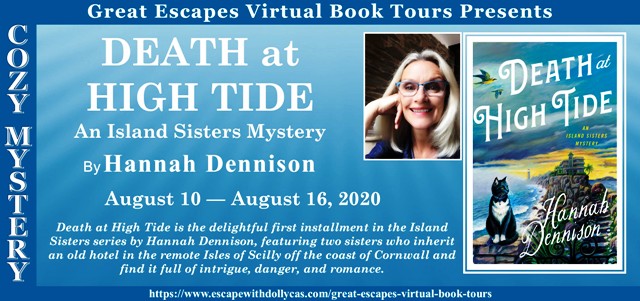
Death at High Tide

Today Hannah Dennison is visiting Ascroft, eh? to tell us about Death at High Tide, her first novel in the Island Sisters mystery series.

Welcome, Hannah. Let’s get started, shall we?

Tell us about your novel. Is it part of a series? If so, please tell us about the series too.

“Death at High Tide”, the first book in the Island Sisters Mysteries has been described as “Doc Martin” meets “The Durrells in Corfu” with a splash of Agatha Christie’s, “And Then There Were None.” This is my third mystery series, (I write the Vicky Hill Mysteries and the Honeychurch Hall Mysteries), all of which lean toward the lighter traditional mystery side.

I have always been intrigued by the dynamics of siblings and so, when I moved back to the UK after twenty-five years in California, I was over the moon about reconnecting with my sister again. Of course we had been in touch regularly and visited many times, but it wasn’t the same as living just half a mile from each other again.

“Death at High Tide” follows aspiring photographer, Evie Mead and her Hollywood producer older sister Margot Chandler, who unexpectedly discover that a crumbling Art Deco hotel on a remote island twenty-eight miles off the southwest Cornish peninsula has been mysteriously left to Evie in her husband’s will.

Margot surprises Evie with tickets for a weekend away at the Tregarrick Rock hotel, insisting they should go undercover to find out the 5 W’s –“Who, What, When, Where and Why.” Needless to say, murder and mayhem follow.

Where did the idea for the mystery that is central to the story come from?

The idea came from a good friend who was the HR director for a resort on one of the five inhabited islands on the Isles of Scilly. My friend claimed that seasonal workers often fled to the islands because they were running away from something or hiding from someone. This concept intrigued me and in many ways, it is true of Evie and Margot who are hoping to start a new life there.

Is there a theme or subject that underlies the story? If so, what prompted you to write about it?

I always find that the theme presents itself after I have finished each book. And, without fail, even though I don’t intend to do it, I always write about reinvention. It’s in my two other series as well.

I’m fascinated by how those (including myself) have to start over following a loss— whether it’s through a death, a divorce or a serious illness, a big move to a new town or country and sometimes, it’s just starting a new job or becoming a parent. I’m interested in how people cope with what life throws at them.

How do you create your characters? Do you have favorite ones? If so, why are you partial to them?

Of course writers are usually all their characters so I don’t really have a favorite! I keep telling my own sister that she is not Margot Chandler in Death at High Tide  (the sisters are both parts of me). I always start with someone I know and can visualize physically. Sometimes it could be someone I noticed on a train or just someone I spotted when I was out walking my dogs. Often it’s an actor – I just need to see their face. Once I have the visual and maybe a pronounced character trait e.g. a turn of phrase or a pet peeve, I will write a brief character bible with the usual questions that include motivation etc. I always give my characters – even the minor ones – a secret, something that they would hate anyone to know about, as well as what I would expect find in their trash bin. You can tell a lot about a person by what they throw away.

How do you bring to life the place you are writing about?

If it truly exists, even if part of it is fiction, it’s critical that I visit the place. You can only get so much from Google, YouTube and travel shows. When I wrote an early draft of “Death at High Tide” I had not been to Tresco, (my fictional island is a mash-up of Tresco and Burgh Island off the South Devon coast). I had described everything as I had imagined it to be but when I actually got there, the visceral experience of smelling the fresh air, walking the wild northern part of the island (which is like the Scottish Highlands) or sitting in the Abbey Gardens (which is like the South of France), affected me deeply. And of course, who wouldn’t be affected by the history of the place with the dozens of shipwrecks that litter the surrounding ocean floor. The island was also a refuge for Royalists during the English Civil War.

Tresco itself is tiny. It only measures 2 miles by 1 mile wide and there are no cars, no streetlights and no police presence or hospital. There was a sense of isolation and remoteness that I hadn’t felt in my online research.

What research do you do to provide background information to help you write the novel?

I get completely sidetracked by research. It’s a blessing and a curse. I have to know the background to everything I write about. There is an abandoned lighthouse that is featured in the book so I spent ages just looking at photographs and reading diaries of lighthouse keepers! I can’t help it.

Is there anything else you’d like to tell readers about the book?

Yes! I must talk about the cat on the cover. His name is Mister Tig. He and I went through a lot during our seventeen years together – the death of my dad, my international moves, my daughter going off to college and of course, the trials and tribulations of launching my writing career. I never intended to put Mister Tig into a book but voila! Now he is immortalized on paper. Mister Tig has his own Instagram page if any of your readers are cat lovers. It’s mistertig_hotelcat.

Thank you for these questions.

It was my pleasure. Thanks for answering them, Hannah, and good luck with Death at High Tide, the first book in theIsland Sisters Mystery series.

Readers can learn more about Hannah and her writing by visiting her website and her Facebook, Goodreads and Instagram pages. You can also follow her on Twitter.

The novel is available at the following online retailers:

 Amazon     Barnes & Noble     IndieBound    Books A Million

About Hannah Dennison: Hannah was born and raised in Hampshire but spent more than two decades living in California. She has been an obituary reporter, antique dealer, private jet flight attendant and Hollywood story analyst. For many years Hannah taught mystery writing workshops at the UCLA Extension Writers’ Program in Los Angeles, California.

Hannah writes the Honeychurch Hall Mysteries and the Vicky Hill Mysteries both set in the wilds of the Devonshire countryside where she now lives with her two high-spirited Hungarian Vizslas.

Posted in Archives, August 2020 | Tagged , , , , , | 2 Comments

Crime and Cocktails

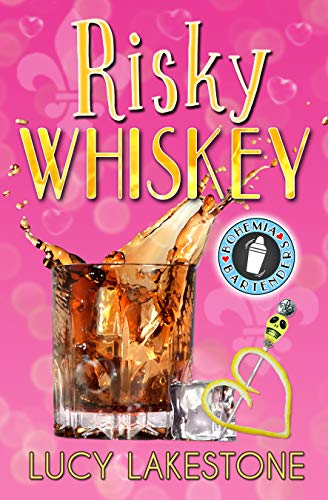
Today Lucy Lakestone is visiting Ascroft, eh? to tell us about Risky Whiskey, her first novel in the Bohemia Bartenders mystery series.

Welcome, Lucy. Let’s get started, shall we?

Tell us about your novel. Is it part of a series? If so, please tell us about the series too.

Risky Whiskey is the first novel in the Bohemia Bartenders Mysteries, fun whodunits starring a team of bartenders who travel to different events to make craft cocktails. Of course, they find trouble and solve mysteries along the way. In the first book, Pepper Revelle joins the team at a New Orleans cocktail convention as they make drinks to promote whiskey for a distiller from their Florida town. When the bourbon turns out to be dangerously bad, they have to track down the villain trying to sabotage the distiller while dodging attacks and making thousands of cocktails. Meanwhile, Pepper, an energetic extrovert, is drawn to Neil, the lead bartender, a cocktail nerd who is almost entirely her opposite. The contrast between them makes for good comedy.

It’s a bit unusual for a cozy series in that the settings change, but the cocktail world is almost like a traveling circus. Familiar characters show up in each story. While the first novel is set at a cocktail convention in New Orleans, the setting for the second novel, Wrecked by Rum, is a tiki convention in Fort Lauderdale. Many of the same characters appear in each book.

Where did the idea for the mystery that is central to the story come from?

We’ve all heard about bad batches of liquor that can make someone sick, whether it’s a moonshiner’s still gone wrong or something a traveler picks up from a market vendor. I was interested in the idea of what might happen if a villain wanted a batch of “bad” liquor to appear to be an accident. The added appeal for me was re-creating the fun, color and energy of a cocktail convention like one I’ve attended in New Orleans, with its historic and storied bars, creepy cemeteries, great music and eccentric characters.

Is there a theme or subject that underlies the story? If so, what prompted you to write about it?

One theme of Risky Whiskey is family and friendship. While my heroine, Pepper, who survived Hurricane Katrina while growing up in New Orleans, is mostly estranged from her parents, she finds a new family in the Bohemia Bartenders. I think a lot of us, even if we get along with our relatives, form lifelong bonds with people who love the same things we do. As Edna Buchanan said, “Friends are the family we choose for ourselves.”

The second theme is more of an idea: that cocktails have come into their own as a culinary art form, and there are dedicated artists in that world who are as skilled and creative as any great chef. They aren’t just slinging beers and pouring pink frozen drinks. The cocktail world is full of fascinating stories and characters that offer great inspiration for a series of books.

How do you create your characters? Do you have favourite ones? If so, why are you partial to them?

Bartenders are intensely fun to write about, especially craft bartenders. They range from Pepper, who’s outgoing and fun and even a little edgy (yes, she curses occasionally, though she’s trying to stop), to Neil, a well-educated bar owner who’s written a cocktail book and is very serious about his work. He first appeared as a minor character in a romance series.

Pepper is sort of who I wish I could be. She’s up for anything. She loves the romance and history of New Orleans (as do I). And after seeing the aftermath of Hurricane Katrina in person, I was inspired to make that storm part of her backstory. It’s enjoyable to write about someone who is always ready to plunge in where angels fear to tread, often with funny results.

How do you bring to life the place you are writing about?

New Orleans almost writes itself. I can close my eyes and see it, smell it, taste it. It’s beautiful and seedy and occasionally dangerous. It’s a rich and enticing city. All of my impressions of it go into Risky Whiskey.

The same could be said of Wrecked by Rum, which takes place in Fort Lauderdale, from the gorgeous tropical setting to the alluring 1950s-era Polynesian restaurant (inspired by the real Mai-Kai) where much of the action takes place. The tiki world is another world I love.

What research do you do to provide background information to help you write the novel?

I can get totally lost in research. I’m passionate about knowing my setting and details before I write, and sometimes I detour for an hour or two on the way looking up an elusive fact online. Ideally, I’ve experienced a place in person. I sometimes interview people to get a sense of my topic, and that’s a great way to get ideas that beget even more ideas and layers in my stories. One of the most enjoyable aspects of research for these books is tasting the cocktails.

Is there anything else you’d like to tell readers about the book?

I hope readers have as much fun reading Risky Whiskey as I had writing it. I wrote it and part of the second book before the troubled times we’re experiencing now, but I figure the Bohemia Bartenders Mysteries take place in the “before time” — or in a parallel universe where people still get together in large numbers and have fun. It’s a great escape for me, and I hope it will be for readers, too. There’s a bit of romance, a dash of heat and some cursing, as previously mentioned, so I want them to know what to expect and to get to love my characters as much as I do.

Thanks for answering my questions, Lucy, and good luck with Risky Whiskey, the first book in theBohemia Bartenders Mystery series.

Readers can learn more about Lucy and her writing by visiting her website and her Facebook, Goodreads, Pinterest, Bookbub and Instagram pages. You can also follow her on Twitter.

The novel is available at the following online retailers:

Apple iBooksAmazonBarnes & NobleGoogle PlayKobo

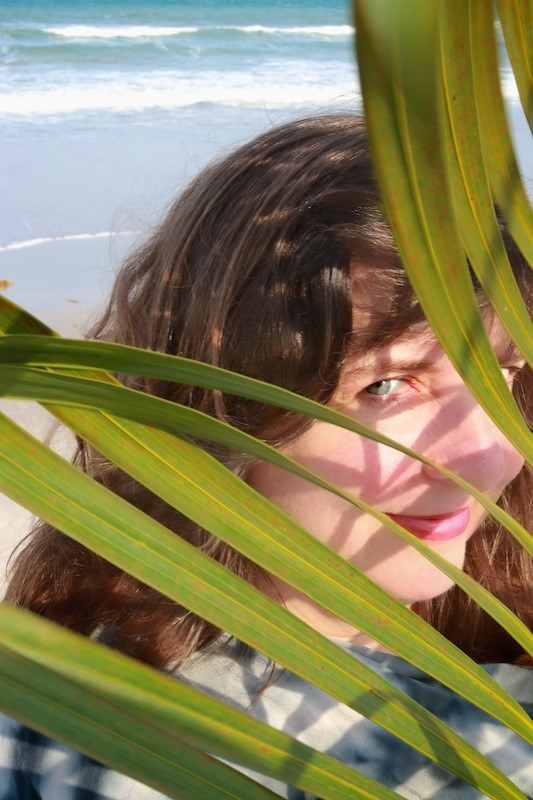
Lucy Lakestone is an award-winning author who lives on Florida’s east central coast, among the towns that serve as an inspiration for the hot romances of her Bohemia Beach Series and the jumping-off point for the Bohemia Bartenders Mysteries. She’s been a journalist, photographer, editor and video producer but prefers living in her imagination, where the moon is full and the cocktails are divine. 

See the book trailer

Posted in Archives, August 2020, Uncategorized | Tagged , , , | Leave a comment

Step into the South old and new

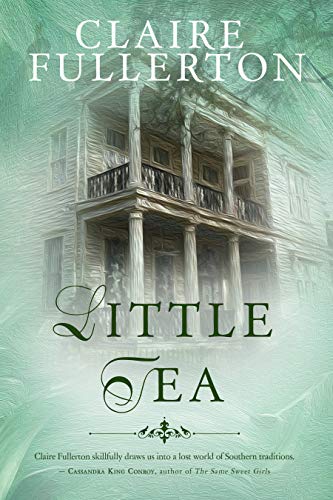
Today Claire Fullerton is visiting Ascroft, eh? to tell us about Little Tea, her novel of female friendship.

Welcome, Claire. Let’s get started, shall we?

Tell us about your novel. Is it part of a series?

Little Tea ( named after a character whose real name is Thelonia Winfrey) is a stand-alone story of those long-lasting female friendships that see you through a lifetime, wherein there’s shared history; language; and sense of humor. The narrator, Celia Wakefield spent part of her childhood at her family’s 3rd generation land in Como, Mississippi, where the cultural social mores concerning racial integration had yet to fully evolve. This premise sets the dynamic of a trajectory of events that impact her friendship with Little Tea and haunt Celia Wakefield decades later. When Celia reunites with two childhood friends at Greer’s Ferry Lake in Heber Springs, Arkansas, Celia’s past resurfaces for long-overdue resolution.

Where did the idea for the mystery that is central to the story come from?

In telling the story of three childhood friends who reunite after many years from the point of view of narrator, Celia Wakefield, who grew up in the Deep South but now lives in California, I wrote in the opening pages that she was hesitant to fly back home, yet the lure of friendship prompted her to brave her reservation. Twenty-five pages into Little Tea, I realized I had to answer to Celia’s hesitancy, so I began writing Celia Wakefield’s Back-story. I wanted to write about “the South as place” as accurately as possible to set the backstory and tell the reader about a tragedy that happened in her family’s history that Celia has yet to fully reconcile. Because Little Tea is told in two timeframes, the tragedy in Celia’s backstory is a build that unfolds, and I believe the reader will find it suspenseful.

Is there a theme or subject that underlies the story?

The unique ties that bind in long friendships and the idea of reconciling one’s own history in the interest of closure.

If so, what prompted you to write about it?

My desire to capture female friendships spawned Little Tea. I’ve always thought that when women friends get together to discuss the plight of one, the problems of the world are solved! Women have such intuitive insight and ability to conceptualize. The sage advice and profound wisdom of women that comes from what can only be called commiserative compassion is something I’ve always seen as uncanny. The way friends speak to each other when they’re uncensored has its own language, and typically there’s a shared sense of humor. All of this amazes me, so as a writer, my aim was to tell about that!

How do you create your characters?

In the case of Little Tea, I wanted to have one of the women have a problem. Ava Cameron is approaching fifty and in a marital crisis. And she’s drinking too much because a part of her can’t let go of her youth. I put this dilemma square in the center of Little Tea and created two friends so that the reader could have one problem seen through the eyes of three women. I loved the idea of one problem in the hands of three different women because of the differing vantage points.

How do you bring to life the place you are writing about?

I am partial to writing about the way an environment feels, and for this, it’s best to write about what makes it unique. In the Deep South, the oppressive humidity affects everything from how one dresses to how one spends the day. In Little Tea, the three friends spend a long weekend at Greer’s Ferry Lake in Heber Springs, Arkansas—340 lakefront miles with sycamore, pin oak, and pine trees all around. They spend much time in a boat on the water, and water, as an element, is suggestive of fluidity and changing emotions.

What research do you do to provide background information to help you write the novel?

I’m so glad you asked! Because Little Tea takes place in part in Como, Mississippi, I flew to Memphis and drove 45 miles South to see Como for myself. I spent five hours with a fifth generation “gentleman farmer” named Sledge Taylor, whose forebears were integral to the development of the area. Let’s just say that the stain glass windows in Como’s Holy Innocence Church are dedicated to his ancestors. Sledge Taylor is an historian, artist, scientist, botanist, and owner of hundreds of acres of cotton and soybean fields. He was my tour guide in Como, and driving through town and Como’s wooded outskirts while he gave a running monologue only interrupted by my questions was one of the finer days I’ve ever spent. I took notes all the while, and all of the information I received from Sledge Taylor found its way into Little Tea’s story.

Is there anything else you’d like readers to know?

Little Tea is the story of female friendships and how one reconciles one’s familial history, but it is also a story that is attendant to Southern culture in terms of cause and effect. The three women friends reunite in modern time, but Celia Wakefield’s backstory is set in the 1980’s.  There are cultural repercussions having to do with 1980’s, regional social mores, and they figure into the story. The ending of Little Tea lays bare what I see as a satisfying ending.

Thanks for answering my questions, Claire, and good luck with your new novel, Little Tea.

Readers can learn more about Claire and her writing by visiting her website and her Instagram page.

The novel is available online at  Amazon 

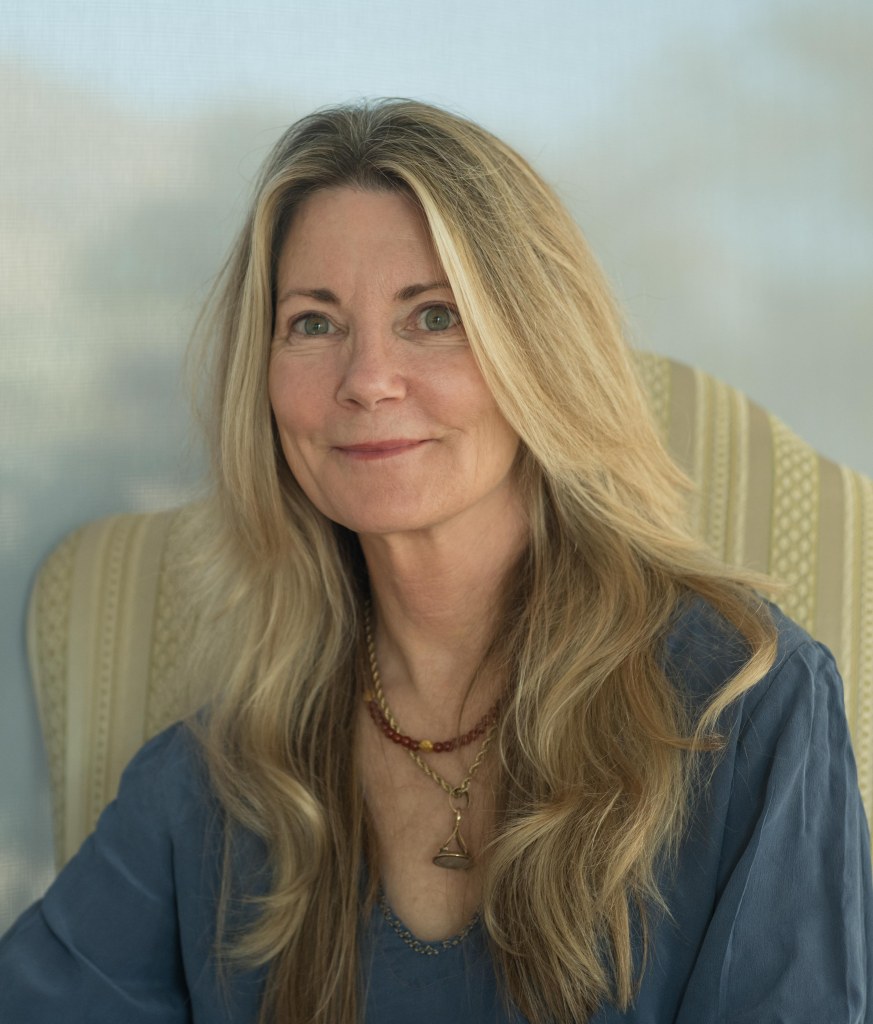
About Claire Fullerton: Claire hails from Memphis, TN. and now lives in Malibu, CA. with her husband and 3 German shepherds. She is the author of Mourning Dove, a coming of age, Southern family saga set in 1970’s Memphis. Mourning Dove is a five-time award winner, including the Literary Classics Words on Wings for Book of the Year, and the Ippy Award silver medal in regional fiction (Southeast.) Claire is also the author of Dancing to an Irish Reel, a Kindle Book Review and Readers’ Favorite award winner that is set on the west coast of Ireland, where she once lived. Claire’s first novel is a paranormal mystery set in two time periods titled, A Portal in Time, set in Carmel-by-the-Sea, California. She is a contributor to the book, A Southern Season with her novella, Through an Autumn Window, set at a Memphis funeral (because something always goes wrong at a Southern funeral.) Little Tea is Claire’s 4th novel and is set in the Deep South. It is the story of the bonds of female friendship, healing the past, and outdated racial relations. Little Tea is the August selection of the Pulpwood Queens, a Faulkner Society finalist in the William Wisdom international competition, and on the short list of the Chanticleer Review’s Somerset award. She is represented by Julie Gwinn of the Seymour Literary.

Posted in Archives, August 2020, Uncategorized | Tagged , , , , , | 3 Comments

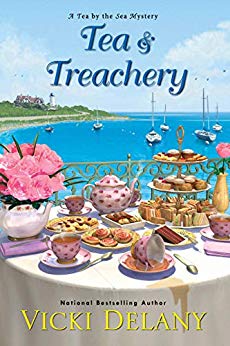
Tea & Treachery

Today Vicki Delany is visiting Ascroft, eh? to tell us about Tea & Treachery, her first novel in the Tea by the Sea mystery series.

Welcome, Vicki. Let’s get started, shall we?

Tell us about your novel. Is it part of a series? If so, please tell us about the series too.

Tea and Treachery is the first in the Tea by the Sea series from Kensington Books.  It’s a cozy series, set in a traditional afternoon tea room on Cape Cod. The main character is Lily Roberts, pastry chef and owner of Tea by the Sea. The tea room is located next to Lily’s grandmother’s B&B Victoria-on-Sea.

Where did the idea for the mystery that is central to the story come from?

Lily’s grandmother Rose has moved to North Augusta, on Cape Cod to fulfil her dream of living by the sea. Rose is looking for peace and quiet in her declining years, but can’t actually afford her dream home, so she turned the 19th century mansion into a B&B. When the owner of the property next door tries to sell it to a developer for a golf course and resort Rose vows to stop the project. One way or another. That’s a situation I see in the area where I live. We’re dependent on the tourist trade for income but people resent the actual tourists themselves and the infrastructure they require.

Is there a theme or subject that underlies the story? If so, what prompted you to write about it? 

This is a cozy mystery so it’s not trying to say anything important about anything. I hope I’ve created interesting characters and put them into a fun setting and presented them (and the reader) with a challenging puzzle. Having said, that, yes, the conflict between growth and development and preserving a beautiful place is the idea behind the plot.

How do you create your characters? Do you have favourite ones? If so, why are you partial to them?

My characters grow pretty organically. I had the idea of Lily, the pastry chef, and her grandmother Rose and as I started writing them, I just let them reveal themselves. My favourite character in this series is Lily’s friend Bernadette Murphy. Bernie is a writer (or she wants to be) but she’s far too impulsive to simply sit down and write her book. Perhaps I see something of myself in Bernie.

How do you bring to life the place you are writing about?

I’ve been to Cape Cod and I’ve attempted to capture that seafront setting in the book. The main setting in the book is the tea room and I’ve tried to give it that frantic pace restaurants have.

What research do you do to provide background information to help you write the novel?

I have enjoyed afternoon tea in places as diverse as the National Portrait Gallery in London and the Prince of Wales Hotel in Niagara-on-the-Lake. I am a good amateur baker and I’ve given Lily several of my own recipes to make for the tea room.

Is there anything else you’d like to tell readers about the book?

Recipes! Food! Lots of tea tips and facts.

Thanks for answering my questions, Vicki, and good luck with Tea & Treachery, the first book in theTea by the Sea Mystery series.

Readers can learn more about Vicki and her writing by visiting her website and her Facebook and Instagram pages. You can also follow her on Twitter.

The novel is available at the following online retailers:

Amazon – B&N – Kobo – Google Play – IndieBound

Made with Repix (http://repix.it)

About Vicki Delany: Vicki is one of Canada’s most prolific and varied crime writers and a national bestseller in the U.S. She has written more than thirty-five books: clever cozies to Gothic thrillers to gritty police procedurals, to historical fiction and novellas for adult literacy. She is currently writing four cozy mystery series: the Tea by the Sea mysteries for Kensington, the Sherlock Holmes Bookshop series for Crooked Lane Books, the Year Round Christmas mysteries for Penguin Random House, and the Lighthouse Library series (as Eva Gates) for Crooked Lane.

Vicki is a past president of the Crime Writers of Canada and co-founder and organizer of the Women Killing It Crime Writing Festival. She is the 2019 recipient of the Derrick Murdoch award for contributions to Canadian crime writing. Vicki lives in Prince Edward County, Ontario.

Posted in Archives, August 2020 | Tagged , , , , , | 1 Comment

Be careful what you eat

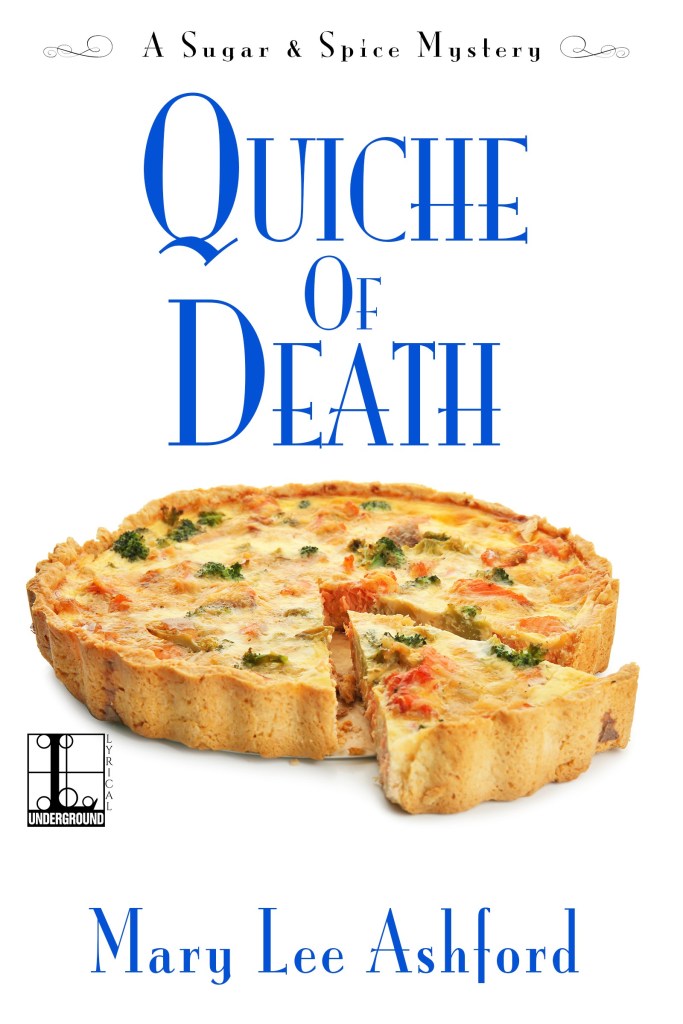
Today Sugar Calloway is visiting Ascroft, eh? to tell us about Quiche of Death, the latest novel in the Sugar & Spice mystery series.

Welcome, Sugar. Let’s get started, shall we?

Tell us about the novel that you live inside. Is it part of a series? If so, please tell us about the series too.

Well, I live in St. Ignatius, a small town in Iowa. But I guess, St. Ignatius lives inside the Sugar & Spice Mystery Series. Don’t you just love that name? It’s called that after the cookbook business that I own with my best friend, blue-ribbon baker Dixie Spicer.

The story kind of starts just as we are starting our business. You see, we publish cookbooks. But not just any kind of cookbooks – these are community cookbooks. You know, the kind where the glee club or the church group or the soccer team collects recipes, puts them in a book, and then sells the cookbooks as a fundraiser. Dixie and I help them do that.

The series started with Game of Scones and then moved on to Risky Biscuits and I don’t know if I should broadcast this or not, but there were murders in both of those books. Which Dixie and I solved, by the way.

And now, here we are, in Quiche of Death. We are working on something a bit different – a cookbook for the Arbor family. And they have invited us to spend the weekend with them at a family get-together. The weekend gathering seemed like a good way to collect the recipes they wanted include and maybe pick up some colorful stories to include as sidebars in the book. But I have to say I can already tell, there are some weird dynamics going on with this group.

Does the writer control what happens in the story or do you get a say too?

My writer is what I would call a control freak. She figures it all out ahead of time and expects me to stay in line. Though I don’t always do as I’m told.  So sometimes I like to throw a wrench in her well-oiled machine. For instance, she had not planned on a little explosion in the middle of the story. But I thought it was more fun than what she had in mind. And then there was the glue incident…

How did you evolve as the main character?

I’m not really sure. I guess I kind of like being in charge and so it just shook out that way. I’m not pushy, but when I decide to dig into something, I stay the course. I’m not snoopy, but I’m willing to keep asking questions. Plus, I’m the outlier. Most everyone in the books has lived in St. Ignatius most of their lives and I’m new to the town. Sort of an outsider.

Do you have any other characters you like sharing the story with? If so, why are you partial to them?

Oh, my stars, where do I start? I adore my best-friend and business partner
Dixie Spicer. She has a heart as big as all outdoors. If you find yourself in any kind of trouble and need help, she’ll be there. Plus, she’s the best cook in the world and I get to taste whatever she’s cooking.

And then there’s Greer Gooder, my landlady and my role model. She is self-sufficient, no nonsense, unwaveringly upbeat. When I am eighty, I want to be just like her.

And I can’t forget, Max Windsor. Greer calls him Handsome Max and he’s all that and more. He’s an extremely talented professional photographer and we use to take photos of the food for the cookbooks. Why am I partial to Max? I like his intensity when he’s working. I like his vivid blue eyes. Most of all, I like that he gets me.

What’s the place like where you find yourself in this story?

Do you mean place as in the actual location? Well, as I said earlier, I live in St. Ignatius, which I love.

I rent a house, though I have my sights set on buying it when Greer is ready to sell. It’s a beautiful Queen Anne Victorian on a big lot with a maple tree that turns a bright beautiful crimson red in the fall. The yard is bordered by lilac bushes and oh my, the wonderful smell in spring. The only drawback is my neighbor, Mrs. Pickett, who just plain doesn’t like me. I’ve tried and tried to be friendly, but no dice. I truly believe that one day I’ll break her with my kindness.

The town itself is a beautiful clean midwestern community with a town square that has a limestone courthouse at its center. The square is bordered on all four corners by local shops. One of my favorites is the Red Hen Diner, a chicken-themed restaurant where not only does everyone know your name, pretty much everyone also knows your business. A handy spot when I’m trying to solve a murder.

Is there anything else you’d like to tell readers about you and the book?

Well, one important thing to note is that though the books are focused around solving murders, we have a lot of fun, too.

Though I have to say, that’s mostly thanks to me. Remember what I said about the explosion. And the glue.

Thank you for answering my questions, Sugar, and good luck to you and your author, Mary Lee Ashford, with Quiche of Death, the latest book in the Sugar & Spice mystery series.

Readers can learn more about Sugar and her author, Mary Lee Ashford by visiting the author’s website and her Facebook, Goodreads, Bookbub, Instagram and Pinterest pages. You can also follow her on Twitter.

The novel is available at the following online retailers:

Amazon – Barnes & Noble – Kobo – Google Books – Apple Books

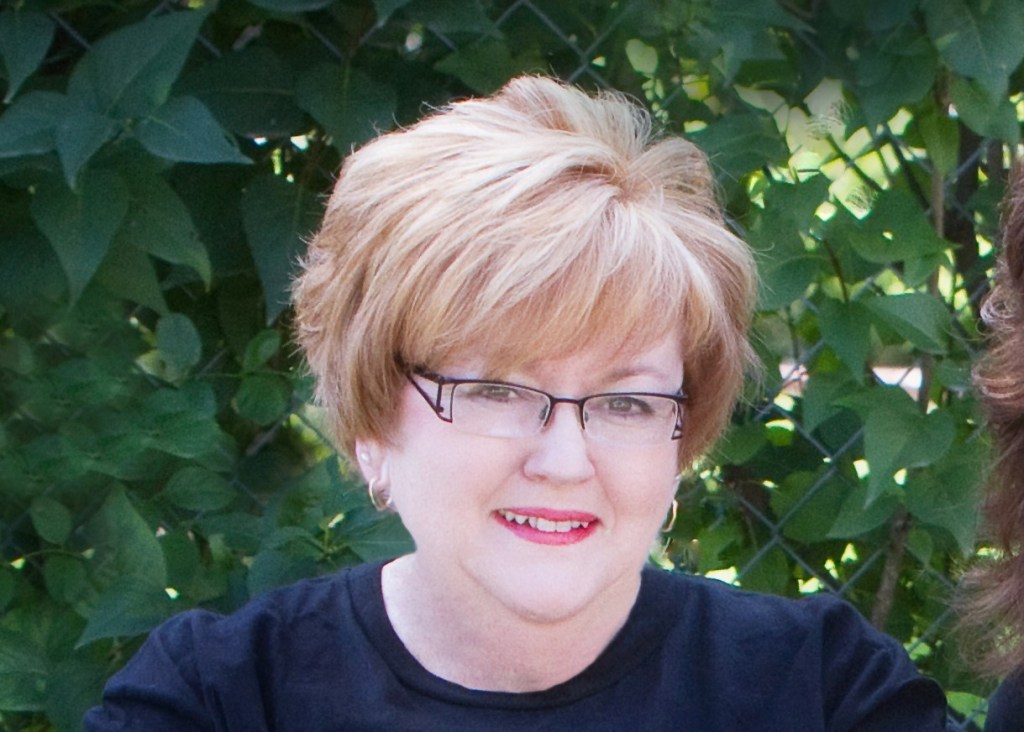
About Mary Lee Ashford: Mary is a lifelong bibliophile, and avid reader, and supporter of public libraries. In addition to writing the Sugar and Spice series for Kensington Books, she also writes as half of the writing team of Sparkle Abbey, author of the national bestselling Pampered Pets mystery series from Bell Bridge Books.

Prior to publishing Mary Lee won first place in the Daphne du Maurier contest, sponsored by the Kiss of Death chapter of RWA, and was a finalist in Murder in the Grove’s mystery contest, as well as Killer Nashville’s Claymore Dagger contest.

She is the founding president of Sisters in Crime – Iowa and a past board member of the Mystery Writers of America Midwest chapter, as well as a member of Novelists, Inc., Romance Writers of AmericaKiss of Death the RWA Mystery Suspense chapter, Sisters in Crime, and the SinC internet group Guppies. She loves encouraging other writers and is a frequent presenter for writers’ groups. Mary Lee has a passionate interest in creativity and teaches a university-level course in Creative Management to MPA candidates, as well as presenting workshops and blogging about creativity.

She currently resides in the midwest with her husband, Tim, and cat, Zoey. Her delights are reading and enjoying her two sons and daughters-in-law, and six grandchildren.

Posted in Archives, July 2020 | Tagged , , , , | 2 Comments

Meet the Countess of Harleigh

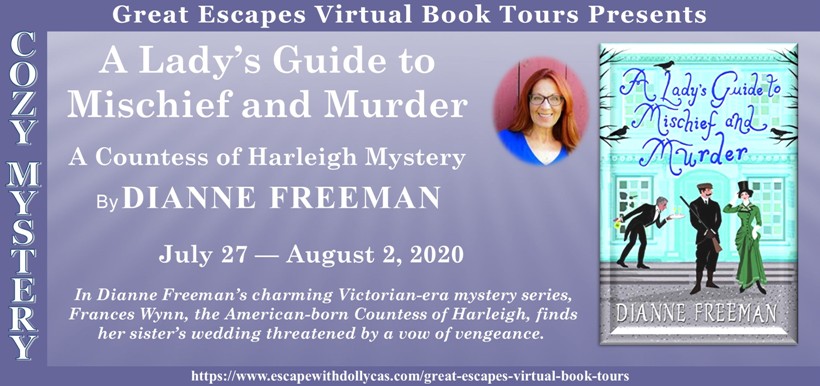
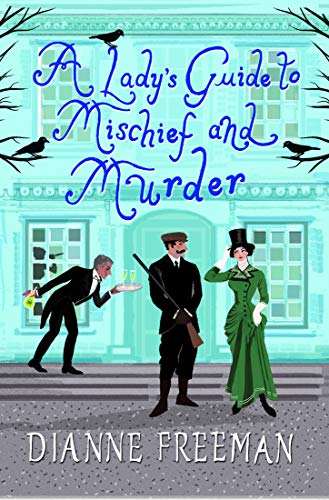
Today Dianne Freeman is visiting Ascroft, eh? to tell us about A Lady’s Guide to Mischief and Murder, her latest novel in the Countess of Harleigh mystery series.

Welcome, Dianne. Let’s get started, shall we?

Tell us about your novel. Is it part of a series? If so, please tell us about the series too.

I write the Countess of Harleigh Mystery series set in late Victorian London. The central character, Frances Wynn is a former American Heiress, now widow to the Earl of Harleigh. When the series begins, Frances has just finished her mourning period for her late husband and moved to a posh neighborhood in London to start a new life for herself and her young daughter. The ghosts of her old life follow her however, and she finds herself a suspect in a case of murder.

In A Lady’s Guide to Mischief and Murder, the third book in the series, Frances is planning a simple wedding in the countryside for her sister, Lily. Everyone is having a lovely time until the servants, the wedding party, and even the guests begin to fall victim to mysterious “accidents.” The injuries are bad enough, but when someone dies, Frances is driven to find out if someone is trying to put an end to this wedding—or just to the groom.

Where did the idea for the mystery that is central to the story come from?

A Victorian house party personifies the British upper-crust for me—all those aristocrats at play and behaving badly. What better place to set a murder mystery? Even with a murderer on the loose, it would be an egregious breach of manners to leave before the designated date, so the only choice is to find the killer.

Is there a theme or subject that underlies the story? If so, what prompted you to write about it?

When she was eighteen, Frances married the man her mother chose for her. It was an exchange of money for a title. Now, ten years later, her mother is interfering with Lily’s choice for a husband, so their mother/daughter relationship and how they come to an understanding plays a role in the story.
How do you create your characters? Do you have favourite ones? If so, why are you partial to them?

My characters come to me pretty well formed. I learn to understand them by examining their pasts. I don’t write biographies for them. I rely on one or two experiences that shaped their lives. Frances plays the leading role because she’s my favorite. She has so much to learn and so much to give and she’s always willing and eager to do both. She adopted the British “stay calm and carry on” attitude, so even when everything is chaotic, she remains unflappable.
How do you bring to life the place you are writing about?

I don’t enjoy a lot of description myself, so I tend to stay away from it. However, letting the characters interact with the setting will let readers experience it through the character’s eyes, or ears, or nose.

What research do you do to provide background information to help you write the novel?

Historical fiction requires a lot of research. I spend much of my time in the pages of the British Newspaper Archive. The news stories let me know if any major event took place during the time of my story and what interested the people of that time. There were newspapers that dealt specifically with crime so I can learn not only what type of crime the people of London were dealing with, but how the police managed to solve and prosecute the cases. Even the classified ads help in determining things like where my characters can afford to live and how much their servants can expect to earn.

For A Lady’s Guide to Mischief and Murder I needed to learn about the leisure activities of the late Victorian era—the types of pastimes one might find at a country house party. I also needed to find a country house, something I could use as a model for Risings, George Hazelton’s family seat. Fortunately, I enjoy research and hope these details transport the reader to another time.

Thanks for answering my questions, Dianne, and good luck with A Lady’s Guide to Mischief and Murder, the latest book in theCountess of Harleigh Mystery series.

Readers can learn more about Dianne and her writing by visiting her website and her Facebook and Goodreads pages.

The novel is available at the following online retailers:

Amazon – B&N – Kobo – Google Books – IndieBound

About Dianne Freeman: Dianne is the acclaimed author of the Countess of Harleigh Mystery series. She is an Agatha Award and Lefty Award finalist, as well as a nominee for the prestigious Mary Higgins Clark Award from Mystery Writers of America. She spent thirty years working in corporate accounting and finance and now writes full-time. Born and raised in Michigan, she and her husband now split their time between Michigan and Arizona.

Posted in Archives, July 2020 | Tagged , , , , | 2 Comments