Step Carefully Into This Shop

DOWN IN FLAMES BANNER 640

Today Cheryl Hollon is visiting Ascroft, eh? to tell us about Down in Flames, her latest novel in the Webb’s Glass Shop mystery series.

Welcome, Cheryl. Let’s get started, shall we?

Tell us about your novel. Is it part of a series? If so, please tell us about the series too.

DOWN IN FLAMESCH: DOWN IN FLAMES is the sixth book in the Webb’s Glass Shop Mystery Series. Savannah Webb is the owner of a glass shop and she teaches a different type of glass art in each book. As a subject matter expert within the art community, she consults with the St. Petersburg Police Department when a crime is committed.

Where did the idea for the mystery that is central to the story come from?

CH: My husband and I have been glass hobbyists for more than twenty-five years. When I decided to write a cozy mystery series, the two worlds came together in a flash.

Is there a theme or subject that underlies the story? If so, what prompted you to write about it?

CH: There have always been small business owners in my family, so I was drawn to tell a bit about the back story of how hard it can be to stay afloat.

How do you create your characters? Do you have favourite ones? If so, why are you partial to them?

CH: For a new character, I usually gather together a Frankenstein-like collection of traits that I feel the character needs. The next most important element is the name. After I have a name that fits, they come to life to me as a unique individual.

How do you bring to life the place you are writing about?

CH: Lucky me, I simply walk out my front door. I live in downtown St. Petersburg, Florida.

What research do you do to provide background information to help you write the novel?

CH: I have personal experience in each of the glass arts that Savannah teaches. I’ve either made the items myself or taken a class. Research is a bit like cross-training for me.

Is there anything else you’d like to tell readers about the book?

CH: This series has been inspired by a real-life stained-glass store. The owners were forced to make a tough decision to move out of the downtown area last fall because of rising rents. It’s a rough world for small businesses out there. Shop local.

Thanks for answering my questions, Cheryl, and good luck with Down in Flames, the latest book in the Webb’s Glass Shop Mystery series.

Readers can learn more about Cheryl and her writing by visiting her website and her Facebook page. You can also follow her on Twitter (@CherylHollon).

The novel is available at the following online retailers:

Amazon B&N   Kobo

Author Hollon PhotoAbout Cheryl Hollon: Cheryl now writes full-time after she left an engineering career of designing and building military flight simulators in amazing countries such as England, Wales, Australia, Singapore, Taiwan, and India. Fulfilling the dream of a lifetime, she combines her love of writing with a passion for creating glass art. In the small glass studio behind her house in St. Petersburg, Florida, Cheryl and her husband design, create, and produce fused glass, stained glass, and painted glass artworks.

Posted in July 2019, Uncategorized | Tagged , , , , , | 1 Comment

Meet Belinda Blake and Her Unusual Companions

BELINDA BLAKE AND THE SNAKE IN THE GRASS BANNER 640

Today Heather Day Gilbert is visiting Ascroft, eh? to tell us about Belinda Blake and the Snake in the Grass, her first novel in the Exotic Pet-Sitter mysteries series.

Welcome, Heather. Let’s get started, shall we?

Tell us about your novel. Is it part of a series? If so, please tell us about the series too.

HDG: Yes, Belinda Blake and the Snake in the Grass is the first in a three-book cozy mystery series called the Exotic Pet-Sitter Series. It features amateur sleuth Belinda Blake, who lives in a carriage house in wealthy Greenwich, CT. Her parents live in Upstate New York, and she visits them throughout the series.

Where did the idea for the mystery that is central to the story come from?

bb cover png (1)HDG: I wanted to come up with an occupation for my sleuth that hadn’t been overdone in the cozy mystery genre, and somehow I stumbled onto the idea for an exotic pet-sitter. Her first “mission” is sitting a ball python. It was challenging to bring that to life in a way that wouldn’t repulse readers, but I think it worked—one endorser (cozy author Emily James) said that although she didn’t like snakes going into the book, the snake wound up being one of their favorite characters!

Is there a theme or subject that underlies the story? If so, what prompted you to write about it?

HDG: I wanted to portray a twenty-something year old sleuth who has a strong family support unit, and Belinda does. She has a psychologist sister, Katrina, who’s always telling her to be more careful, as well as loving parents. Family is a kind of a theme running through the series, although Belinda does trip into some romance along the way…

How do you create your characters? Do you have favourite ones? If so, why are you partial to them?

HDG: My characters come to life as I write them. In the Exotic Pet-Sitter series, I’d say I’m kind of like a blend between Belinda and her sister, Katrina. But her all-natural, off-grid mom was a delight to write.

How do you bring to life the place you are writing about?

HDG: Well, we lived in Greenwich, CT, when we had our first child, and you could rent carriage houses just like Belinda’s, so I felt very familiar with that area, as well as NYC, which plays into some of the books (we lived there, as well). And with the rural Upstate NY scenes where Belinda’s parents live—we ALSO lived there too, for six years, and rural settings are easiest for me to write because I grew up in the mountains of West Virginia. So I felt highly familiar with all the locales in this series.

What research do you do to provide background information to help you write the novel?

HDG: I did research how Greenwich has changed since we lived there. I do a lot of research for names of places, and later in the series, for the Native American element that played into the final book. Not to mention hours of research on whatever exotic pet I happen to be writing about!

Is there anything else you’d like to tell readers about the book?

Nothing I can think of! 😉 Thank you!

Thank you for answering my questions, Heather, and good luck with Belinda Blake and the Snake in the Grass, the first book in the Exotic Pet-Sitter Mystery series.

Readers can learn more about Heather and her writing by visiting her website and her Facebook, Pinterest and Goodreads pages. You can also follow her on Twitter and Instagram and sign up for her newsletter.

The novel is available at the following online retailers:

Kindle:    Nook     Kobo      AppleBooks     Google Play

heatherdaygilbertwoodsAbout Heather Day Gilbert: Heather is an ECPA Christy award finalist and Grace award winner, writes contemporary mysteries and Viking historicals. Her novels feature small towns, family relationships, and women who aren’t afraid to protect those they love. Like Belinda Blake, Heather plays video games, although so far she hasn’t done any exotic pet-sitting or hunted any murderers.


Posted in Archives, June 2019, Uncategorized | Tagged , , , , , | 3 Comments

Is Education Harmful?

DEATH BY DISSERTATION BANNER 540

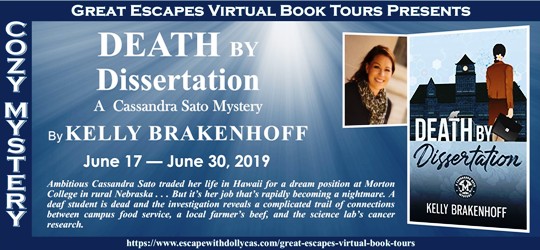
Today Kelly Brackenhoff is visiting Ascroft, eh? to tell us about Death by Dissertation her first novel in the Cassandra Sato mysteries series.

Welcome, Kelly. Let’s get started, shall we?

Tell us about your novel. Is it part of a series? If so, please tell us about the series too.

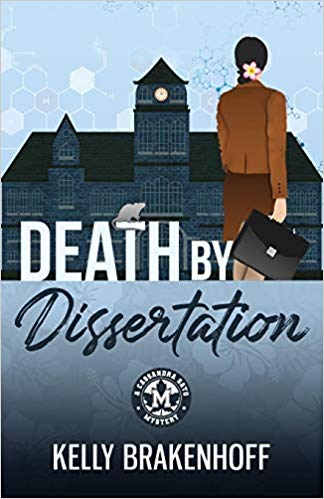
DEATH BY DISSERTATION COVERKB: After years of dreaming, writing, and re-writing, Death by Dissertation is my first novel and the beginning of the Cassandra Sato mystery series set in the U.S. in rural Nebraska. After graduating with a Ph.D. and working a few years at a college in Hawai’i—where she was born and raised—Cassandra moves to Morton College in the heart of the Midwest because she thinks it will help her get experience to someday become a university president.

When a student dies two months into her dream job, she struggles with culture shock, academic politics, and threats of violence while she helps the investigation. Cassandra is surrounded by an old friend, hilarious students, and supportive co-workers, but it’s her job on the line if she can’t figure out how to end the nightmarish string of suspicious incidents.

Where did the idea for the mystery that is central to the story come from?

KB: Years ago, I met one of my best friends while my husband and I lived in Hawai’i. I’ve often wished she lived closer to me in Nebraska so we could hang out together in person. Of course, who in their right mind trades the sunny skies and sandy beaches of paradise for miles and miles of cornfields? Right, no one.

When I began writing my novel during National Novel Writing Month in November of 2014, it was my chance to finally bring my wishes to life. So, I invented Cassandra Sato (who is only a little like my real-life friend) and moved her to Carson, Nebraska, to see how she’d handle the face-freezing winters and ethnically homogenous people.

For this story, I combined topics I’m interested in that seem to have no connection:  cancer research and cattle feed additives. To my surprise, when I worked out the plot and asked my experts, I was told that my crazy ideas are actually possible in the real world. Which is both exciting and just a bit scary that people out there way smarter than me are working on ways to improve our food supply and cure diseases all within the same system. Amazing!

Is there a theme or subject that underlies the story? If so, what prompted you to write about it?

KB: As an American Sign Language Interpreter with more than twenty years of experience, I’ve worked in college classrooms for fifteen different majors. I actually attend classes with the deaf students and overhear both the most inspiring and the most inane professors you could imagine. I think we all struggle to fit in somewhere, whether it’s a new job, with schoolmates, or who we want to be when we grow up. This story touches on all of those emotions, while also making you laugh. Because when I’m overwhelmed by life, laughter is the best way for me to deal with difficulties and move on.

How do you create your characters? Do you have favourite ones? If so, why are you partial to them?

KB: In addition to writing mysteries, I love to read them. My favourites are the series with a large cast of characters who feel like my friends. For Cassandra’s character, I used my memories of feeling like an outsider when I moved to Hawai’i. The culture and everyday life is so drastically different than living in the Midwest, it was a huge adjustment. Those things are all reversed in Cassandra’s story, but the feelings are the same. Cassandra’s interpreter friend, Meg, gives me a way to write about things I can’t usually say out loud at work without being fired. I also love the student office workers because they say and do hilarious things that real-life students say if you take the time to pay attention.

How do you bring to life the place you are writing about?

KB: I live in Nebraska where we just experienced a six-month long winter that began in October with snow, included fourteen straight December days of below-freezing temperatures, and ended in March with biblical flooding that destroyed farms and businesses in 70 out of 93 counties.

Imagine moving here from warmer climates! Because of the extreme weather, Nebraskans are hardy folks whose survival depends on having a sense of humor. Our state tourism department recently made a new slogan called “Nebraska: Honestly, it’s not for everyone.” For real! #nebraskahonestlyitsnotforeveryone

What research do you do to provide background information to help you write the novel?

KB: My interpreting job has involved traipsing across muddy farm fields, stomach churning medical procedures, and stage interpreting for famous figures. I love the academic world, and strange things happen there that even a talented fiction writer could not make up. It seemed like the perfect setting for a mystery series. For this story, I interviewed a biologist friend and a family member who owns a cattle farm to find out about the cancer research and beef feed additive details.

Readers might like to know that SODs are real enzymes, and there is current research happening to use them to cure common diseases.

Is there anything else you’d like to tell readers about the book?

KB: Don’t give up on your dreams! It took me twenty years of wanting and four years of writing to get this book published. If you work on projects a little at a time, eventually they become reality! I hope you enjoy the book!

Thanks for answering my questions, Kelly, and good luck with Death by Dissertation, the first book in the Cassandra Sato Mystery series. I’m intrigued by a story set in an educational setting. It evokes memories of my university days for me and I’m eager to read this book.

Readers can learn more about Kelly and her writing by visiting her website. You can also follow her on Twitter and Instagram (@kellybrak).

The novel is available on Amazon and is on a Countdown Deal for $.99 that runs June 22 – 30th: https://amazon.com/author/kellybrakenhoff

KELLYBRAKENHOFFAbout Kelly Brakenhoff: Kelly is an American Sign Language Interpreter whose motivation for learning ASL began in high school when she wanted to converse with her deaf friends. As an American Sign Language Interpreter with more than twenty years of experience, Kelly’s worked in college classrooms for fifteen different majors. From traipsing across muddy farm fields to stomach-churning medical procedures, and stage interpreting for famous figures, Kelly’s community interpreting interactions number in the thousands. Unfortunately, once she’s stepped away from the job, she usually forgets 90% of what happened. Which helps her keep confidential information safe, but also makes it really hard to grocery shop for more than 5 items without a written list.

Kelly wants to live in a world filled with peace, love, and joy, where people who can hear learn enough sign language to include deaf people in everyday conversations and work. Where every deaf child has early access to language and books with characters like them, and dark chocolate is cheap and plentiful. When she’s not interpreting or writing, you can find Kelly cheering for her favorite Husker teams or training for half-marathons because she really likes dessert.

Posted in Archives, June 2019, Uncategorized | Tagged , , , , | 1 Comment

Here’s A Dame You Have To Meet

DECO-DAMES-BANNER-540

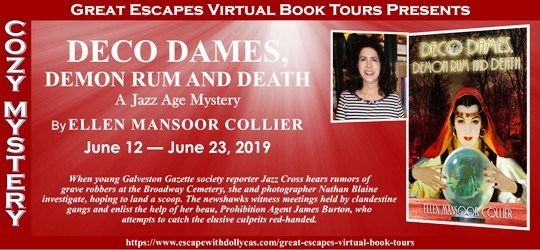
Today Ellen Mansoor Collier is visiting Ascroft, eh? to tell us about Deco Dames, Rum and Death, her latest novel in the Jazz Age mysteries series.

Welcome, Ellen. Let’s get started, shall we?

Tell us about your novel. Is it part of a series? If so, please tell us about the series too.

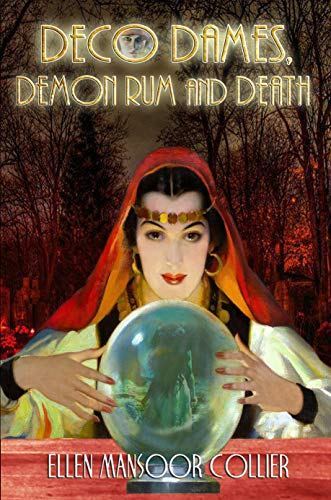
DECO-DAMES-DEMON-RUM-AND-DEATHEMC: DECO DAMES is the last novel in my five-part series featuring Jasmine (Jazz) Cross, a society reporter who’s caught between two clashing cultures: the high society and high-rollers she covers in the Galveston Gazette, and her brother’s illicit underground world of gangsters, speakeasies and bootleggers.

Where did the idea for the mystery that is central to the story come from?

EMC: According to Galveston legend, a ghost bride has haunted the Hotel Galvez since the 1950s when a bride-to-be killed herself after her fiance was reportedly lost at sea. In my 1920s version, the bride-to-be drowned herself in the Gulf, but Jazz discovers that she was actually murdered.

Is there a theme or subject that underlies the story? If so, what prompted you to write about it?

EMC: During the 1920s, people were fascinated with the supernatural and occult.  Galveston is famous for its cemeteries and I wanted to use that setting to combine the dual stories of murder and the supernatural world. A skeptic, Jazz asks a fortune teller to delve into the ghost bride’s past to help solve her murder.

How do you create your characters? Do you have favourite ones?

EMC: Naturally I’m partial to my main characters because they’re bits and pieces of different people, but I combine their characteristics to create unique personalities. I feel like I know them!

How do you bring to life the place you are writing about?

EMC: I try to incorporate actual locations and settings, and also mention places that were lost over time. To convey the Jazz Age, I’ve described flapper fashions, cars and habits of that time as well as used period slang in dialogue ( e.g. “You’re on the trolley!” means “You’ve got it!”).

Many readers found some of the slang distracting in FLAPPERS, so I revised and shortened that novel and cut down on the slang in the rest of my series. I do include a glossary of slang in the back, and try to use terms with clear meanings.

What research do you do to provide background information to help you write the novel?

EMCI’m a magazine journalist in real life, and found the subject and research fascinating. I’ve used Gary Cartwright’s book and various books on Galveston quite a bit and have done online research as well as personal interviews. In DECO DAMES, a murder victim was found in Broadway Cemetery—and I based that on hearsay from a Louisiana gangster’s daughter. In those days, most gangland activity wasn’t reported so my plot lines are purely fictitious and imaginary.

Is there anything else you’d like to tell readers about the books? 

EMC: Everyone has heard about Al Capone and the Chicago mobsters, but Galveston gangsters are virtually unknown outside of Texas. The Beach Gang and Downtown Gang were real-life rival gangs who faced off during Prohibition, profiting from the Island’s lax laws. In my series, Prohibition Agent James Burton must confront dirty cops, savvy gangsters and ruthless bootleggers to uphold the Volstead Act—with little support. Fact is, a crime family ruled Galveston for 30 years, from the 1920s-50s while the locals turned a blind eye, since they contributed to the community.

I call my novels “soft-boiled” historical mysteries since they deal with actual people and places—namely gangsters and criminal activity—but they’re not gory or violent. My character, Jazz Cross, is an ambitious young society reporter who strives to write hard news—but unlike many flapper slueths, she’s not British royalty or rich or privileged. In FLAPPERS, the first novel, Jazz wants to protect her half-brother Sammy who owns a speakeasy, the Oasis, but the local Prohibition Agent wants to shut down his bar. I find that era fascinating yet I can’t stand blood and guts stories since I’m a wimp in real life. I live in a big city and if I wanted to hear about grisly murders and violent crimes, I’d turn on the news!

Thanks for answering my questions, Ellen, and good luck with Deco Dames, Rum and Death, the latest book in the Jazz Age Mystery series.

Readers can learn more about Ellen and her writing by visiting her website and her Goodreads and Pinterest pages.

The novel is available on Amazon stores:

Amazon

EllenSanLuisout1About Ellen Mansoor Collier: Ellen is a Houston-based freelance magazine writer and editor whose articles and essays have been published in a variety of national magazines. Several of her short stories have appeared in Woman’s World. During college summers, she worked as a reporter for a Houston community newspaper and as a cocktail waitress, both jobs providing background experience for her Jazz Age mysteries.

A flapper at heart, she’s worked as a magazine editor/writer, and in advertising and public relations (plus endured a hectic semester as a substitute teacher). She graduated from the University of Texas at Austin with a degree in Magazine Journalism and served on UTmost, the college magazine and as president of WICI (Women in Communications).

She lives in Houston with her husband and Chow mutts and visits Galveston whenever possible.

“When you grow up in Houston, Galveston becomes like a second home. I had no idea this sleepy beach town had such a wild and colorful past until I began doing research, and became fascinated by the legends and stories of the 1920s. Finally, I had to stop researching and start writing, trying to imagine a flapper’s life in Galveston during Prohibition.”Co

Posted in Archives, June 2019, Uncategorized | Tagged , , , | 3 Comments

Definitely Not A Sheepish Tale

DIED IN THE WOOL BANNER 540

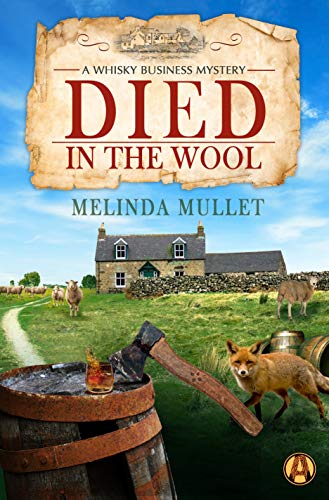
Today Melinda Mullet is visiting Ascroft, eh? to tell us about Died in the Wool, her latest novel in the Whiskey Business mysteries series.

Welcome, Melinda. Let’s get started, shall we?

Tell us about your novel. Is it part of a series? If so, please tell us about the series too.

DIED IN THE WOOLMM: Died in the Wool is the fourth book in the Whisky Business Mystery Series.  The protagonist is a young woman named Abi Logan.  A highly respected, globe-trotting photojournalist who suddenly finds herself thrust into the male dominated world of whisky making in rural Scotland when she inherits a distillery from her uncle.  Being both inexperienced and a woman she’s harassed and threatened, but she refuses to back down especially after one of her employees is found murdered in a vat of the distillery’s finest.  It’s a murder mystery of course, but it’s also a journey of personal discovery for a woman burnt out by her own over-stressed life.  In the whisky world she finds a new life, and a new purpose.

Died in the Wool finds Abi investigating a suicide and a kidnapping at a woman’s shelter in Edinburgh when the police seem unmotivated to help the already marginalized group of women.

Where did the idea for the mystery that is central to the story come from?

MM: I’d been following my husband around on a tour of the Speyside whisky distilleries in Scotland and at what felt like distillery number four hundred and thirty seven, I found myself thinking that the giant wooden vat we were peering into would make a great place to discover a dead body.  Other mystery people will understand that this isn’t really as disturbed a thought as it seems, nor is it a subconscious desire to be rid of my whisky loving husband.  From there I started writing the Whisky Business series.

Is there a theme or subject that underlies the story? If so, what prompted you to write about it?

MM: The story looks at preconceived gender stereotypes and at the crisis of self that so many of us face at the mid-point of our lives.  What am I doing with my life?  How did I get here?  Where am I going?  Am I really happy?  I think these are things that all of us can relate to. Abi is in the process of reinventing herself and finds that the challenges associated with facing down the whisky fraternity, learning a new craft and bringing her own business skills into play are enlivening. She of course also discovers that a life-time of detailed observation has made her good at solving crimes.

How do you create your characters? Do you have favourite ones? If so, why are you partial to them?

MM: All of my characters start as a name and then a detailed character sketch. Once they have a name they become a person in my mind and I lay out a detailed character portrait covering everything from their age, weight, height, to their childhood issues, their biggest fears, their values and their panic response. Once I have this I can drop them into any situation and feel confident about the way they will react. My favourite characters are always the extremely complex ones. They are the most fun to write.

How do you bring to life the place you are writing about?

MM: I always visit the places I write about. Like Abi I take lots of pictures as I roam around. Sometimes odd little vignettes that can bring a place to life — light reflecting on the water, a crumbling stone bridge, flowers, the local tea shop. Those generally show up in my books somewhere. It’s also nice to look back at the pictures to refresh my sense of place. A good picture can bring back the smell and the feel of a location for me.

What research do you do to provide background information to help you write the novel? 

MM: I’ve done a great deal of research on the art of making single malt whisky and could bore my readers with reams of tedious information, but I don’t!  The actual whisky making is in the background, but I try to use the complex process as an analogy for investigation. It can be as tricky to distil truth from lies, as it is to distil the golden heart from a batch of new whisky.

For this series I also did quite a bit of research on smuggling and bootlegging in Scotland. It’s a fascinating history and bits and pieces of it pop up in the various stories.

Is there anything else you’d like to tell readers about the book?

MM: The Whisky Business series walks the line between a cosy and a traditional mystery.  You won’t find gratuitous violence on the page, but the mysteries tend to be more complex. Of course, there are plenty of light moments and an enchanting setting that leaves you feeling as if you’ve gone on a delightful holiday and solved a few good puzzles along the way.  I hope your readers will take a trip to Scotland with me this summer!

Thanks for answering my questions, Melinda, and good luck with Died in the Wool, the latest book in the Whiskey Business Mystery series.

Readers can learn more about Melinda and her writing by visiting her website and her Facebook page. You can also follow her on Twitter.

The novel is available at the following online retailers:

Amazon  B&N    Kobo   Google Play

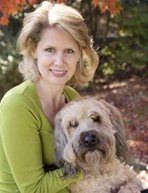
MELINDA MULLETAbout Melinda Mullet: Melinda was born in Dallas and attended school in Texas, Washington D.C., England, and Austria. She spent many years as a practicing attorney before pursuing a career as a writer. Author of the Whisky Business Mystery series, Mullet is a passionate supporter of childhood literacy. She works with numerous domestic and international charities striving to promote functional literacy for all children. She lives in Washington, D.C., with her family.

Posted in Archives, June 2019, Uncategorized | Tagged , , , , , , , | 1 Comment

What’s Been Happening on Bay Island?

SPIRITED AWAY BANNER 540

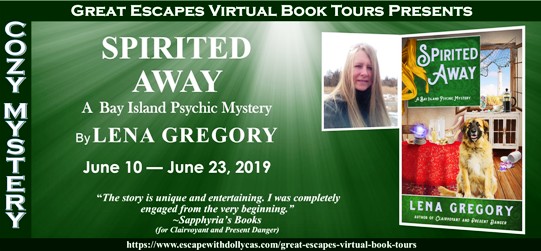
Today Lena Gregory, author of the Bay Island Psychic Mysteries, is visiting Ascroft, eh? to tell us about a couple of her brushes with the unexplained.

Welcome, Lena. I’ll turn it over to you:

Lena: Have you ever had a brush with the paranormal? And encounter you couldn’t quite explain away, no matter how hard you tried to convince yourself there was a logical explanation? I’ve had several over the years, but I’ll only share a couple.

I have three kids, and not one of them slept through the night, so I can only assume it’s something I did wrong. Of course, neither my husband nor I sleep through the night either, so I guess it’s no surprise.

Anyway, one night, when my middle guy, Nicky, was around a year and a half old, he just would not go to sleep. I was so exhausted I couldn’t keep my eyes open another minute, and I was afraid to bring him in my bed for fear he’d fall down the stairs if he got up and wandered, which he did even then, so I crawled into the crib with him and closed my eyes.

The next thing I knew, someone was shaking my shoulder. Startled, I opened my eyes and looked up, fully expecting to find my husband standing over me wondering what in the world was going on, but there was no one there. I was absolutely positive a hand had gripped my shoulder and shaken me, so I sat up and looked around the room, figuring either my husband or my ten-year-old daughter had tried to wake me then walked away when I didn’t respond.

When I looked down, I didn’t see Nicky. Terrified, I jumped up and found him tangled in the blanket. I quickly unwrapped the blanket from his head. His face was beet red, and he was breathing hard but, thankfully, he was okay. It might have ended much differently if something hadn’t nudged me awake that morning. When I finally calmed down enough to get up, my husband and daughter were both still asleep and hadn’t been up to wake me.

To this day, eighteen years later, I still get chills and hug my son whenever that memory surfaces.

On a lighter note, I used to teach dance for a living, until Nicky was about three. I’d always brought my kids to the studio with me while I was teaching, but he couldn’t handle the noise. The kids talking and laughing, the music blasting, tap shoes hitting the wood floor, all proved to be too much for him. He would always want to be in my arms with his hands over his ears.

Within the year, he was diagnosed on the autistic spectrum. He needed physical therapy, occupational therapy, and speech, so I gave up teaching and started cleaning houses to give me the flexibility necessary to bring him to therapy five days a week.

One of the houses I took was a beautiful, old house on the bay. The view was gorgeous, as was the house, which was built in the 1800s. One of the first times I went in to clean, I put the garbage pail back in the bathroom beside the shower. Then I realized there was an old stain beneath the pipe under the sink where the pail had been. I figured it must leak sometimes and put the pail back under it. When I returned a few minutes later, the pail was beside the shower again.

That freaked me out a little, but I figured maybe I’d left the floor a little wet and it slid over a couple of feet, or maybe I’d meant to put it under the pipe but then forgot to actually do it. So, I made sure the floor was dry and put it back. The next time I looked in the bathroom, it was back beside the shower. Needless to say, that’s where it stayed that time.

Every time I returned to the house after that day, I put the pail under the pipe and it stayed where it was.

Then, one day, I was in the basement doing laundry when there was a weird sort of scratchy, tapping sound. It was coming from the ceiling rafters in the basement beneath the foyer. It definitely freaked me out, but I finally decided it must be mice or something, and I filed the incident away to use in a book somewhere down the line—which I haven’t yet but still intend to.

When the homeowner asked how everything was going and if I was finding everything okay, I told her everything was fine, but I thought the house was haunted, and I sort of laughed.

She laughed too and asked me what had happened.

I told her about the garbage pail, but not the tapping, since I’d already explained that to myself.

She then told me the house definitely was haunted, and what was now the foyer was originally a bedroom, and someone died in there. She also said they often here a strange knocking sound in the foyer.

The existence of the unexplainable has always fascinated me. Is there truly a world beyond our own that sometimes overlaps with ours? Or are we just creatures with extremely vivid imaginations?

Cass Donovan, from my Bay Island Psychic Mysteries makes a living delving into that world, “contacting” the dead. At least, that’s what her customers think. She thinks she’s just very intuitive. What do you think?

Have you ever had a brush with the paranormal?

Thanks for telling us about your otherworldly encounters, Lena, and good luck with Spirited Away, the latest book in the Bay Island Paranormal Mystery series.

Readers can learn more about Lena and her writing by visiting her website and her Facebook and Goodreads pages. You can also follow her on Twitter and sign up for her newsletter.

Here’s a peek into some of the happenings in her novel, Spirited Away:
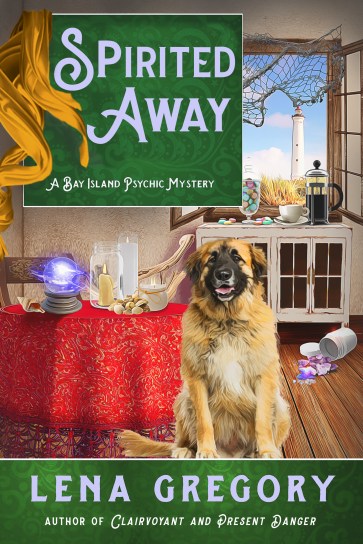
Spirited AwayWith the summer tourist season on Bay Island in full swing, shop owner Cass Donovan barely has a minute to breathe, and things at Mystical Musings become even more hectic when a fight breaks out at one of her psychic readings. Shaken by the fracas and discouraged that her sixth sense seems to be on the blink, Cass is even more dispirited to learn that one of the men involved in the altercation was later found dead—and that a close friend of hers is the main suspect.

Desperate to help her friend prove his innocence and consumed by haunting visions, Cass follows the clues from one possible culprit to the next, including some very mysterious tourists and not a few questionable locals. And when the police turn to Cass to help them find out who committed the ghoulish deed, she knows she’ll have to tread carefully, because her next grim premonition may be her last.”

The novel is available at the following online retailers:

Amazon – B&N – Kobo – Google Play

lena-gregory-portraitAbout Lena Gregory: Lena is the author of the Bay Island Psychic Mysteries, which take place on a small island between the north and south forks of Long Island, New York, the All-Day Breakfast Café Mysteries, which are set on the outskirts of Florida’s Ocala National Forest, and the Puzzle Solvers Mysteries, which take place in a small town on eastern Long Island. Lena grew up in a small town on the south shore of eastern Long Island, where she still lives with her husband, three kids, son-in-law, and five dogs. Her hobbies include spending time with family, reading, jigsaw puzzles, and walking. Her love for writing developed when her youngest son was born and didn’t sleep through the night. She works full time as a writer and a freelance editor and is a member of Sisters in Crime.


Posted in Archives, June 2019, Uncategorized | Tagged , , , , , | 4 Comments

What Will She See In His Eyes?

LOVE LIES AND AZURE EYES BANNER 540

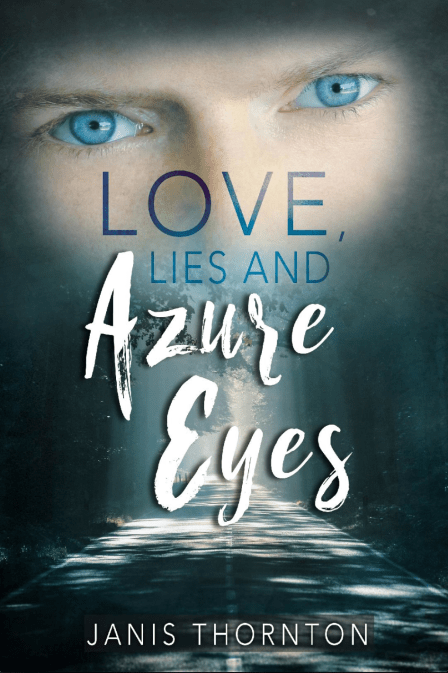
Janis Thornton is visiting Ascroft, eh? today to tell us about Love, Lies and Azure Eyes, her romantic suspence novel.

Welcome, Janis. Let’s get started, shall we?

Tell us about your novel. Is it part of a series? If so, please tell us about the series, too.
JT: “
Love, Lies, and Azure Eyes” tells what happens when freelance journalist Annie Sinclair journeys from Los Angeles to her rural Indiana hometown to investigate the 25-year-old unsolved murder of her high school classmate, Shelayne Goodnight. Unexpectedly, Annie comes face to face with the ghost of another classmate, Johnny Lange, the boy accused of killing Shelayne. While Annie helps Johnny find Shelayne’s killer, he helps Annie find her happily-ever-after. “Love, Lies, and Azure Eyes” is all about possibilities for second chances, righting old wrongs, and finding love that lasts forever.

It is a stand-alone, and I have no plans for a sequel … but who knows?

Where did the idea for the mystery that is central to the story come from?
AzureEyesCoverJT
: The inspiration for my story is derived from a tragic incident that rocked my hometown during my senior year of high school. The incident was the mysterious death of a girl in my class whose body was found along a remote country road two days after she went missing. One of the suspects was another of my classmates, a boy who unfortunately was killed in a car crash six months later. Today, even after almost 54 years, the girl’s death remains unsolved, and many people in town still insist her killer was the boy.
I’ve always been bothered by my classmates’ tragic endings and never stopped wondering why she died and who abandoned her on that road. Because it’s unlikely I will ever know, I concocted my own answers by novelizing their stories.

Is there a theme or subject that underlies the story? If so, what prompted you to write about it?
JT
: Themes can be tricky because they are often difficult to identify. “Love, Lies, and Azure Eyes” is driven by a number of underlying themes — among them are doubt, regret, deceit, injustice, vindication, forgiveness, rebirth, and love. But, by far, love drives most of the story. And in this instance, love is explored not simply as romantic love, but also familial love, love between friends, unrequited love, controlling love, self love, and true love.

How do you create your characters? Do you have favourite ones? If so, why are you partial to them?
JT
: I must admit that when I’m developing characters for a new writing project, everyone I know is fodder. It’s fortunate for authors that gestures, facial expressions, vocal intonations, body types, attitudes, habits, etc. aren’t subject to copyright. If they were, we’d be in trouble.

All my characters are like children to me, so I can’t help but love them all. (Even the dastardly Logan McKuen.) One of my most favorites is Annie’s father, Charlie Sinclair. That’s because I loosely based him on my own father, Bill Thornton. My dad was not a gruff man, as Charlie is, but Charlie is a good and honest man like my dad. Also, my dad had a habit of calling me “Girl” from my earliest memory of him until the day he died. Like my dad, Charlie calls his daughter “Girl” instead of her name. For these reasons, when I reread passages in the book that feature Charlie, I see and hear my dad, and that’s why I’m partial to Charlie.

How do you bring to life the place you are writing about?
JT
: My fictional town in which this story is set is much like my hometown — a small farming community in central Indiana with an abundance of colorful settings. Using some of those surroundings in the story helped me inject authenticity into the backdrop as my characters go about their business.

In addition, I attempted to breathe life into the settings by describing selective details that appeal to the reader’s five senses — sight, smell, sound, taste, and touch. Sometimes it’s difficult to write all five into a scene, and sometimes appealing to all five isn’t necessary. However, there’s a balance that must be struck. Too little sensory detail may cause the reader to get lost in the narrative. Include too much and they will nod off.

What research do you do to provide background information to help you write the novel?

JT: Even though “Love, Lies, and Azure Eyes” is a work of fiction, I often paused while I was writing it to refer to my file of news clips about the true incident that inspired my story. I wanted to be sure my version captured the essence of the original. I also developed a timeline to ensure that the sequence of events in the book flowed properly. I’m also grateful for Google. Whenever I encountered details I wasn’t familiar with, such as wine and firearms (not necessarily in the same scene), I consulted Google. It helped me to, at least, “sound” like I knew what I was writing about.

Is there anything else you’d like to tell readers about the book?
JT
: “Love, Lies, and Azure Eyes” is my third novel, and while I’m proud of the other two, this one means the most to me. A great deal of the story is personal, and my heart and soul are woven into every page. Thank you, Dianne, for this opportunity to tell your visitors about my new book.

Thanks for answering my questions, Janis, and good luck with Love, Lies and Azure Eyes. I’m sure the fact that the story is based on real events in your own community will particularly speak to readers. It has certainly intrigued me.

Readers can learn more about Janis and her writing by visiting her website and her blog, as well as her Facebook and Goodreads pages.

The novel is available online at Amazon.

JanisThornton1


About Janis Thornton: Janis is the author of a true crime/oral history/memoir, Too Good a Girl, as well as two cozy mysteries, Dust Bunnies & Dead Bodies and Dead Air & Double Dares. She also is the author of two local history books and contributor to Undeniably Indiana. She is a member of Sisters in Crime, the Authors Guild, and the Indianapolis Writers Center. She lives in her Indiana hometown in the same house where she grew up.

Posted in Archives, June 2019, Uncategorized | Tagged , , , | 1 Comment

What A Way To Go

SCONED TO DEATH BANNER 540

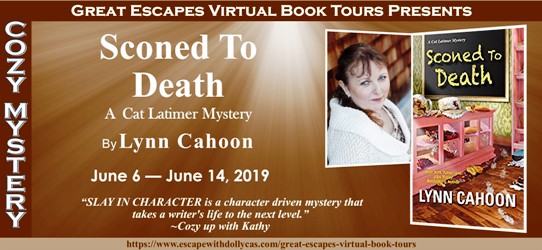
Today Lynn Cahoon is visiting Ascroft, eh? to tell us about Sconed to Death, her latest novel in the Cat Latimer mysteries series.

Welcome, Lynn. Let’s get started, shall we?

Tell us about your novel. Is it part of a series? If so, please tell us about the series too.

LC: SCONED TO DEATH is book 5 of the Cat Latimer series.  Cat is a YA author who opens a writers retreat in the house she inherited after her ex-husband’s death. She and her BFF run the retreat starting with A STORY TO KILL and her high school sweetheart joins the team to help get the house in shape.  When a famous author is killed during the retreat, Cat has to find the murderer to keep them from shutting her down.

We find Cat, Shauna, and Seth in SCONED TO DEATH at the start of a new retreat. But someone keeps calling the health department on Shauna’s kitchen.

Here’s the official blurb: Cat Latimer pursues a scone-cold killer who iced a top chef in a local bakery . . .

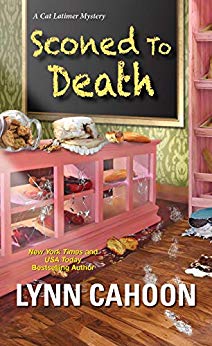
SCONED TO DEATHCat has a full plate at her Aspen Hills Warm Springs Resort, as a group of aspiring cozy mystery authors arrives for a writers retreat. So when baker Dee Dee Meyer stirs up trouble by filing a false complaint with the health inspector against the B&B—all because she insists Cat’s best friend Shauna stole her recipes—Cat marches into the shop to confront her.

But Dee Dee’s about to have her own batch of trouble. Greyson Finn—a celebrity chef and, until today, one of Denver’s most eligible bachelors—has been found dead in her bakery. Cat’s uncle Pete, who happens to be the chief of police, warns her not to engage in any half-baked sleuthing. But as her curiosity rises, Cat’s determined to discover who served the chef his just desserts—before the killer takes a powder.

Where did the idea for the mystery that is central to the story come from?

LC: I’m a huge Top Chef fan. Okay, so I love all the competition cooking shows. When I built this plot I had the jealousy of the bakery owner on my mind but who better to kill than a local top chef?

Is there a theme or subject that underlies the story? If so, what prompted you to write about it?

LC: I’m always writing about friendship, community, and relationships.

How do you create your characters? Do you have favourite ones? If so, why are you partial to them?

LC: Since I’m writing series, the main characters stay the same. Sometimes new townies are introduced and later, they might have a bigger role in an upcoming story. Shauna’s been front and center for a few books now. With her writing a cookbook, I can see a lot of possible futures for her and the cookbooks.  They’re all my favorites, but I do love Uncle Pete. Having a strong father figure in the books is important to me. (And my characters.)

How do you bring to life the place you are writing about?

LC: It’s all about setting. If you can imagine yourself in Aspen Hills walking the college campus or visiting Tammy’s bookstore, I’ve done my job. I also use Google to figure out what I need to know that my character would know about the area even though I build fictional towns. They are set in real areas.

What research do you do to provide background information to help you write the novel?

LC: I research the things I need to know. I’m not writing police procedural so I don’t have to deal with how many set of handcuffs a typical officer has on his belt. But I do need to know how a stunner works. Which I wrote wrong the first draft of a different book, but something was bothering me and I found it before I sent the book to my editor.

Is there anything else you’d like to tell readers about the book?

LC: There’s a recipe at the end of the book. I hope you try out Sconed and the rest of the Cat Latimer series. Set in Colorado, Aspen Hills is a place where I’d love to vacation or even live. So I satisfy the urge by letting my character live there.

Thanks for answering my questions, Lynn, and good luck with Sconed to Death, the latest book in the Cat Latimer Mystery series.

Readers can learn more about Lynn and her writing by visiting her website and her Facebook and Goodreads pages. You can also follow her on Twitter.

The novel is available at the following online retailers:

Amazon – B&N – Kobo – Google Play

LYNN CAHOON 1About Lynn Cahoon: Lynn is the award-winning author of several New York Times and USA Today bestselling cozy mystery series. The Tourist Trap series is set in central coastal California with six holiday novellas releasing in 2018–2019. She also pens the Cat Latimer series available in mass market paperback. Her newest series, the Farm to Fork mystery series, debuted in 2018. She lives in a small town like the ones she loves to write about with her husband and two fur babies.
 

Posted in Archives, June 2019, Uncategorized | Tagged , , , , | 4 Comments

Let’s drop into the Oakwood Book Club

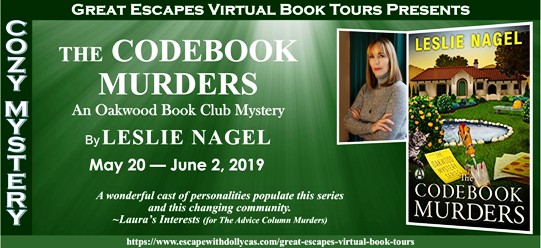
THE CODEBOOK MURDERS BANNER 540

Today Leslie Nagel is visiting Ascroft, eh? to tell us about The Codebook Murders, her latest novel in the Oakwood Book Club mystery series.

Welcome, Leslie. Let’s get started, shall we?

Tell us about your novel. Is it part of a series? If so, please tell us about the series too.

THE CODEBOOK MURDERSLNThe Oakwood Book Club Mystery Series follows the adventures of amateur sleuth Charley Carpenter, a young vintage clothing shop owner. She’s a lifelong resident of Oakwood, a wealthy insular suburb of Dayton, Ohio. Since things can get a bit dull, she and a group of friends formed a book club in which they read nothing but murder mysteries by female authors.

Charley’s semi-obsession with crime detection drew her into her first case, when someone close to her was killed. Not only that, but with the second murder in the case dubbed THE BOOK CLUB MURDERS, she realized that someone was using scenes from her book club’s reading list to stage the crime scenes. When she took proof to the police, she reconnected with a high school crush, Detective Marcus Trenault. He also helps her to solve cases—without becoming the next victim.

THE CODEBOOK MURDERS begins with a tornado that drives Charley into a creepy tunnel under the football stadium. She discovers a long-lost coded journal belonging to a high school girl murdered forty years before. The boyfriend was convicted of the crime, but he never stopped protesting his innocence. When Charley and her gang start investigating and a nosy reporter is killed, it’s clear this case is far from cold.

The ladies of The Oakwood Mystery Club draw inspiration from classic mysteries to solve baffling crimes. With each case, Charley’s skills and reputation as a sleuth—and her relationship with Marcus—continue to flourish.

How do you bring to life the place you are writing about? Where did the idea for the mystery that is central to the story come from?

LN: Oakwood, Ohio is a very real place. In fact, I’ve lived here all my life! While suburbia may seem dull to an outsider, there is plenty of intrigue happening just below the surface. Because I stage many scenes from each book in real places around town, bringing life to my settings is never difficult. Oakwood itself is almost another character in each story. It’s a beautiful little town, quiet and welcoming.

I got the idea for the first book when I was on the jogging trail that follows along an abandoned railroad track near my home. “What a perfect place to hide a dead body” just . . . jumped into my head. Once I stopped feeling creeped out, I ran home and started outlining. WHO would be killed, and WHY? WHY led to WHO did the killing? After that, I needed someone to solve the case.

I knew I wanted to have an amateur sleuth at the heart of my mysteries, and that it would be a young woman. The idea of using a book club as an engine for solving crimes came from a chance remark by a friend. We were in a book club and not enjoying the reading list very much. “Why can’t we read something fun, like murder mysteries?” she asked. Why, indeed?

THE CODEBOOK MURDERS was inspired by another very real landmark here in Oakwood. During an interview for our local rag, the Oakwood Register, the editor commented that he’d just been granted a peek at the long-forgotten tunnel that runs from the football stadium to the high school furnace room, built in the twenties for utility access. It was dark, damp and spooky, and he casually suggested that “it would make a marvellous place to hide a body.”

I get that a lot, actually.

The tunnel definitely seemed like a super place to start a new mystery, but I didn’t think a dead body would realistically go undiscovered for very long. But if not a body, then what else might lie hidden down there, perhaps for decades? And how could a lost object lead to an unsolved crime?

Is there a theme or subject that underlies the story? If so, what prompted you to write about it?

LN: Aside from the obvious goal of catching a killer, all of my stories revolve around the themes of family and community. Charley loves her father, who is wheelchair bound and requires a lot of support. Her growing relationship with Marcus adds another dimension to her personal life, one that creates potential conflict as she sorts out where her duty lies.

Protecting the ones she loves, as well as innocent bystanders who get drawn into the mystery, is a huge motivator for Charley. This personality trait is one that she and I have in common. Nothing is more important to me than family.

How do you create your characters? Do you have favourite ones? If so, why are you partial to them?

LN: Charley and her best friend Frankie are closer than sisters. Their hilarious banter and take-no-prisoners approach to any situation is a pretty good reflection of the dynamic between me and my oldest girlfriend from junior high and high school. Frankie drags Charley into joining a book club, then prods her into investigating their first case.

Marcus Trenault has been tougher to figure out. In the first two books, he’s actually kind of a jerk. It takes a combination of traumatic events and his growing feelings for Charley to get his head on straight. I had to try—then discard—several backstories for those two, before I found something that rang true to the Oakwood experience, a small town where everyone knows everyone else. Suburban living can result in some uncomfortable encounters. Some of us need more time than others to grow up and get over it.

What research do you do to provide background information to help you write the novel?

LN: I am not a former police officer, forensic scientist, coroner or attorney, so I turn to friends and family for critical details. And what did any writer do before the Internet?

I am currently writing the fifth book in the series, about a poison garden and a woman who is murdered in front of sixty witnesses. Researching poisons has been an interesting journey. I have a friend who’s an ER nurse; she has provided me with some pretty gruesome details that may—or may not!—make their way into the final mystery.

Is there anything else you’d like to tell readers about the book?

LN: I grew up reading Nancy Drew and the Hardy Boys. My favorite stories always involved solving a puzzle, following hidden clues, or cracking a code. THE CODEBOOK MURDERS will thrill any reader who loves those things, too.

In fact, I’ve got a little code breaking game on my website for fans who want to try their hand at sleuthing. Crack the code, send me the solution, and I will send you free bonus content, a secret prologue to the novel that didn’t make the final revision. It gives a glimpse into events that happened several years before Charley and Frankie became the sleuths they are today!

Thanks for answering my questions, Leslie, and good luck with The Codebook Murders, the latest book in the Oakwood Book Club mystery series.

Readers can learn more about Leslie and her writing by visiting her website and her Facebook and Instagram pages. You can also follow her on Twitter.

The novel is available at the following online retailers: 

Amazon – B&N – Kobo –  Google Play

LESLIE-NAGELAbout Leslie Nagel: Leslie is a writer and teacher of writing at a local community college. Her debut novel, “The Book Club Murders”, is the first in the Oakwood Mystery Series. Leslie lives in the all too real city of Oakwood, Ohio, where murders are rare but great stories lie thick on the ground. After the written word, her passions include her husband, her son, and daughter, hiking, tennis and strong black coffee, not necessarily in that order.
 

Posted in Archives, May 2019, Uncategorized | Tagged , , , , , | Leave a comment

I’m Seeing Red Today

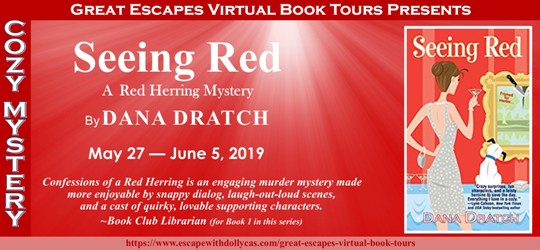
SEEING RED BANNER 540

Today Dana Dratch is visiting Ascroft, eh? to tell us about her latest novel in the Red Herrings mystery series.  

Welcome, Dana. Let’s get started, shall we?

Tell us about your novel. Is it part of a series? If so, please tell us about the series too.

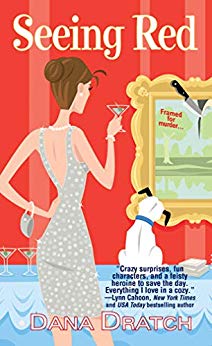
SEEING RED coverDD: Hi Dianne, and thanks for hosting me! Seeing Red is the second mystery in the Red Herring series. It centers around Alex “Red” Vlodnachek, a 30-something former reporter turned freelance writer.
This one opens with a one-two punch for Alex. She’s attending a glamorous party in a large Victorian mansion – very 1920s with jazz, cocktails and a collection of intriguing strangers. As a thunderstorm rages outside, there are power outages, ghost sightings and all kinds of mischief. Then at dawn next morning, back in her own kitchen, she discovers an abandoned baby.

Where did the idea for the mystery that is central to the story come from?  

DD: No one is exactly as they describe themselves. (Check the height and weight on anyone’s drivers’ license!) And in a mystery, you can have a lot of fun with the idea that some of the characters are not what they appear.  Or, in the case of Alex’s grandmother, Baba, that what you see is just the tip of one very tough iceberg.

In Seeing Red, Alex matches wits with spies, art thieves and a professional killer. She finds two bodies that vanish before she can call the cops. Yet the two people stressing her the most are a colicky baby and her own mother.

Is there a theme or subject that underlies the story? If so, what prompted you to write about it?

DD: It’s all about family. Alex can’t turn away someone who needs help. And, in turn, her family is always there to give her a hand. Her younger brother, Nick, is staying at her house for a few months, along with his rescue puppy, Lucy. Alex tells it best:

“Nick was living with me temporarily. After a sudden career change and relocation from Arizona by way of Vegas. Followed by an even more sudden engagement that had recently crashed and burned. That was about the same time I’d launched my new freelance career. Which sounded a lot better on LinkedIn than saying I’d been accused of murder and fired. We Vlodnacheks had kinda had a rough couple of months. But, hey, we land on our feet.”

And in this one, you finally meet Alex and Nick’s mother, Eleanor. As Alex relays it:

“I didn’t even bother to check the peephole. I just threw open the door, Big mistake. A couple of months outside the newsroom, and I was already getting soft.

My mother stood on the porch. She was wearing a Chanel suit, L’Occitane perfume, and a sour expression. But it was clear where my supermodel sister got her knockout looks.”

How do you create your characters? Do you have favourite ones? If so, why are you partial to them?

DD: I love Alex because she never takes herself too seriously. And she’s real. When she finds the sleeping infant in her kitchen, she pauses to swipe a cookie from her brother’s latest batch. Because, you know, chocolate.

I love Trip because who wouldn’t want him for a best friend? He’s always up for fun, he’s willing to loan his Corvette at a moment’s notice for a good cause, and he doesn’t judge. He’s the one Alex calls when she’s planning to break into a room at the B&B. And he knows better than to try to talk her out of it. Instead, he’s Googling “how to pick a lock.”

And what can I say about Baba? There’s nothing Alex’ grandmother can’t do – except cook. Like Alex says, “She’s what I want to be when I get to her age – whatever that is.”

How do you bring to life the people and places you are writing about?

DD: Nothing beats having a reader say “I know that person” or “I recognize that place,” or “that happened to me!”

In this one, Alex takes Lucy to the new neighborhood dog park. And Lucy –independent thinker that she is – loves the park but decides that those teeter-totter things on the agility course are not for her. So the puppy completes the course her own way. Lucy-style. I think anyone who’s ever loved a quirky dog can relate.

What research do you do to provide background information to help you write the novel?

DD: The knowledge of news rooms comes from my own life. I used to be a reporter and, like Alex, I’m now a freelancer. (But not a redhead. Or a former murder suspect.)

Fordham, Virginia (the fictional Northern Virginia town where the Red Herring series takes place), is a mash-up of a few towns I know and love that are bedroom communities for big metro hotspots. I set it just outside DC because that’s familiar geography and it’s also one of the few places left that still has competing daily papers – which I needed for the first book, Confessions of a Red Herring.

As for the characters themselves, dog- and people-watching are favorite sports. If there’s someone near you sitting on a bench or at a nearby table wearing sunglasses and scribbling furiously, that’s probably me.

Is there anything else you’d like to tell readers about the book?

DD: Thanks for your interest in Alex and Seeing Red! If you’re craving a light mystery with a lot of humor and plenty of comfort food, check it out. If you like it, you’ll probably enjoy Confessions of a Red Herring, too. (And if you read that, you’ll find out why Alex became a freelancer and what really happened to her car.)

Thanks for answering my questions, Dana, and good luck with Seeing Red, the latest book in the Red Herrings mystery series.

Readers can learn more about Dana and her writing by visiting her website.

The novel is available at the following online retailers:

Amazon    B&N   Kobo   Google Play

About Dana Dratch: Dana is a personal finance writer and the author of CONFESSIONS OF A RED HERRING and SEEING RED. She’s currently working on the third Alex Vlodnachek mystery adventure, RED HOT. 

Posted in Archives, May 2019, Uncategorized | Tagged , , , , | 1 Comment