Today Nicole Evelina joins me to talk about Camelot’s Queen, the second book in her Arthurian legend trilogy. Welcome, Nicole.
Let’s get started, shall we?
Tell us about your novel.
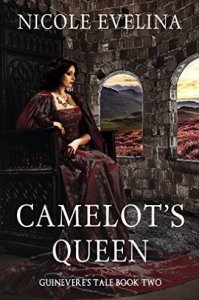 NE: Camelot’s Queen is the second book of my Arthurian legend trilogy that tells Guinevere’s life story from her point of view. This one focuses on the story we think we all know – Guinevere’s time as queen. (Her early life before King Arthur is told in Daughter of Destiny, the first book in the series.) All the familiar elements are there – the battles, the infamous affair, the Holy Grail – but they are told in a way that’s different from the medieval legends we’re familiar with. Guinevere is a battle queen who rules side-by-side with Arthur, rather than being in his shadow; her affair with Lancelot doesn’t happen simply out of lust – it’s actually Arthur’s fault; and the Grail is different than you’ve ever seen it. Plus, Morgan is a disrupting influence in a way I don’t think any other author has ever shown her. And I delve into the dark side of Arthurian legend surrounding Guinevere’s kidnapping which is something many authors have shied away from. No matter the situation, this is a Guinevere with agency, perfectly willing to rescue herself.
What prompted you to write about this historical event?
NE: I’ve loved the character of Guinevere my whole life; she was one of my childhood heroes. When I was in college, a friend gave me a copy of Marion Zimmer Bradley’s The Mists of Avalon as a gift. I read it and loved it (it changed my life in more ways than I can say), but I hated her portrayal of Guinevere as meek, Christian and agoraphobic. That led me to seek out other fictional books written about her and I came across Parke Godwin’s Beloved Exile, which covers her life after the fall of Camelot. That got me thinking that you don’t hear too much about what happened to Guinevere outside of her time with Arthur.
Around that time, Guinevere came into my head and said previous portrayals have done her wrong, and it was time for me to set the record straight. We made a deal that day that I would tell her whole life story, from before Arthur and encompassing the time after his death.
How closely did you stick to the historical facts? If you used them loosely, how did you decide whether to deviate from them?
NE: It’s really hard to know what is fact when it comes to Arthurian legend. No one can prove that King Arthur existed, much less that his wife was really called Guinevere. Pretty much all we know is that someone led a battle (which we call the battle of Mount Badon) in which the Saxons suffered a sound defeat that kept them from attacking the post-Roman Britons for the next 50 years or so – but even the historians can’t agree when or where that battle took place. It is from that unknown historical leader and a mixture of Celtic myth that the Arthurian story evolved.
I did a lot of research on the Celts and post-Roman Britain (see next answer) to try to make the time period as realistic as I could. But I also couldn’t resist keeping some of the magic and mysticism of the medieval tales, so I used those elements in a shamanistic manner that is in keeping with what little we know of the Celtic/Druidic faith.
What research did you do for this book?
NE: I spent about 15 years studying everything I could get my hands on about Arthurian legend, Celtic and post-Roman Britain, the Druid faith (historical and neopagan versions) and related topics so that I was as well-versed in the subject as I could be. Most of it was books, but I also watched several documentaries. A full list of the sources I consulted can be found here: https://nicoleevelina.com/the-books/guineveres-tale/daughter-of-destiny-book-1/guinevere-trilogy/
I was fortunate to consult with two men who helped Marion Zimmer Bradley with her research, Jamie George and Arthurian scholar Geoffrey Ashe, both of whom were so wonderful to me. I met Jamie when he led an Arthurian Legend tour of England I took a few years ago and he introduced me to Geoffrey.
Do you use a mixture of historic figures and invented characters in the novel. Which is more difficult to write? Which to you prefer to write and why?
NE: Yes. I have a few historic figures such as King Vortigern, the Saxon leaders Alle and Octha, and the Pictish chief Caw in this book. I also have your standard mythological characters like Arthur, Guinevere, Lancelot, Merlin, Nimue, Viviane, Isolde, Morgan, etc. But I have characters I have totally made up, too, such as Sobian and Father Marius. They are all pretty much equal in my eyes as far as preference and difficulty are concerned. Because we don’t know much about the historical Dark Age/early Medieval figures, I’m not bound to tradition or fact like I would be with people from a later period and I have some creative leeway with them. Tradition plays a strong role in the mythological characters and I’ve chosen to keep a lot of the familiar elements, but I like to put my own twist on characters and events as well. That’s what makes my books a new contribution to the Arthurian tradition, not simply just a retelling.
In an historical novel you must vividly re-create a place and people in a bygone era. How did you bring the place and people you are writing about to life?
NE: Traveling there helped a lot. It gives an authenticity like nothing else. Even when you are writing about the distant past, knowing that the hills, mountains and rivers that you see are still pretty much the same, even if everything else has changed, gives you a bit of feeling of what the place must have been like. Every location has its own energy and when you’ve been there, you can incorporate it into your stories.
The rest was incorporating what I learned through research and what I imagined. I think having a strong sense of place and an understanding of the culture are key. But too, you have to have well rounded characters who think as much as possible in the way of the time. That being said, the basics of human nature don’t change, so having characters people can relate to, not matter if they love them or hate them, goes a long way toward making the reader feel like they are part of the story.
There often seems to be more scope in historical novels for male characters rather than female characters. Do you prefer to write one sex or the other. And, if so, why?
NE: This is exactly why I write historical fiction. I’m very much a first-person, female POV writer. My personal mission is “to rescue little-known women from being lost in the pages of history. While other writers may choose to write about the famous, I tell the stories of those who are in danger of being forgotten so that their memories may live on for at least another generation. I also tell the female point of view when it is the male who has gotten more attention in history (i.e. Guinevere to King Arthur).” I feel like women’s stories have been massively undervalued and certainly underreported, so I make it my job to do what I can to change that.
That’s not to say you won’t ever see me writing in the male POV, but when you do it will be in the context of a female-based story. For example, I plan to write the story of Isolde and Tristan from multiple first person POVs, including his, but the focus of the story will be on her.
Thank you for your insightful answers to my questions, Nicole. I share your enthusiasm for the stories of the women who are often sidelined in history books and wish you well with your trilogy.
Readers can learn more by visiting her website/blog and she can be found on Twitter as well as on Pinterest, Facebook, Goodreads, Instagram and Tumblr.
About Nicole Evelina: She is a St. Louis historical fiction and  romantic comedy writer. Her debut novel, Daughter of Destiny, the first book of an Arthurian legend trilogy that tells Guinevere’s life story from her point of view, has been short-listed for the Chaucer Award in Early Historical Fiction. Camelot’s Queen is its sequel.
Later this year, she will release Been Searching for You (May 10), a romantic comedy that won the 2015 Romance Writers of America (RWA) Great Expectations and Golden Rose contests, and Madame Presidentess (July 25), a historical novel about Victoria Woodhull, America’s first female Presidential candidate, which has been short-listed for the Goethe Award in Late Historical Fiction.
She hopes to have the final book in Guinevere’s Tale available in late 2016 or early 2017.
Nicole is one of only six authors who completed a week-long writing intensive taught by #1 New York Times bestselling author Deborah Harkness. She has traveled to England twice to research the Guinevere’s Tale trilogy, where she consulted with internationally acclaimed author and historian Geoffrey Ashe, as well as Arthurian/Glastonbury expert Jaime George, the man who helped Marion Zimmer Bradley research The Mists of Avalon.
Nicole is a member of and book reviewer for the The Historical Novel Society, and Sirens (a group supporting female fantasy authors), as well as a member of the Historical Writers of America, Women’s Fiction Writers Association, Romance Writers of America, the St. Louis Writer’s Guild, Women Writing the West, Broad Universe (promoting women in fantasy, science fiction and horror), Alliance of Independent Authors and the Independent Book Publishers Association.
She spent 15 years researching Arthurian legend, Celtic Britain and the various peoples, cultures and religious practices that shaped the country after the withdrawal of Rome. Other historical interests include the Middle Ages and women who made their mark on history. She’s also a frequent visitor to Chicago, where Been Searching for You takes place.

 Here’s how the publisher, Thomas & Mercer, describes the novel: “England, 1185. John is a prince without prospect of a crown. As the youngest son of Henry II, he has long borne the hated nickname ‘Lackland’. When warring tribes and an ambitious Anglo-Norman lord threaten Henry’s reign in Ireland, John believes his time has finally come. Henry is dispatching him there with a mighty force to impose order.
 About E.M. Powell: E.M. Powell’s medieval thrillers The Fifth Knight and The Blood of the Fifth Knight have been number-one Amazon bestsellers and on the Bild bestseller list in Germany.
 hemisphere, winter for those in the southern hemisphere. It’s more or less, half way through the year.
 As a Private Investigator, Jenna Preston had been hired to help solve murders, insurance fraud, cheating spouses and more. This was a new one for her.
 “Jenna, you’ve seen how difficult and fussy they can be, and their egos—they’re constantly seeking confirmation of how beautiful they look. They want to come to a high-end salon, expecting to be treated like royalty. And believe me, we do.”
 About M. Glenda Rosen: She is the author of The Woman’s Business Therapist: Eliminate the MindBlocks and RoadBlocks to Success, and award-winning My Memoir Workbook. For over fifteen years, she helped numerous authors develop and market their books, and presented writing programs in New York, The Hamptons, New Mexico and Carmel, California, on “Encouraging and Supporting the Writer Within You!” She’s the founder and owner of a successful marketing and public relations agency for twenty-five years.
 JA: Against the background of Chicago history in the last half of the 19th century, The Gilded Cage tells the story of Potter and Bertha (Cissy) Honoré Palmer. He was a prominent businessman and builder of the city, owner of the still-operating Palmer House Hotel; she was one of the first socialites to believe that wealth carried an obligation to philanthropy and to put her belief into actions beyond monetary donations. Her greatest accomplishment came as president of the Board of Lady Managers at the 1893 Columbian Exposition.
 About Judy Alter: She is the award winning author of fiction for adults and young adults. Other historical fiction includes Libbie, the story of Elizabeth Bacon (Mrs. George Armstrong) Custer; Jessie, the story of Jessie Benton Frémont and her explorer / miner / entrepreneur / soldier / politician husband; Cherokee Rose, a novel loosely based on the life of the first cowgirl roper to ride in Wild West shows; and Sundance, Butch and Me, the adventures of Etta Place and the Hole in the Wall Gang.
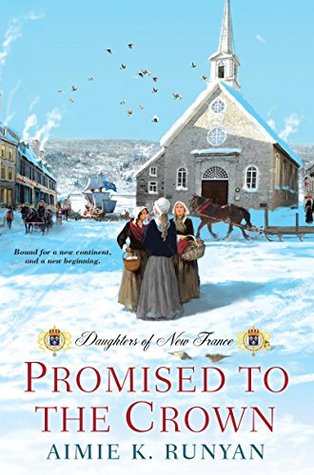 AKR: Promised to the Crown tells the story of three very different women who chose to accept Louis XIV’s offer to travel to his colony in Canada, then known as New France, in order to choose husbands from among the legion of bachelor settlers. The King needs women to help increase the population to hold the colony from the British menace and to tie the men to the land. France was in a time of relative prosperity, yet 770 brave women answered the call to go to the frozen north. Elisabeth, Rose, and Nicole face hardships and triumph in the new world, and the friendship they forge on their crossing sees them through it all.
 About Aimie K. Runyan: A member of the Rocky Mountain Fiction Writers and Women’s Fiction Writers Association, she has been an avid student of French and Francophone Studies for more than fifteen years. While working on her Master’s thesis on the brave women who helped found French Canada, she was fortunate enough to win a generous grant from the Quebec government to study onsite for three months, which enabled the detailed research necessary for her work. Aimie lives in Colorado with her husband and two children.
 Gathered at their childhood home to mourn their father’s death, Ally D’Aplièse and her five adoptive sisters receive tantalizing clues to their distinct heritages. Ally soon finds herself in Norway where she begins to make sense of her elusive past in the second part of an epic new series by #1 internationally bestselling author Lucinda Riley.
 About Lucinda Riley: She was born in Ireland and wrote her first book aged 24. Her novel ‘Hothouse Flower’ (also called ‘The Orchid House’) was selected for the UK’s Richard and Judy Bookclub in 2011 and went on to sell 2 million copies worldwide. She is a multiple New York Times bestselling author and has topped the bestseller charts in four European countries.
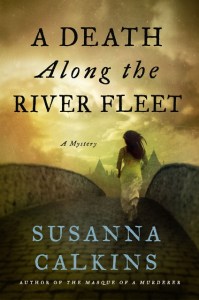 SC: A Death Along The River Fleet opens with Lucy Campion, 17th century printer’s apprentice and bookseller, on her way to deliver some books to a customer several miles from her shop. As she crosses the River Fleet and enters the vast wasteland created by the Great Fire of London of 1666, she encounters a strange woman who speaks of being chased by the Devil. The woman is barefoot, clad only in a shift, covered in blood that is not her own, and unable to remember her identity. Worried that the woman will be set upon by fearful villagers, Lucy brings the woman to the home of a physician she knows. When they suspect that the woman may be a noblewoman, the physician does not wish to throw her out of her house and presses Lucy to tend the woman while the woman’s family is being located. To make matters more strange, the body of a murdered man is found in the ruins nearby, and the odd woman may well be the murderess.
 SC: This time period in British history fascinates me generally. King Charles had only been restored to the throne for several years (following two decades of more repressive Puritan rule) when the plague struck, followed soon after by the Great Fire. Those events completely disrupted families and communities in London, as people died, or fled from the area. Not only was there a great deal of identity theft (servants could become masters and appropriate titles, property and wealth) but there were also unheralded job opportunities. Lucy was able to avoid some of the patriarchal strictures of her time, by finding a way to become a printer’s apprentice (even if the stationer’s guild does not formally accept her).
 SC: I try to balance accuracy and authenticity. I try to be as accurate as possible, using period maps and primary sources to help me with details, and scholarly secondary sources to help me make sense of the larger social, cultural, religious and political trends. But there were certainly a few things that I had to simplify—for example, there was no police force at this time period, so I had to give my constable a broader range of duties and powers that were probably a bit exaggerated.
 SC: I created every character in my book. I do reference historical figures like King Charles II or the diarist Sam Pepys, but those details just serve to enhance the larger historical backdrop. I made the decision a long time ago not to use real historical figures, because I think I would feel too limited in what I could let the character say or do or act. I would want to be scrupulous in the way I portrayed this person, and that just seems very challenging.
 About Susanna Calkins: Susanna became fascinated with seventeenth-century England while pursuing her doctorate in British history and uses her fiction to explore this chaotic period. Originally from Philadelphia, Calkins now lives outside of Chicago with her husband and two sons. A Death Along the River Fleet is her fourth novel.
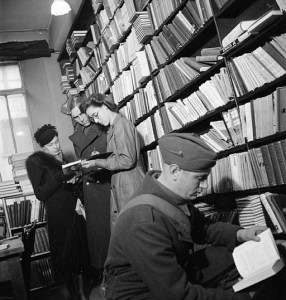 Today I’ve been chatting with Vanessa Couchman on her blog about how to meet wartime fiction readers’ expectations, even when your story isn’t set in one of the places where they expect to find themselves when they open the book and turn to the first page. Since I’m writing the Second World War saga series, The Yankee Years, set in Northern Ireland during the war, I’ve had a bit of experience with this quandary.
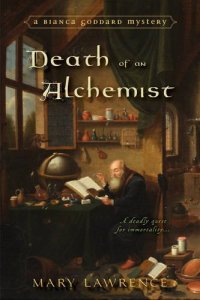 ML: Death of an Alchemist is Book 2 in the Bianca Goddard Mysteries, a new series set in the final years of King Henry VIII’s reign. The series features the estranged daughter of an infamous alchemist who makes medicines for the sick. She combines herbal knowledge (learned from her mother) with alchemy (learned from her father). Death and murder are quite common in Tudor London. Bianca has a curious mind and seeks to understand disease as well as what motivates people to murder.
 About Mary Lawrence: She studied biology and chemistry, graduating from Indiana University with a degree in Cytotechnology. Along with writing and farming, Lawrence works as a cytologist near Boston. She lives in Maine.







 dianneascroft.com