
Nurpur Tustin is visiting Ascroft, eh? to tell us about Death of a Soprano, her latest novel in the Joseph Haydn Mystery series.
Welcome, Nurpur. Let’s get started, shall we?
Tell us about your novel. Is it part of a series? If so, please tell us about the series too.
Death of a Soprano is the fifth mystery in the Joseph Haydn Mystery series. The series is set in eighteenth-century Austria-Hungary with the renowned composer Joseph Haydn as the protagonist.
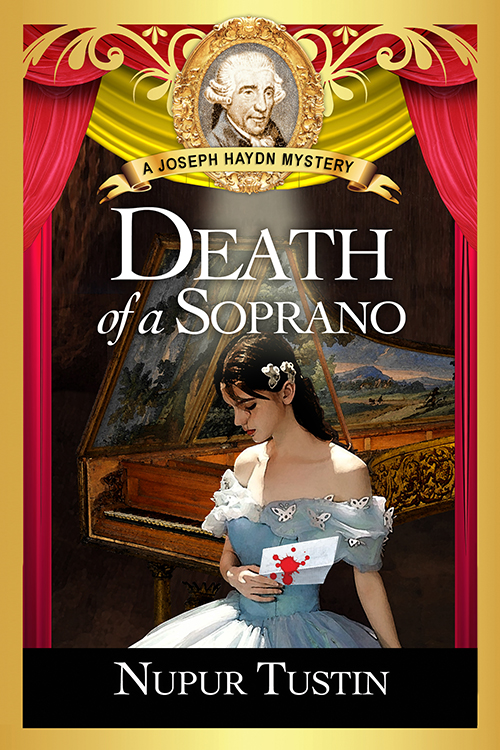
Haydn was the perfect person to cast in the role of detective. The qualities that made him a successful Kapellmeister—Director of Music—also make him well suited for the position of amateur sleuth. As a man who was ever discreet, eager to help, diligent, and responsible, there was never any shortage of people who sought his help and advice in real life.
The son of humble parents who’d risen to great heights, Haydn was comfortable consorting with people of all ranks. And in the Haydn Mysteries, a great number of people do seek his help: from Princes and Empresses to violinists, singers, and Bϋrgermeisters.
In Death of a Soprano, Haydn has been tasked with keeping an eye on young Archduke Ferdinand Karl, a younger son of the Empress Maria Theresa. The Archduke is meeting his bride-to-be, Maria D’Este, for the first time, and as was her wont, the Empress sought detailed reports about the meeting from as many people close to the situation as possible.
Haydn, as you can imagine, takes this role seriously. So the news that someone is blackmailing the Archduke comes as a shock. His suspicion that the blackmailer might be his beautiful prima donna, Lucia Pacelli, is confirmed when the poor woman crashes to her death in the middle of an opera.
You can imagine who his prime suspect is! The Archduke, a mere boy of seventeen who’s been entrusted into Haydn’s care. Haydn is naturally deeply conflicted. But if the boy, young as he is, has resorted to murder, Haydn can’t in all good conscience subtly persuade Maria Beatrice D’Este to accept him as her husband.
His loyalty to the Empress and to the Habsburgs clashes with his duty to God and his sense of justice. He’s compelled to investigate—a woman is dead and the situation could jeopardize the marriage alliance. But Haydn dreads the thought of what he might discover.
Where did the idea for the mystery that is central to the story come from?
The idea was inspired by a brief entry in the Oxford Composer Companion to Haydn. Barbara Dichtler, a longtime soprano at the Esterházy court, had died in the middle of a performanceof Sacchini’s L’isola d’amor. I imagine she must’ve suffered a heart attack or perhaps a brain aneurysm. There’s certainly no indication of foul play or faulty rigging. But as a mystery writer, that’s where my imagination went.
What if it had been murder? How had it been done? Who was the killer? And why?
And I couldn’t help wondering how Haydn, the librettist, and the performers had continued on after their prima donna died in the middle of a performance. What could you possibly do in such a situation? The thought of writing a scene that fleshed out the details was a challenge I couldn’t pass up!
Is there a theme or subject that underlies the story? If so, what prompted you to write about it?
In this mystery as in many of the others, there’s always a conflict between Haydn’s duty to his employer as well as the Empress and his conscience, his duty to God. But there’s a more important underlying theme that developed quite organically: the concept of mutual trust in a relationship.
In a sense this is a question that’s consumed my mind my entire life. When I was very young, I recall my mother reading me a fairy story about a girl who was married to an ogre—it may have been a version of Bluebeard. I was very troubled by the thought that this girl had inadvertently yoked her lot to such a terrible person. Was there any way of avoiding this? How did you ensure such a thing didn’t happen to you?
So in my childlike way, I asked my mother if she’d known my father before she’d married him. Had they lived together? In other words, how had she known he was the right man?
When you grow up in India and you hear awful stories about dowry killings or spousal abuse, you realize it’s very easy to marry in haste and repent at leisure. Of course, these stories are hard to avoid here in the United States as well. Almost every crime show is about husbands and wives betraying and killing each other. It’s nauseating.
I knew it was by the Grace of God that I’d met and married the right man. But how had I earned that grace? What advice could one give young people on the subject?
This plays out in Maria Beatrice’s constant questions to Haydn and in his attempts to guide her toward an answer. It was only last year—after fourteen years of marriage—that I received a semblance of an answer.
As we explore the idea of being united to each other, we need to bring our expectations of the relationship to each other. Do our values and expectations mesh? Here we need to let God—not our egos—guide us. After that, any good relationship is built upon trust and a willingness to be open and lovingly honest with one another. It’s Haydn’s youngest brother, Johann, who gives the bride this key bit of advice.
How do you create your characters? Do you have favourite ones? If so, why are you partial to them?
Since I’m writing about historical figures, my first goal is to ensure I’m true to their character. That means immersing myself in their lives, reading biographies, letters they might have written, diary entries, or any other material that gives me some kind of insight into their personality.
When this research isn’t available I have to work like a detective, using the clues that I have. For instance, the fact that Maria Beatrice D’Este’s father, the Duke of Modena, flagrantly violated his marital vows suggested to me that the bride might have trust issues. My contact at the Austrian National Library sent me material that confirmed this suspicion.
That Maria Beatrice D’Este was very close to her mother-in-law, Empress Maria Theresa, and that the two women corresponded frequently suggested that the two might be very similar. And that was confirmed as well. Like her mother-in-law, Maria Beatrice D’Este was a very devout woman, fond of her children, loving, but also quite strict. As a young woman, she’d been very fond of pleasure—dancing, riding, and the like.
When all else fails, I do have my imagination. But even so what I create is based on a small nugget of truth, whatever is available to me. In Maria Anna Haydn’s case, I knew she and her husband didn’t enjoy a very good relationship. So in my novel, they bicker quite a bit—or she does. She has a sharp tongue.
My husband says she speaks her mind so bluntly, she doesn’t have an “edit” function in her brain. She’s a challenge to write. But it’s one that I enjoy. I also enjoy writing about the maids, in particular, Greta, who, although she isn’t sharp-tongued, can be tactless.
How do you bring to life the place you are writing about?
This is a challenge, too. Twenty-first-century Austria and Hungary are very different from their eighteenth-century counterparts. Street names have changed. Some have ceased to exist. Others have been added.
The Musicians Quarters in Eszterháza, for instance, now houses the public library and city offices of Fertőd.
The same research that I use to investigate my characters provides me details of setting as well.
What research do you do to provide background information to help you write the novel?
When I immerse myself in Haydn’s life and times and I read letters written by contemporaries of his, I get an idea of what life was like at the time. Other details require more investigation. Sometimes I’ll look at eighteenth-century England or Colonial America for insight—into what ovens looked like and how they were used; or how measurements were taken for garments and wigs. Books on rigging and the technical developments that have taken place on the stage help with details pertaining to staging an opera.
Both for Murder Backstage and for Death of a Soprano, I’ve also made sure I have access to the libretto. These are in Italian, which I don’t know, or in German, which I remember quite a bit of. Even so I frequently need to use a translator.
The Director of the Bampton Classical Opera Company has been especially helpful in this regard.
For this particular novel, I also researched early modern courts—life and festivities, the role of dancing and hunting. Believe it or not, one’s deportment on the dance floor or on the horse spoke volumes about one’s character and one’s ability to govern others!
Is there anything else you’d like to tell readers about the book?
Extortion, scandal, and murder, Death of a Soprano has it all. Readers who’ve read an Advance Copy have found the characters entertaining and the mystery so suspenseful they’ve stayed up all night to read the book!
While most of my readers prefer reading the books in order, you don’t really have to do so to enjoy them. So don’t hesitate to pick up a copy—even if you’re new to the series. And if you subscribe to my newsletter (visit ntustin.com), you’ll get a coupon that takes 50% off the ebook price.
Joseph Haydn was a fascinating man, and I’d love to introduce you to him through this series.
Thanks for answering my questions, Nurpur, and good luck with Death of a Soprano, the latest book in the Joseph Haydn Mystery series.
Readers can learn more about Nurpur and her writing by visiting her website and her Facebook, Goodreads and Bookbub pages.
The novel is available at the following online retailers:
Buy Direct & Support the Author: Nurpur Tustin Shop

About Nurpur Tustin: A former journalist, Nupur Tustin relies upon a Ph.D. in Communication and an M.A. in English to orchestrate murder. She also writes the Celine Skye Psychic Mysteries based on the Gardner Museum theft. Childhood piano lessons and a 1903 Weber Upright share equal blame for her musical works.











 dianneascroft.com
Thanks for inviting me to your blog, Dianne. I enjoyed answering your questions.