

When I was growing up in Toronto, I always loved to see houses lit up for the holiday season. Nearly every house on our street was ablaze with Christmas lights and decorations. Some had multi-coloured flashing extravaganzas, others glittering white lights like brilliant snowflakes, and still others, my favourites, tranquil blue ones that had the power to mesmerize me. I loved the sense of peace the blue ones radiated. When I gazed at them, I would forget that I was in a bustling city. Especially after a fresh fall of snow, when they made me feel as if I was alone in a silent, untouched landscape.
At our house, the lights were a bit more modest. My grandfather was a frugal man and wouldn’t spend money on costly window adornments. We had two thin artificial wreaths, with electric candles set in them, hanging in our two front windows. The bulbs were only small but their artificial flames glowed red and welcoming as I returned home each evening. As I walked up the path to the house and saw them, I knew I was home and it was Christmas. (I shared this Christmas memory on Victoria K. William’s blog earlier this month. If you would like to read the full interview, you can find it here.)

I’m amazed that we had those wreaths in our windows at all as my family hated the idea of wreaths as Christmas decorations. When I asked why they shied away from them, they said that wreaths reminded them of funerals and death, and it made them sad.
I can understand why wreaths had such negative connotations for them. As adults they had experienced loss more often than I had as a teenager. But, since my experience was different to theirs, I didn’t have the same response at all. I found wreaths festive and cheery, and I would have loved to have them hanging in our house.
Wreaths have long been part of the traditions of many cultures. In ancient Greece and Rome, they were a symbol of victory, and laurel wreaths were used to crown the victors in war and athletic competitions.
In medieval Europe, ivy and holly were symbols of protection. Wreaths made from these plants were hung on the doors of family homes to ward off evil spirits during the harsh winter months.

Protection for crops has been a universal concern throughout the centuries. In diverse cultures, from ancient Greece to many parts of Europe, and in particular Scandinavia, wreaths were used for this purpose. Wreaths, made from the previous year’s crops, were hung to ensure the coming harvest was protected from harm.
Wreaths were also part of winter solstice celebrations and were believed to bring good luck and prosperity to households.
And, of course, wreaths are part of the rituals of mourning and funerals, and remembering and honouring the dead. While the sight of them makes us think of sad occasions and loss, their symbolism is meant to comfort mourners. The circular shape, which has no beginning or end, symbolizes eternal life. This meaning has been celebrated from ancient civilizations to modern Christian ones.
Weaving evergreen branches together to form wreaths, the early Christians incorporated pagan beliefs about evergreens into their practices to celebrate the triumph of the soul over death. Evergreen plants survive and thrive in the harsh winter months so they have been claimed as a symbol of resilience and hope.
And it’s their association with resilience and hope that I see in Christmas wreaths. Unlike my family who found them depressing, I find them heartening. I guess you can see the glass as half empty or half full. I’m generally a positive person so I embrace their encouraging symbolism. Evergreens are bright spots in the dark winter and provide hope of renewal and good fortune to come.
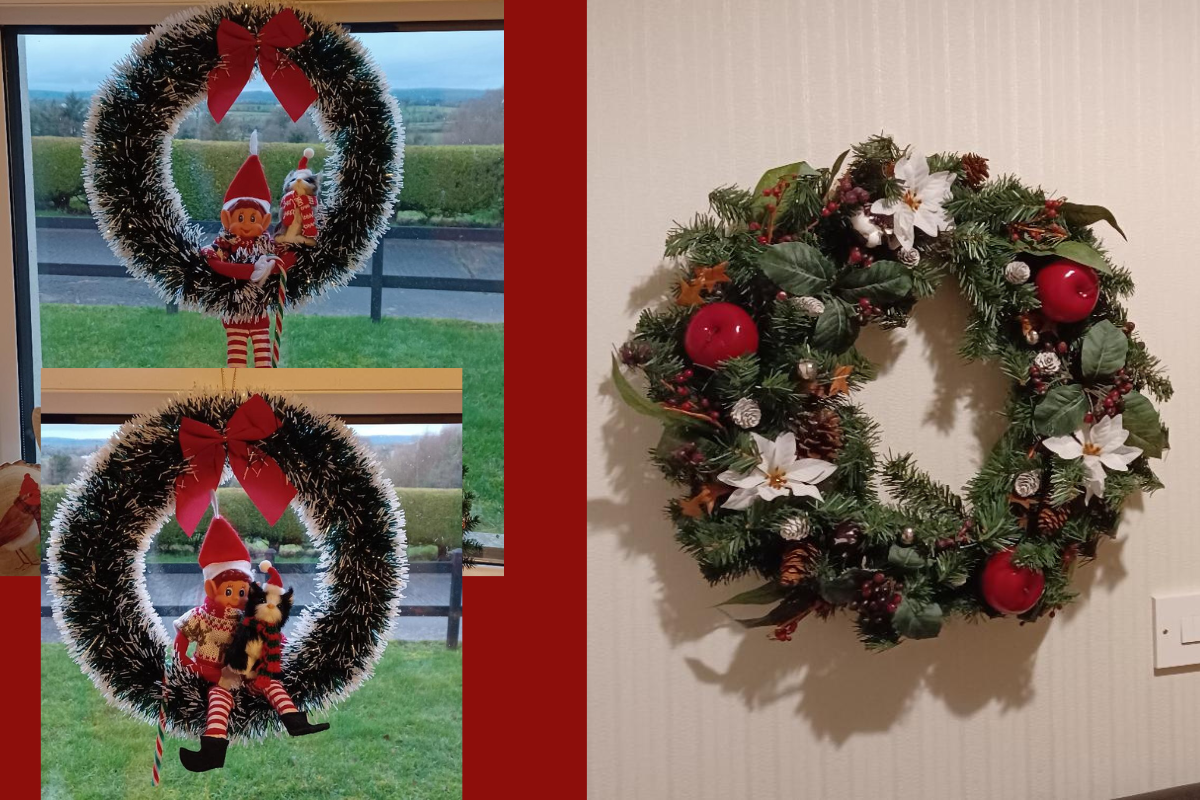
I have a large wreath in the hallway, decked out with red apples, white flowers and pine cones, to welcome visitors. And there are several smaller wreaths hung in the windows in the living room and dining room. These ones are plainer, made with green reflective material and single red bows. But when the light hits them, they glitter and sparkle. They are simple and beautiful.
Anyone who knows me, knows that my decorations don’t stop there. I love the soft glitter of Christmas, and our mantlepiece and living room windowsill are dotted with Christmas figurines. Holly and blue Christmas lights thread through them. And the tree stands on a table in the corner of the living room, decked with a plethora of ornaments I’ve collected since I was a child. The multi-coloured lights on it wink slowly in ever-changing colours, from red to green to blue.
So, there’s lots of holiday sparkle and cheer surrounding us and adding to our festive season. But I always take some quiet time each year to notice the wreaths too and remember their evergreen promise for that moment in time and the future.
I hope you enjoy the holiday season and take time to savour the parts of it that warm and encourage you.
Merry Christmas and best wishes for the coming year.










 dianneascroft.com