
Terri Karsten, author of A Necessary Death, is visiting Ascroft, eh? today.
Welcome, Terri.
Tell us about your novel. Is it part of a series? If so, please tell us about the series too.
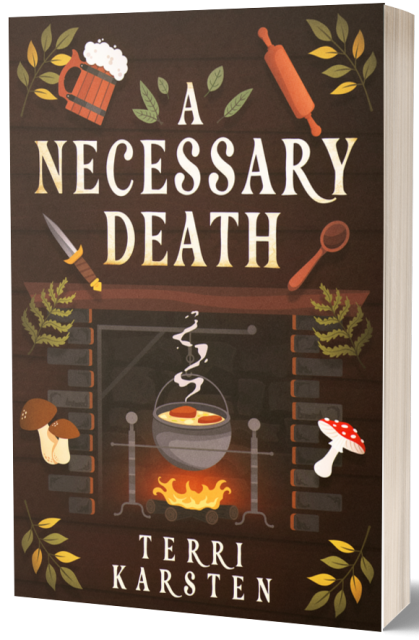
A Necessary Death is a cozy historical mystery set in colonial Pennsylvania. On the same day Penelope Corbitt hears her husband has died, she learns he gambled away their home, and she must sell everything she owns to pay off his debts. As she travels north with her two children to live off her stingy brother-in-law’s charity their coach crashes, leaving them stranded at a rundown tavern. When she stumbles upon a dead man in the tavern privy, she and Miles Tucker, tavern owner and town constable, join forces to figure out what happened to him.
A Necessary Death can be read as a stand-alone title, but it is the first in a three-book series set in the same tavern with the same main characters. All three books include recipes for some of the dishes Penelope serves in the tavern. The second in the series, A Player’s Exit, will be released in September 2026. In it, a traveling theater group arrives at the tavern. Before they settle in, one of their players is murdered.
Where did the idea for the mystery that is central to the story come from?
The germ of this story came from an article I read in a Smithsonian magazine several years ago. The article was about archeological excavations in Pennsylvania. The archaeologists had discovered the skeleton of a child buried in a tavern yard but provided no details about how or why he died. I kept thinking about this boy, imagining what might have happened for him to end up there, not in a cemetery. This novel is the result of the story I gave him. He may not have ever had a ‘happy ending,’ but in my version of his story, those who did him in, got what they deserved.
Is there a theme or subject that underlies the story? If so, what prompted you to write about it?
There are two main underlying themes in this story. The first is the question of justice: what is it, and how do people on the margins of society achieve it? When is it right to ignore the law and take matters into your own hands? The more I read about the American colonies, I realized that’s an important question throughout colonial and revolutionary American history. This theme surfaced because I really wanted to give that unknown boy some kind of justice.
The second subject running through the book is the idea of women’s role in making a home. I write about strong women, who take charge of their own lives in any way they can, but whose voices were less likely included in the historic record. There were legal limitations on women’s rights in the colonial period, but women could still make choices and had varying degrees of influence on those around them. One area where women have traditionally had a great deal of power is in their responsibilty for making a place into a home (think of the title ‘homemaker”). A house is just a place to live, but a home is where a family can thrive.
How do you create your characters? Do you have favourite ones? If so, why are you partial to them?
I start with the main character, giving her a name based on who she is and when she lived. I fill out a character sketch, including what she’s good at, what she’s afraid of, and most of all what she wants. I look at lots of pictures from the time period to figure out what she’s wearing and what she looks like. I give her traits she might need along with some traits that might get in her way. I get to know her better by putting myself in her shoes and asking what I would do in that situation. I spend a lot of time ‘living’ with my character before I ever start writing.
Once I know the main character pretty well, I develop supporting characters based on what kind of person the plot needs. I do a lot of character sketches, so I don’t forget who is who.
I’m very fond of Penelope Corbitt because she’s got the courage to do what she needs to do to keep her family safe. She’s a capable, stubborn woman, full of common sense and vinegar. She knows she’s right.
I’m also very happy with Miles Tucker, the tavern owner and town constable. I developed him as a foil to Penelope, never realizing how close they would become. He’s a man I would love to spend some time with. He may seem gruff and impatient, but he’s really kind and thoughtful, with a strong moral compass.
How do you bring to life the place you are writing about?
As a kid, I used to always play pretend, and I was really good at it, including my sisters and neighborhood kids in elaborate, ongoing scenarios. When I’m bringing to life a place that I’m writing about, I do the same thing I used to do as a kid. I close my eyes and pretend that I am there. To help me be in that place, I do a lot of research/ For these tavern mystery series, I took a road trip in Bucks County Pennsylvania visiting every historical tavern that I could find so that I could immerse myself in old-time tavern atmosphere. I take notes on smells, and lighting, and sounds and anything else I notice. Then I put these details together to make my own place. I draw a sketch of the building lay out and a map of the nearby town, so I can imagine the characters moving about and interacting with each other.
What research do you do to provide background information to help you write the novel?
It’s a good thing I love doing research, because historical fiction is best when it accurately reflects the world of the past. I’m trying to transport my readers to another time and place, so I need to know the general history, various social issues and attitudes, and how people lived. Besides reading about the era, I read materials written at that time, like diaries, journals, letters, and newspapers. I look up unusual or modern sounding words in the Oxford English Dictionary to see if the word might have been used. I look at pictures of clothing, people, and buildings to help me bring the story to life. I get the general knowledge before I start writing and then look for answers to specific questions as they come up during drafting. I love discovering little known facts and artifacts to give my characters, like the ivory jagging iron, used to crimp pie crusts, that I gave to Penelope.
I also do what I call experiential research which means that I try doing some things my characters would do. I’ve done quite of bit of historical reenactment, making and wearing period clothes, so I know what it feels like to wear a corset or cook over a fire. My main character is a cook and the dishes that she makes for the tavern are all dishes that I have made, adapted from recipes from colonial era cookbooks.
Is there anything else you’d like to tell readers about the book?
One thing readers may find surprising is that I have a diverse cast of characters in the book. History classes from school and many movies give a rather one-dimensional view of the colonial era, showing mostly English immigrants. In reality, there were a lot of different kinds of people in Pennsylvania at the time, including enslaved Africans, Black freedmen, various Indigenous people, indentured Germans, and many others. I wanted my book to reflect that diversity as a natural part of the landscape of that time.
Thank you for answering my questions, Maggie, and good luck with A Killer Romance, the latest book in the Beach Reads mystery series.
Readers can learn more about Maggie Blackburn by visiting the author’s website and her Facebook and Goodreads pages. You can also follow her on Substack.
The novel is available at the following online retailers:
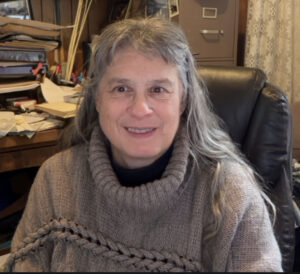
About Terri Karsten: Living in the shadow of the Mississippi River bluffs, Terri Karsten has been a writer and educator for many years. She grew up in sunny San Jose, California, playing amid the cherry orchards that soon gave way to houses. In her search for education and adventure, she lived in Iowa and Wisconsin, Mexico and France, before settling into a hundred-year-old house in Winona, Minnesota. She spends most days in her tiny office, surrounded by books, papers, and good memories.
With more ideas than time, Terri writes a bit of everything, ranging from historical fiction novels to picture book folktales to dozens of short stories and articles in magazines, encyclopedias, and newspapers.
When she is not writing, Terri loves poring over old cookbooks and recreating dishes from long ago, especially medieval, Renaissance, and colonial foods. Always ready for the next adventure, she enjoys camping, hiking, and traveling. Her latest goal is to visit National Parks in every state. Only 13 states to go!








great to ‘meet’ you through your blog, Dianne.