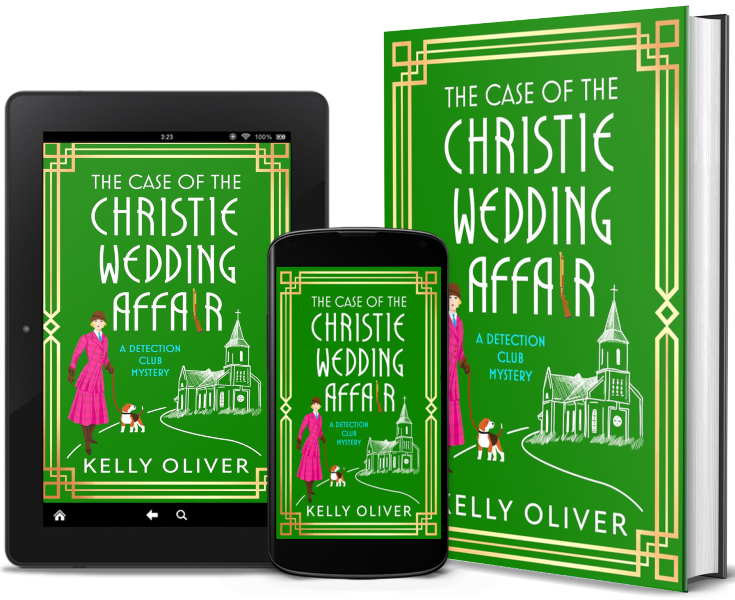
Theo Sharp is visiting Ascroft, eh? to tell us about The Case of the Christie Wedding Affair, the latest novel in the Detection Club mystery series.
Welcome, Theo. Let’s get started, shall we?
Tell us about the novel that you live inside. Is it part of a series? If so, please tell us about the series too.
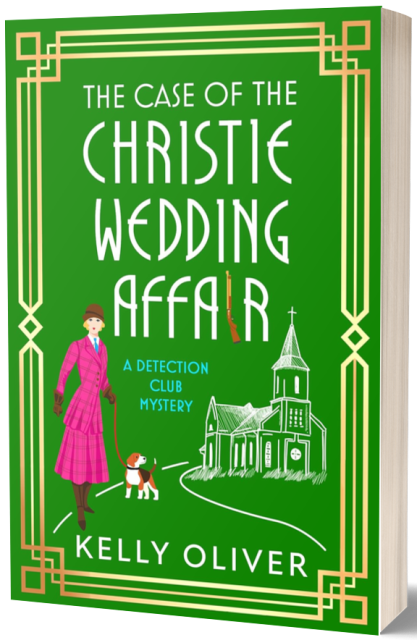
My name is Theo Sharp, and I inhabit a series of mysteries that seem determined to place me in increasingly beautiful locations with increasingly unfortunate corpses. The books follow my investigations alongside the incomparable Eliza Baker, a former Scotland Yard detective with a mind as sharp as a Damascus blade and considerably more practical than my own.
The series begins in England but quickly carries us abroad to Egypt, Mesopotamia, Scotland, and beyond. We solve murders among archaeologists, aristocrats, adventurers, and writers while rubbing shoulders with members of the famous Detection Club, including such luminaries as Agatha Christie and Dorothy L. Sayers.
At its heart, however, the series is not merely about murder. It is about friendship, loyalty, justice, and the stories people tell themselves to live with what they have done. Also, if I may be candid, it is about my ongoing efforts to convince Eliza Baker that life might contain a few pleasures beyond footprints, bloodstains, and suspects with alibis.
Does the writer control what happens in the story or do you get a say too?
The writer would insist she controls everything. The evidence suggests otherwise.
I often begin a novel intending to behave sensibly. Then Eliza dashes headlong into danger, and I find myself following her. I tell myself I shall remain safely in the library with a philosophy book and a pot of tea. A chapter later I’m trapped in a trunk, lost in the desert, or confronting a murderer armed with little more than optimism and poor judgment.
The writer may provide the outline, but characters have a remarkable talent for becoming themselves. Once that happens, we become rather difficult to manage.
How did you evolve as the main character?
When the series began, I was something of an observer. I preferred books to bullets and philosophical puzzles to criminal investigations. I believed reason could explain nearly everything.
Over time I learned that human beings are far messier than philosophical systems. Grief, love, fear, jealousy, and hope rarely fit into tidy categories.
I also discovered courage is not the absence of fear. It is choosing to continue despite it.
The greatest change, however, came through Eliza. She taught me that truth matters not merely as an abstract concept but as a responsibility. One does not pursue justice because it is intellectually satisfying. One pursues it because real people suffer when evil goes unanswered.
I should also confess that somewhere along the way I inherited an earldom. That was rather unexpected, not to mention problematic in its own right… More on that as the series continues.
Do you have any other characters you like sharing the story with? If so, why are you partial to them?
Eliza, naturally. That answer is so obvious it scarcely deserves stating.
She possesses a remarkable ability to cut through nonsense, including my own. While I am inclined to speculate, theorize, and wander into philosophical reflections, Eliza notices the muddy boot print beneath the window. She taught me that while philosophy may help one understand the world, love gives one a reason to improve it.
Together we make a surprisingly effective partnership.
I am also fond of Jane Archer, Eliza’s sister, whose intelligence work often provides crucial assistance, and of Queenie the beagle, who has contributed to several investigations despite lacking formal detective training.
And, of course, there is Agatha Christie herself. One cannot spend time with Mrs. Christie without developing admiration for her keen observations of human nature. She notices everything. She possesses a delightfully sharp wit and a habit of observing everyone in a room while appearing not to observe anyone at all. Spending time with her is rather like playing chess against a grandmaster who politely pretends you’re doing well.
What’s the place like where you find yourself in this story?
That depends on the particular adventure. I have watched the sun rise over the pyramids from the terrace of the Mena House, traveled by steamer along the Nile River, explored ancient ruins in Iraq, and investigated murder on the windswept Isle of Skye.
Our latest adventure finds us in Scotland, whose geography has its own moods, which, for better or worse, make me broodier than usual.
Yet my favorite places are often the quiet ones, a library filled with old books, a drawing room after dinner, a railway compartment carrying one toward an uncertain destination.
Mysteries thrive in such places. They remind us that every stranger carries a story and every story conceals secrets.
Is there anything else you’d like to tell readers about you and the book?
Despite the murders, the danger, and the occasional near-death experience, these stories are fundamentally hopeful. They are not tales about death. They are tales about people choosing what kind of lives they wish to lead.
I began my journey searching for interesting stories. What I found instead were meaningful relationships, difficult truths, and a woman whose courage continually challenges me to become better than I was.
I confess I spend a great deal of time pondering the meaning of life. Eliza would say far too much time. Yet every adventure seems to bring me to the same conclusion. Life is not measured by wealth, titles, or even intellectual accomplishments. It is measured by the people who stand beside you when darkness falls.
If readers close the book having enjoyed a clever mystery, all the better. But I hope they also come away believing that goodness matters, that friendship matters, and that even the smallest act of courage can change the course of a story.
After all, that is how every great mystery is solved. One clue. One choice. One brave step at a time.
Just be warned. Wherever Eliza Baker goes, murder has an alarming tendency to follow. And wherever murder appears, I seem destined to be standing nearby, notebook in hand, wondering how on earth I got involved again.
Thank you for answering my questions, Theo, and good luck to you and your author, Kelly Oliver, with The Case of the Christie Wedding Affair, the latest book in the Detection Club mystery series.
Readers can learn more about Theo and his author, Kelly Oliver by visiting the author’s website and her Facebook, Bookbub, Instagram @kellyoliverbooks and Pinterest pages.
The novel is available at the following online retailers:
Amazon US Amazon CA Amazon UK Amazon AU Amazon IN B&N

About Kelly Oliver: Kelly is the Agatha award-winning and bestselling author of four mystery series: The Jessica James Mysteries, The Pet Detective Mysteries, The Fiona Figg Mysteries, and The Detection Club Mysteries.
The Fiona Figg Mysteries have been on the most anticipated list of Mystery Magazine and won the Mystery and Mayhem Award and the Silver Falchion Award for Best Historical Mystery. And The Case of the Christie Conspiracy, Detection Club Mystery book one, is currently nominated for an Agatha Award for Best Historical Mystery.
Kelly is Past President of Sisters in Crime National, current Education Coordinator for SinC Guppies, and a Distinguished Emerita Professor of Philosophy at Vanderbilt University.