Suzanne Stauffer, author of French Toast a la Santa Fe (Couriers Book 2), is visiting Ascroft, eh? today to share with us how she created the characters in her novel.
Welcome, Suzanne. I’ll turn the floor over to you –
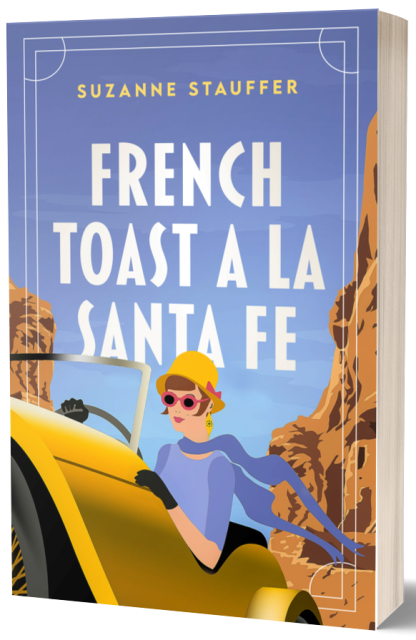
Thank you for inviting me. I’m Suzanne Stauffer, author of the newly released French Toast a la Santa Fe and Fried Chicken Castañeda, the first book in the Couriers Series. Friends who have read FTSF (as we call it) wanted to know how I managed to create more than 14 diverse characters and make it easy to keep them straight.
It is an ongoing process, believe me! In FTSF, Prudence goes on a Detour with 10 other passengers, the Courier, and the driver from the Castañeda Hotel in Las Vegas to the Alvarado in Albuquerque via the La Fonda in Santa Fe.
I began by deciding who those other passengers would be, in very broad terms – a middle-aged retired couple and a floozy to flirt with the husband, a retired single woman, two sisters on a ‘gap year’ trip (not that they called it a ‘gap year’ in 1929, but that’s what it was).
I still needed four more passengers. It would be interesting to include two young men, around the same age as the sisters, so there we’re down to two. What if the retired couple’s party included the wife’s single – no, not single, widowed – sisters? I was thinking about my grandmother after my grandfather died. She moved in with two of her sisters – all three were widows – and they traveled all over. They even went to China!
I also assigned roles to the characters – I mentioned “the floozy.” There was also the “bitter old woman.” The “peacemaker.” The “good ol’ boy,” etc. I’ll let you discover the rest.
What about the Courier and the driver? They had to be more than just “the Courier” and “the driver.” They needed names and personalities and some kind of backstory. Then I had an idea : Why not use real people? I’ve done some research on the Indian Detours and I know the names of some and a little about them. I picked Marcella Matson because I like the name and her photo appears in some of the articles I’ve read, so she felt real to me. I chose Tom Dozier because he was the only Native American driver that the Detours hired. I also found a biography of his younger brother which included information about the whole family, including a photo of Tom.
Then I started fleshing out their backgrounds and developing a mental image of each one. I searched for common names of that time period and chose ones that fit that mental image. I developed wardrobes for them that reflected their personality, age, and social status. As you might guess, it’s a circular process, and sometimes I had to change something because of a later development.
Once I started writing, the characters started taking on a life of their own. The two young men turned out to be gay German college students, and the single woman was a retired schoolteacher from Australia, in part because that was one of the few jobs that women could hold at that time. The sisters were Jewish, and their father was a jeweler in Chicago. The floozy was a manicurist from Kansas City who just liked a good time. She reminded me of a Judy Holliday character.
Their personalities developed and deepened. I started to understand their motivations. They stopped doing what I wanted them to do and started acting according to who they were. I felt like Prudence, coming to know these people through our interactions over the course of the three-day excursion. My impressions of them changed, just as Prudence’s did. The floozy made it clear that she didn’t mess with married men. The married man – he’d never cheat on his wife. There went … well … the entire murder plot. (If you want to know what it was, I wrote it as a short story with slightly different characters that was published in Killer Nashville as “Detour to Murder” https://www.killernashville.com/short-stories/detour-to-murder).
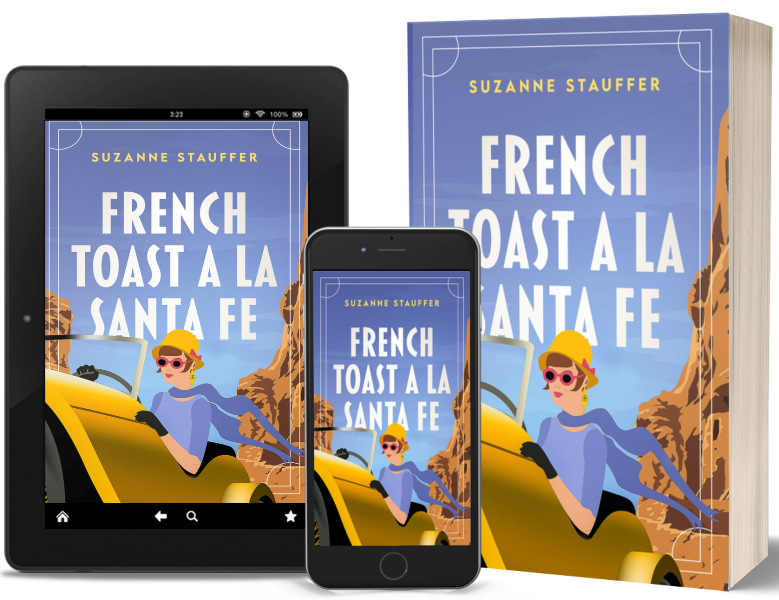
So, I had to rethink the ending. And, suddenly, I needed two law enforcement officers. The revised plot required them. What about Bob, from the first book? He had returned to Santa Fe at the end of that book, so he was on the scene and he already knew Prudence. It would tie the two books together and I wouldn’t have to develop another character. Now, he just needed a partner. That partner should be a native New Mexican, though, preferably either Hispanic or Native or both. Why not both? And so Javier was born.
Thinking of Bob reminded me. The Harvey Girl whom Prudence met on the train on her way to Las Vegas, Sally Johnson, was working at the La Fonda in Santa Fe. It would be rather strange if they didn’t run into each other. And there she was, taking orders for dinner.
Of course, Bob, Javier, and Sally are all secondary characters. They only appear in specific settings, so their characters don’t need to be as well-developed, but they do need to be something more than just cardboard cut-outs. They have names and personalities. I enjoyed getting to know Bob and Sally better, seeing them in these new circumstances, so much so that Sally becomes a main character in the third novel.
Other secondary characters are more two-dimensional. They are given names or titles, as well as roles, but make essentially cameo appearances. We may wonder about them and want to know more, but they just aren’t around long enough. And then, there are the characters who are known only by their role. They don’t get names, I’m afraid, or if they do, it’s just a first or last name. They are “the desk clerk” and “the Harvey Girl” and “the maid.” I have a sort of hazy idea of what they look like, but it’s mainly the uniform.
So, now you know as much as I do! Characters develop as much for the author as they do for the reader and keeping them real sometimes requires changing the plot. Decide for yourself whether I’ve created more than 15 distinct characters by reading French Toast a la Santa Fe. It’s available on Bookshop.org and Amazon.
Thank you for sharing this with us, Suzanne, and good luck with French Toast a la Santa Fe (Couriers Book 2). Readers can learn more about Suzanne Stauffer by visiting the author’s blog and her Facebook and Substack newsletter pages.
The book is available online at Amazon and Bookshop.org.
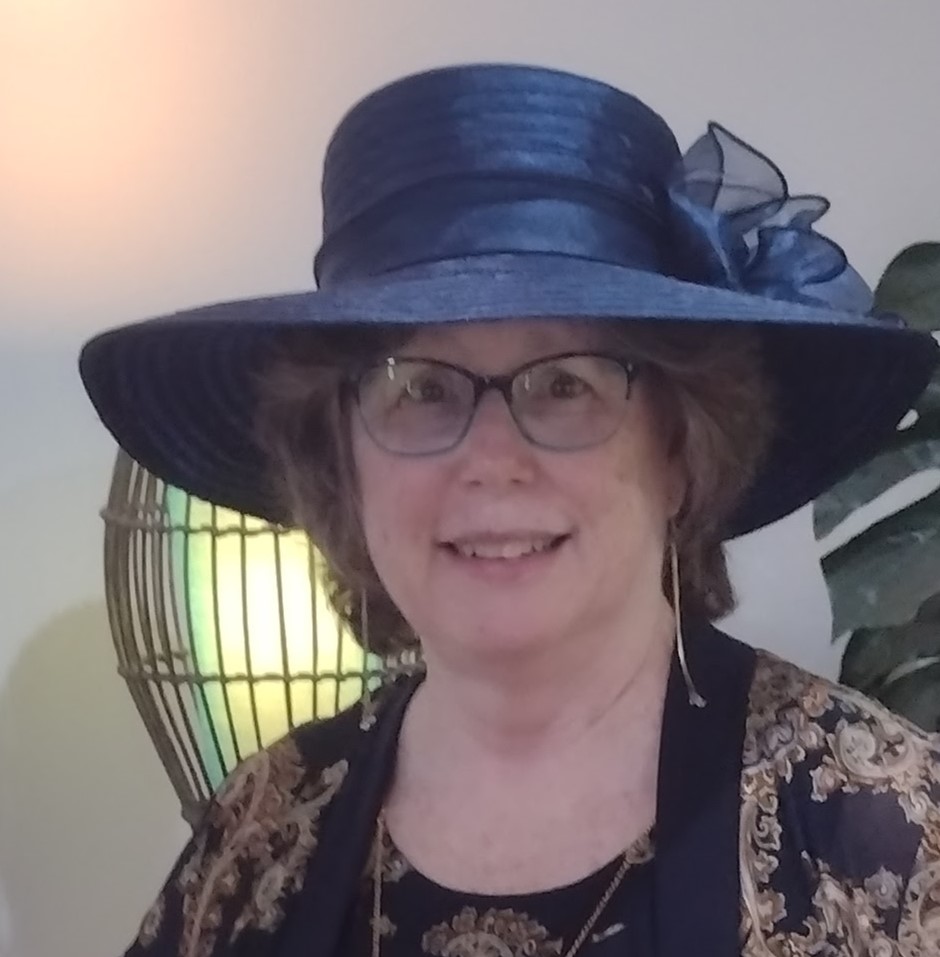
About Suzanne Stauffer: After 20 years as a librarian and 20 as a professor of library science and library historian, Suzanne Stauffer has moved on to a third career as a mystery novelist. She currently lives in Albuquerque with her Australian husband and brown and white spotted rat terrier dogter, Treme. Her debut novel, Fried Chicken Castañeda (Artemesia Publishing, May 2025), won the CIPA EVVY Bronze Medal in Mystery/Crime/Detection and the New Mexico Book Award for Cozy Mystery.