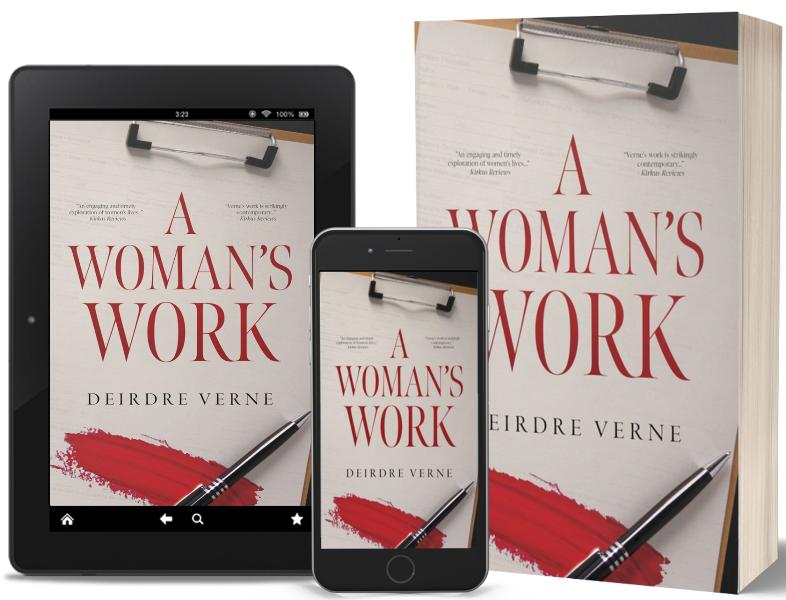
Deirdre Verne, author of A Woman’s Work, is visiting Ascroft, eh? today to tell us a bit about her new novel.
Welcome, Deirdre.
Tell us about your novel. Is it part of a series? If so, please tell us about the series too.
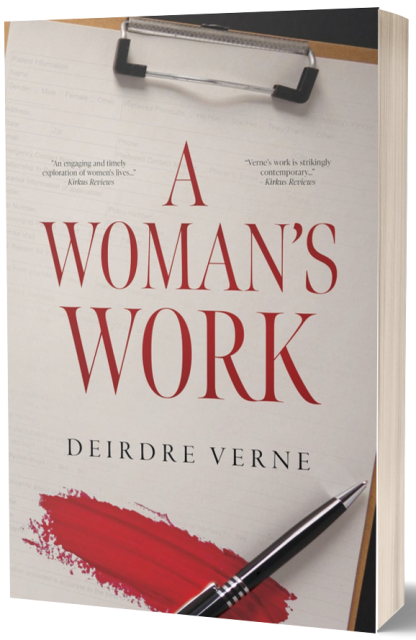
I initially wrote A Woman’s Work, the story of a nurse midwife accused of providing medical care to a teenage girl without parental consent, as a stand-alone novel. But when I reached the last chapter, I realized I wasn’t quite ready to let go of my main character, Rhonda Kask. We’d just spent a year together, and the more chapters I wrote, the more I learned about this amazing woman.
I remember rereading the draft of the final chapter and thinking that, with a few changes, I could leave the door open for a sequel. I already have an idea for book two and have even put some words on paper. So, yes! I’m hoping A Woman’s Work will be the first of more stories featuring my fearless protagonist, Rhonda Kask.
Where did the idea for the mystery that is central to the story come from?
In 2022, I was following a news story about an OB-GYN in Indiana who became caught up in a situation that had some similarities to Rhonda’s. Questions arose about the doctor’s handling of a medical case involving a teenage girl, and her medical license was put at risk. I read numerous articles about the case and was impressed by the doctor’s resilience and commitment to the care of her patients. She had followed the applicable laws and provided appropriate medical care, yet she still found herself having to defend the job she loved.
That situation stayed with me and eventually became the spark for A Woman’s Work.
Is there a theme or subject that underlies the story? If so, what prompted you to write about it?
The overarching theme of the book is women supporting women despite their differences. Throughout the story, readers meet women from multiple generations, backgrounds, and belief systems. I wanted to explore whether these women could rise above controversy, recognize what they have in common, and find ways to support one another even when they don’t always agree.
Another theme I wanted to explore was conformity versus individualism and the responsibilities we have to our communities. My protagonist, Rhonda Kask, consistently goes against the grain, yet she desperately wants to fit in. That’s her dilemma.
How do you create your characters? Do you have favourite ones? If so, why are you partial to them?
Like many authors, I create characters who are compilations of people I’ve encountered throughout my life. I’m a good listener and observer, and I tend to remember what people tell me. (I also ask a lot of questions!) Very often, a specific phrase or turn of language will stand out, and I’ll file it away for later use.
For example, I had a lovely friend who didn’t see eye to eye with her twin sister. She once described her twin as a sibling who just happened to be born on the same day. I loved that description. It wasn’t mean-spirited, but it dispelled the notion that twins are automatically two peas in a pod. I tucked that line away and eventually used the idea in a book.
In A Woman’s Work, I became especially partial to a minor character, Carolyn Upton. Carolyn is a patient of Rhonda’s who has multiple sclerosis, and she finds herself facing a situation that requires more bandwidth than she can muster. Of all the characters in the book, Carolyn felt especially real to me. As I wrote her scenes, I had the sense that somewhere there was a woman very much like Carolyn—a woman who didn’t need someone to rescue her, but who simply needed the support of her community to help her through a difficult time.
How do you bring to life the place you are writing about?
I love to walk. When we travel, we usually choose locations that can be explored on foot. Walking slows everything down and gives me a chance to absorb a place without feeling rushed. There’s nothing better than wandering down a small side street, peeking into a few shop windows, noticing the houses, and getting a sense of how people actually live.
I’ll also pick up a local newspaper whenever I can. Local papers are wonderful for uncovering the latest controversy in town—the issues residents are arguing about, the personalities everyone knows, and the little stories outsiders might never hear about. Then I’ll usually do some online research to fill in the blanks. I even read real estate listings, which can tell you quite a bit about a community, including who has money and how much of it!
For this book, I have a city friend who bought a second home in upstate New York. I’m a regular guest, and whenever I visit, she gives me the lowdown on the local scene in great detail. Her town became the model for Mount Carmel.
Interestingly, an editor who reviewed my book remarked that Mount Carmel reminded her of her own town. As it turned out, she lived just down the road from my friend—and none of us knew it! I took that as a sign that I had captured the place pretty well.
What research do you do to provide background information to help you write the novel?
First, I love doing research. I adore diving into a topic without necessarily knowing exactly what I’m looking for, hoping to uncover some small detail that can move the story forward. When I find a gem, I’ll often say, “Ooh, that’s great. I can use that!”
I’ve also found videos on YouTube particularly helpful. Unlike a written article, a video can give you a firsthand account from someone whose experiences may resemble those of a character you’re creating. Listening to a person’s intonation, noticing the words they choose, and watching their facial expressions can provide details that are difficult to get from written research alone.
I also rely heavily on my network of friends and family. As I mentioned, I love to walk, and I frequently walk with a good friend who just happens to be an obstetrician. She graciously allowed me to pick her brain and then introduced me to other people in the medical field who could answer my questions. My college roommate is also an obstetrician, and she was incredibly helpful as well. Having knowledgeable people willing to answer my many questions was invaluable when I was creating Rhonda’s world and making sure the medical aspects of the story felt authentic.
Is there anything else you’d like to tell readers about the book?
I’ve written other books, but A Woman’s Work is my favorite. As Kirkus noted in its review, the book is timely, and I felt a real urgency to write it.
Most of all, I wanted to create a protagonist who felt fully human. Rhonda Kask is compassionate, capable, stubborn, and flawed. She has strong convictions, but she doesn’t always have all the answers. I tried to balance the seriousness of the issues she faces with a mildly sarcastic, but ultimately hopeful sense of humor.
And, of course, this is a mystery, so I hope readers enjoy the twists and turns lurking around every corner in the town of Mount Carmel.
Thank you for answering my questions, Deirdre, and good luck with A Woman’s Work. Readers can learn more about Deirdre Verne by visiting the author’s website and her Facebook, Goodreads and Instagram pages.
The novel is available at the following online retailers:
Amazon – Barnes & Noble – BookBub – Bookshop.org

About Deirdre Verne: Deirdre is the author of the Sketch in Crime mystery series published by Midnight Ink: Drawing Conclusions 2015 & Drawing Blood 2016.
In 2017, Drawing Blood was selected as a top five cozy mystery favorite on the Escape into a Good Book with Dollycas’s annual list. A member of Sisters in Crime, Deirdre’s short stories appear in three SinC Anthologies. Deirdre is a professor of Marketing at Westchester Community College, where she has taught for twenty-five years. She also serves as
the VP of the WCCFT Teacher’s Union, representing over 1,000 professors.