It’s Dunkirk Week

Dunkirk Dianne 2

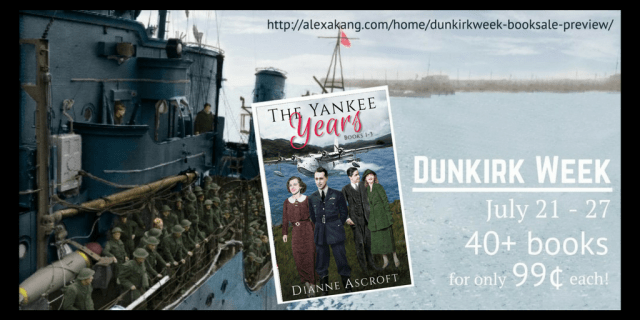
About a month ago now, I asked whether you were ready for Dunkirk – and not just the Christopher Nolan film. I was also referring to the Dunkirk Week WWII Epic Book Sale. The WWII Epic Book Sale was kicked off by a Giveaway of 11 signed print novels included in the sale. The giveaway has closed and the winners have been notified. So now we’re into Dunkirk Week itself.

The Christopher Nolan film Dunkirk was released on Friday and to celebrate its release more than 50 authors of the FB Second World War Club have joined together for the Dunkirk Week WWII Epic Book Sale. From 21-27 July, we are offering you our WWII novels, most at 99c.

Our novels range from military war tales, home front drama and sagas, harrowing accounts of the Holocaust, gripping spy thrillers, moving wartime romances, and much, much more. To see our great selection of WWII books, go to the event page.

As part of the celebration, we’ve also got some great giveaway prizes, including the Grand Prize of a paperback copy of Joshua Levine’s Dunkirk: The History Behind the Motion Picture. No purchases are necessary to enter the drawing. Come visit our book sale page to find out more details about our prizes and how to win.

We’re also bringing to you:

  1. A two-part blog series about the Dunkirk. You can read the excellent blog posts to learn more about this historical event by two of our authors, Suzy Henderson (The Beauty Shop) and Jeremy Strozer (Threads of War), here: https://lowfellwritersplace.blogspot.co.uk/
  2. Readings by The Book Speaks podcast of excerpts from All My Love, Detrick by Roberta Kagan plus another novel, both of which are part of the Dunkirk Week Book Sale: https://thebookspeakspodcast.wordpress.com/
  3. Our authors’ pick of the Top 40 WWII Movies: http://alexakang.com/40-recommended-wwii-films-english/

The Second World War changed our world forever. In our stories, we strive to bring you a glimpse of what happened and how everything happened through the eyes of our characters and to let you share their feelings, emotions, fears, and hopes. We are thankful that director Christopher Nolan is bringing this important part of history to the attention of the wider public, and we will try to continue what he had done through the stories we tell. We hope you’ll enjoy them.

Pop over to our Dunkirk Week WWII Epic Book Sale page and have a browse: http://www.alexakang.com/dunkirk-book-sale/

Dunkirk-week-1-640x333

Posted in Archives, July 2017, Uncategorized | Tagged , , | Leave a comment

Our Ledwidge Centenary in Enniskillen

On Thursday evening the Inniskillings Museum with Fermanagh Writers hosted a centenary concert jointly in St. Macartin’s Cathedral, the home of the Inniskillings Regimental Chapel, and St. Michael’s Church to mark the anniversary of the death of Irish war poet, Francis Ledwidge. Although I had been sceptical about the project when it was first suggested to the writers group, I was delighted to see how well it all came together.

Ledwidge

Francis Ledwidge

Francis Ledwidge was an Irish nationalist who fought for the British Army during the First World War. He was a member of the Gaelic League and he and his brother Joe were among the first to join the local branch of the Irish Volunteers, where he became friends with Thomas MacDonagh, one of the seven leaders of the 1916 Easter Rising. When the Volunteers split over the issue of support for the First World War, Ledwidge sided with the minority opposed to joining the war effort.

So, what connection does Ledwidge, who was from Slane, Co Meath, have with Fermanagh Writers and Enniskillen?

Shortly after the spilt in the Gaelic League, he enlisted in the 5th Royal Inniskilling Fusiliers, saying: “I joined the British army because she stood between Ireland and an enemy common to our civilisation.” 

He was killed by a stray shell during the Battle of Passchendaele on July 31, 1917.

The concert evening was a mix of readings of Ledwidge’s poetry, recitals of musical settings of his work by Head and Gurney, poetry which influenced him such as WB Yeats and Thomas Moore, and short talks about his military career. Enniskillen born actor and director, Adrian Dunbar drew the evening to a close by reading Seamus Heaney’s emotive poem ‘In Memoriam – Francis Ledwidge’.

Ledwidge museum

Ledwidge’s birthplace, now a museum

I wasn’t really sure what to expect from this project when we first started it but I quickly became interested in the historical aspect of it. In early June, Fermanagh Writers visited Slane, Co Meath to see the birthplace of Ledwidge. While we were there, we visited his family home which is now a museum, stopped into his favourite pub in the town to chat with committee members who run the Ledwidge Museum and climbed the Hill of Slane to visit the grave of the woman he loved.

After learning a bit about Ledwidge’s life and writings, our members wrote their own poetry and stories inspired by the poet and his times. A booklet of these stories and poems was produced and distributed at the concert on Thursday.

Ledwidge’s love of his homeplace and the countryside he grew up in was something that particularly spoke to me, as I never cease to be amazed by the countryside where I live in County Fermanagh. Despite the fact that we lived a century apart, I know he would have seen many of the same sights as I do in the countryside and my contribution to the booklet sprang from this thought. I had first thought that it might be rather a chore to produce ‘writing to order’ on a particular theme but, the more I learned about the poet and his life, the easier it was to write.

Adrian Dunbar

Adrian Dunbar singing Fare Thee Well, Inniskilling

My poem, Waiting To Be Called, was inspired by the mutual love of nature that Ledwidge and I share, and also by a letter that Ledwidge wrote home in July 1917. He was hoping for leave which was long overdue for his unit after seven months on active service. In the letter, he said that he may be home again soon and added, “In fact, I am only waiting to be called home.” His hope was never realised, of course, as he died on the 31st of the same month.

After the commemorative concert, the evening was rounded off by music and poetry in Blakes of the Hollow. Pat McManus and his band provided the music, Adrian Dunbar sang a rousing rendition of Fare Thee Well, Inniskilling, the 5th Royal Inniskilling Guards regimental march, and members of Fermanagh Writers shared the poems we had written.

It was a great evening and the inspiration I drew from the project will spill over into my other writing.

Posted in Archives, July 2017, Uncategorized | Tagged , , , , , , , | Leave a comment

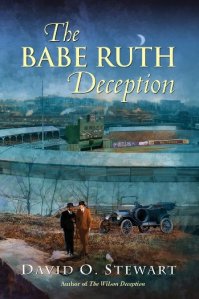
Delving Into The Babe Ruth Deception

Today I’ve invited David O. Stewart to visit Ascroft, eh? to discuss The Babe Ruth Deception, his latest historical novel set during the American Prohibition era.

Welcome, David. Let’s get started, shall we?

Tell us about your novel.

DOS: It’s about people swept up at the beginning of the Roaring Twenties, a century ago, when hemlines go up and morals plunge, when every bright promise brings a dark underside. Prohibition brings illegal bootlegging and gangsters, while big-time sports attracts gamblers and the fixing of the 1919 World Series. At the center of these powerful forces stands Babe Ruth, the awesomely talented man-child who is reinventing baseball as a power game.

The mismatched protagonists of my Fraser/Cook series (this is # 3) are Dr. Jamie Fraser from Ohio and Speed Cook, a black ex-ballplayer. They connect with the Babe when Fraser’s wife produces his 1920 silent movie, Headin’ Home (Ruth really made such a movie), that was financed by a gangster who paid off the World Series bribes the year before (that part also is true!). Needing help to escape a looming scandal, the Babe turns to tough-guy Cook, though Fraser ends up holding the key to the situation.

The cross-currents grow more treacherous when Cook’s son and Fraser’s daughter launch an interracial romance that can cost them their lives in the America of 1920.

What prompted you to write about this historical event and era?

Babe Ruth

DOS: The real draw for me was Babe Ruth – he’s a legendary figure yet was a tangle of contradictions. No one has come close to his achievements on the baseball diamond: he was a great pitcher and then the greatest hitter of all time! He had a public image as a virtually uneducated, affable buffoon, while the private reality was of a man from a non-functioning family with massive appetites for food, liquor, and sex. At the same time, he invented the American phenomenon of mass celebrity. Virtually everyone in America still knows the name Babe Ruth. I wanted to dig into who he was and the times that shaped him.

How closely did you stick to the historical facts? If you used them loosely, how did you decide whether to deviate from them?

DOS: The factual framework respects the history we know. I honored all of the events in the Babe’s baseball career, right down to individual at-bats in World Series games. I figured that true fans would crucify any writer who messed with those. I also followed the facts of his movie career (which came to a speedy and richly-merited halt), of the gangsters portrayed, and of the terrorist violence that visited New York City in those years.

What research did you do for this book?

DOS: I read up on the Babe’s career and the era and also found film and audio recordings of the Babe – especially the movie, Headin’ Home, which you can watch online. I also read novels that were written in 1920 to try to get some feel for how people were using language then.

Do you use a mixture of historic figures and invented characters in the novel? Which is more difficult to write? Which to you prefer to write and why?

DOS: I sweat more over the historic figures. I feel an extra obligation when I create words and actions for someone who was a real person, who cared what people thought about him or her, and I don’t want to be unfair in my characterizations. So the invented characters tend to come easier. I made them up, so I can do with them what feels right and let the chips fall as they may.

In an historical novel you must vividly re-create a place and people in a bygone era. How did you bring the place and people you are writing about to life?

DOS: I like to go to the places where the story unfolds, and luckily Babe’s Manhattan home was in the Ansonia Hotel, a swanky spot on Broadway that still stands, now as condos. Having grown up in New York, lots of the New York locations were familiar to me, though I always look at old photos from the era, just to get the clothes and building styles right.

There often seems to be more scope in historical novels for male characters rather than female characters. Do you prefer to write one sex or the other? And, if so, why?

DOS: As someone who also writes books of history, I think your question reflects the unfortunate asymmetry of the historical record: women’s lives in the past are not as well-documented as men’s lives, so it’s more difficult to write about them. Nevertheless, some novelists do a great job of exploring women’s lives in the past (Philippa Gregory, for one). For me, writing women characters can be more challenging but I enjoy that challenge. Imagining other people’s experiences is part of the deal when you portray people of the past, or people of other races (like my character, Speed Cook). If you get it wrong, readers will let you know!

Thanks for taking the time to answer my questions, David, and good luck with your new release.

Readers can learn more about the author by visiting his website at www.davidostewart.com. Copies of the novel can be purchased at various online retailers, including the following:

Amazon | Barnes & Noble

About David O. Stewart: Formerly a lawyer, he writes fiction and history. His first historical work told the story of the writing of the Constitution (“The Summer of 1787”). It was a Washington Post Bestseller and won the Washington Writing Prize for Best Book of 2007. His second book (“Impeached”), grew from a judicial impeachment trial he defended before the United States Senate in 1989. “American Emperor: Aaron Burr’s Challenge to Jefferson’s America” explored Burr’s astounding Western expedition of 1805-07 and his treason trial before Chief Justice John Marshall. “Madison’s Gift: Five Partnerships That Built America” debuted in February 2015. He has received the 2013 History Award of the Society of the Cincinnati and the 2016 William Prescott Award for History Writing from the National Society of the Colonial Dames of America.

Stewart’s fiction career began with the release of “The Lincoln Deception,” an historical novel exploring the John Wilkes Booth conspiracy. “The Wilson Deception,” the sequel, is set at the Paris Peace Conference in 1919. “The Babe Ruth Deception” occurs during the Babe’s first two years with the Yankees while he remade baseball and America began the modern era with Prohibition, bootlegging, and terrrorism.

Stewart lives with his wife in Maryland.

Posted in Archives, July 2017, Uncategorized | Tagged , , , , , , | 1 Comment

Da Vinci’s Disciples: The Competition

Today I’ve invited Donna Russo Morin to Ascroft, eh? to tell us about her historical series, Da Vinci’s Disciples, and the second book in the series, The Competition.

Welcome Donna. Let’s get started, shall we?

Tell us about your novel.

DRM: The trilogy itself, Da Vinci’s Disciples, is the story of a secret society of women The Competition coverartists, under the tutelage of the great Leonardo da Vinci, who must navigate the treacherous life of 15thcentury Florence while trying to bring their artistry to the world. In the first book, PORTRAIT OF A CONSPIRACY, we learn how da Vinci’s becomes their maestro, and how they became embroiled in one of the largest and most far-reaching conspiracies in all of history, reaching all the way to the Vatican.
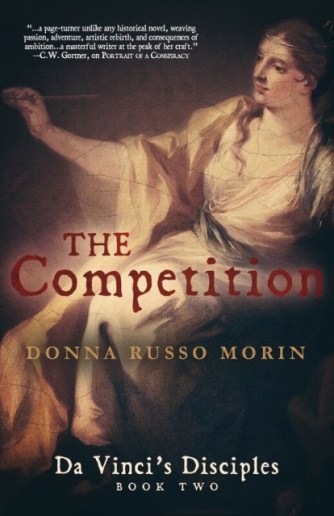
I knew I wanted the second book in this trilogy to be a little more personal, get into the lives of these courageous women, and da Vinci himself, a bit more deeply. Oh, they are still daring to go where women had never gone before in the Renaissance, and they put everything on the line for the love of their art—their marriages, their family relationships, even their lives—to do it, to bring their work out into the open, no matter the consequence. But in THE COMPETITION, I’ve pulled back more of the layers of their lives and the secrets they may hold. Desire love is brought to fruition, desire is ignited, disastrous illnesses change lives, and familial condemnations are shattered. All set amidst the glory that is Florence during the Renaissance. THE COMPETITION, in a nutshell, captures the moment when the women dare to come out of hiding. Not only do they dare to openly bid on a fresco commission (the method by which artists of the time received jobs), they win. What happens next are the consequences of their daring. 

What prompted you to write about this historical event?

DRM: My work was starting to include more and more artists, especially those of the Renaissance. But as I have done with all my books, I wanted to illuminate the period through the lives of women, women who dared to do the unthinkable. In this case, to be a part of the artistic revolution that came to be known as the Renaissance. At the same time, I was going through a horrific divorce that lasted years. If not for my female friends, I’m not sure I would have made it through. The Da Vinci’s Disciples trilogy is nothing if not an homage to the power of female friendships, a bond that is unlike any other. It is all there, both the good and the bad of how women are with each other, and what they can accomplish when they are united. And while the women are not based on actual historical figures, each and every one is based on actual women, myself included.

How closely did you stick to the historical facts? If you used them loosely, how did you decide whether to deviate from them?

DRM:I’m a bit fanatical about keeping as close to the historical facts as possible. For me, the craft becomes writing my story around those true events. The only time I fiddle with history is when I condense it in order to write about the entirety of the event without producing a 600-page book.

What research did you do for this book?

DRM: I am a self-proclaimed history geek, I adore the research process. Typically, if I’m under a contract that calls for a book a year (which I’ve been under for three years), I’ll conduct both academic and hands-on research for nine months and then I’ll write for three.

For the Da Vinci’s Disciples trilogy, I spent time in art classes painting (attempting to). The art department at my state’s university helped a great deal in teaching me how paints were made during the time of the Renaissance. I’ve always been in love with art and artists, so the union was a good one.

Just as an aside, for my first book I learned to fence and for the second I learned to blow glass. For my third book I learned to use a bow and arrow; something I came to love so much, I own my own bow and target shoot whenever I get the chance. For my fourth book, I took dagger-fighting lessons, which ended up coming in handy for this trilogy as well. Reading about fencing or shooting a bow is typically written from a male perspective. I wanted to detail how it would feel for a woman to do the same…how muscles not typically used for such activities would feel. I hope it gives my work the authenticity I strive for. 

Do you use a mixture of historic figures and invented characters in the novel. Which is more difficult to write? Which to you prefer to write and why?

DRM: My protagonists have always been fictional characters thrust into factual events surrounded by historic figures. I think there is a bit more freedom in this method; my fictional characters can do whatever I want them to. Historic figures, in my mind, need to be written to match their lives.

I am planning on writing my first biographical historical novel. I am interested in learning which one is more difficult myself. 

In an historical novel you must vividly re-create a place and people in a bygone era. How did you bring the place and people you are writing about to life?

DRM: Research, research, and more research. I especially love when I can find documentaries on the event or on a specific person. With their budgets, they are able to gather enormous amounts of data from highly regarded specialists that can put you right in the moment. It becomes my job to turn that into a novel.

I see my stories visually, like a movie playing in my mind. I allow my mind’s eye to wander as much as it pleases and then I attempt to turn those visuals into words that are well crafted enough to become visuals in my readers’ minds.

There often seems to be more scope in historical novels for male characters rather than female characters. Do you prefer to write one sex or the other. And, if so, why?

DRM: It seems to have become my intent, though it was not done purposefully so, to tell HERstory. Perhaps it has a lot to do with the fact that my formative years were in the 1960s. The history taught in schools is what I like to call ‘White Man’s History.’ It was predominantly written by white men for white men. To think that the freedoms and opportunities available to modern women just magically happened is somewhat naïve. Though we still have a long road ahead, there are these women, women whose names have been lost in the passage of time, who dared to do the unthinkable. We stand on their shoulders, and it is my pleasure to shed a bit of light on their lives.

Thanks for answering my questions, Donna. I’m also keen to discover women who are lost to the history books so I’ll enjoy this series.

Readers can learn more about Donna and her writing by visiting her website at www.donnarussomorin.com. You can also connect with her on Facebook and Twitter

Her books are available on various online retailers, including

Amazon | Barnes & Noble |

About Donna Russo Morin: Donna earned two degrees from the University of Rhode The Competition Donna Russo MorinIsland. In addition to writing, teaching writing, and reviewing for literary journals, Donna works as a model and actor; highlights of her work include two seasons on Showtime’s Brotherhood and an appearance in Martin Scorsese’s The Departed. Donna is the proud mother of two sons, one a future opera singer, the other a future chef.

Donna’s titles include The Courtier’s Secret, The Secret of the Glass, To Serve a King, The King’s Agent, Portrait of a Conspiracy, and The Competition.

Donna enjoys meeting with book groups in person and via Skype chat. Visit her website.

Posted in Archives, July 2017, Uncategorized | Tagged , , , | 1 Comment

Kate Clifford Mysteries

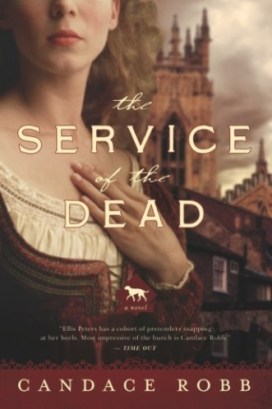
Today I’ve invited Candace Robb to Ascroft, eh? to tell us about her new Kate Clifford historical mysteries series. Welcome Candace. Let’s get started, shall we?

Tell us about your new series.

CR: Set in late medieval York, 26 years after the most recent book in my Owen Candace The Service of the DeadArcher series, my new crime series follows Kate Clifford, a young widow from the northern border with Scotland, as she navigates her way through the clash between the royal cousins King Richard II and Henry Bolingbroke. The first book in the series, The Service of the Dead, is set in winter, 1399, as rumors spread that King Richard declares that his cousin, Henry Bolingbroke, has forfeited his right to the inheritance of his father, John of Gaunt, Duke of Lancaster. Such a betrayal will not go unchallenged by the Lancastrian heir. A civil war is inevitable. That’s the historical backdrop.
But what most excites me about this series is Kate herself. She’s a kickass woman skilled in archery and the battle axe. Her late husband left his business buried in debt, a secret he managed to keep from his partners and his wife; a savvy businesswoman, Kate’s working hard to pay off the debt while resisting her brother-in-law’s attempts to arrange a marriage for her. His motivation is clear—her late husband’s will stipulates that Kate keeps the business until she remarries, at which time it goes to her brother-in-law. Nasty will, eh? Fairly common in medieval England, sad to say. In fact, Kate’s story is not uncommon. I’ve sought out the stories of women who were necessarily strong to build Kate’s background.

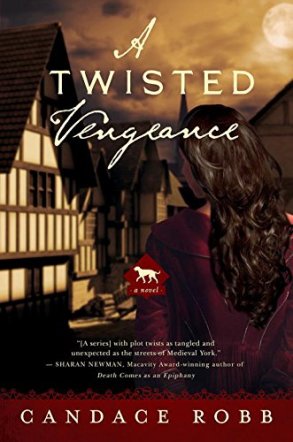
Candace A Twisted VengeanceAnd I’m having fun with this young widow determined to choose her own future. Kate’s household includes a former assassin turned cook, a burglar turned maidservant—both fiercely loyal to her, a pair of Irish wolfhounds, and her late husband’s two bastard children—whom Kate loves as her own. With such martial/criminal/animal protection you would think no one in their right mind would mess with Kate, but her life is complicated and her past even more so. And, of course, there are many people not quite in their right minds, especially in the midst of civil war, which begins in the second book, A Twisted Vengeance.
What leads Kate to sleuthing? She must protect her reputation, especially because one of her businesses counts on discretion: she runs a guest house in which wealthy burgesses and their lovers enjoy evenings in luxurious bedchambers. And, in the second book, Kate is busy protecting her mother, Eleanor, who refuses to explain why she fled Strasbourg, though it’s clear she harbors dangerous secrets.

What prompted you to write about this historical event?

CR: Ever since I began researching the city of York for my Owen Archer mysteries I’ve wanted to write about York’s tragic role in the troubled reign of King Henry IV, beginning with Henry’s landing on the coast of Yorkshire to challenge his cousin, King Richard. What writer can resist a civil war and a paranoid king?

How closely did you stick to the historical facts? If you used them loosely, how did you decide whether to deviate from them?

CR: With my background in historical research, I have no interest in playing fast and loose with history. But I also know full well how differently two historians might interpret the same data, and that we are always finding evidence that overturns what we thought we knew. That’s why I pay close attention to the latest research. In this series I stick to what we know (or think we know) about Henry of Lancaster’s usurpation of his cousin’s throne as the historical backdrop. I also do my best to present York and everyday life as accurately as a twenty-first century person can. But Kate is a fictional character, as are many of the other characters in the books, and the mysteries themselves are my creations, albeit grounded in historical research. When I deviate from historical facts I explain why in my Authors Note.

What research did you do for this book?

CR: As far as research, it’s ongoing. For this series I’ve devoured the most recent scholarship on the conflict between Richard II and Henry of Lancaster, York’s role in the conflict and the early years of Henry IV’s reign, Richard Scrope the Archbishop of York, widows, bawds, beguines, and York merchants in the early 15th century. I’m just back from one of my many visits to York where I met with historians and archeologists, filling in the gaps in my knowledge.

Do you use a mixture of historic figures and invented characters in the novel. Which is more difficult to write? Which to you prefer to write and why?

CR: I do use a mixture. I don’t think one is more difficult than the other, but it’s far more satisfying to write about a character whose fate isn’t already recorded.

In an historical novel you must vividly re-create a place and people in a bygone era. How did you bring the place and people you are writing about to life?

CR: Detail detail detail. And I imbue each of my characters with a rich history and emotional life, crucial in all fiction.

There often seems to be more scope in historical novels for male characters rather than female characters. Do you prefer to write one sex or the other. And, if so, why?

CR: I would say a male sleuth has a potentially wider range of activities in 14th-15th century England than a female sleuth, which is why I crafted Kate Clifford’s background with an eye toward making plausible the ways in which she seems unconventional. Actually, the sleuths who are the most engaging are unconventional, regardless of sex. As I’ve mentioned, Kate’s background is a combination of women I’ve found in the records, women who took control of their lives and overcame adversity. They are there in the archives if you look; strong women aren’t a modern phenomenon. They took charge of manors and farms when their men went off to war, took over businesses when widowed. It’s great fun to bring one of those women to life and see just what she can accomplish.

That doesn’t mean I don’t enjoy writing Owen Archer, my sexy male sleuth! Or Kate’s cook, Berend.

Thanks for answering my questions, Candace. Kate sounds like an intriguing character and I look forward to reading about her.

Readers can learn more about Candace Robb by visiting her website. You can also find her on Facebook, Twitter, and Goodreads. The Kate Clifford mystery series is available on Amazon and other online retailers.

About Candace Robb: Candace did her graduate work in medieval literature and Candace Robb authorhistory, and has continued to study the period while working first as an editor of scientific publications and now for some years as a freelance writer. Candace has published 13 crime novels set in 14th century England, Wales, and Scotland. The Owen Archer series is based in York and currently extends over 10 novels beginning with THE APOTHECARY ROSE; the most recent is A VIGIL OF SPIES. The Margaret Kerr trilogy explores the early days of Scotland’s struggle again England’s King Edward I, and includes A TRUST BETRAYED, THE FIRE IN THE FLINT, and A CRUEL COURTSHIP.

Writing as Emma Campion, Candace has published historical novels about two fascinating women she encountered while researching the Owen Archer mysteries, Alice Perrers (THE KING’S MISTRESS) and Joan of Kent (A TRIPLE KNOT).

Candace was born in the Blue Ridge Mountains of North Carolina, grew up in Cincinnati, Ohio, and has lived most of her adult life in Seattle, Washington, which she and her husband love for its combination of natural beauty and culture. Candace enjoys walking, hiking, and gardening, and practices yoga and vipassana meditation. She travels frequently to Great Britain.

Posted in Archives, July 2017, Uncategorized | Tagged , , , , , , | Leave a comment

Celebrating Canada’s 150th Birthday

Today is Canada Day and my homeland is celebrating the 150th anniversary of the birth of the modern nation. Although I’ve lived away from the country of my birth for almost half my life now, if I’m asked, I still immediately identify myself as Canadian.
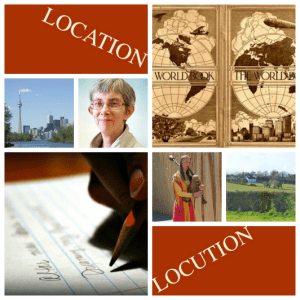
Many years ago I emigrated to the land where my ancestors came from. Over several generations they had migrated from Ireland to England and finally to Canada. For some reason I felt a strong pull to travel in the opposite direction and I returned to where they had started from. I’m happily settled in Northern Ireland now but Canada also holds a special place in my heart.

When I think of my homeland, vivid images flash through my mind: lounging in a Muskoka chair in the backyard on a summer day with a book in my hand, huddling against driving snow outside the Simpson Sears store to peer into the Christmas window display, looking up at the CN Tower while dodging the bustling crowds as I walk along a downtown street, leaning on the polished wooden rail of a ferry heading to Toronto Island with the breeze in my face, the sun beating down on me as I splash in the cold lake water at Wasaga Beach and walking along the street in my neighbourhood in the humid darkness of a summer night enveloped in the hum of grasshoppers.

As Canada celebrates its 150th year, I have all these memories of my homeland and I also clearly remember the centenary celebrations in 1967. As a young school child I diligently learned the words of ‘O Canada’, Canada’s national anthem and practiced with the school choir for the big day. At our school’s centenary celebration, barely big enough to manage it, I proudly carried a Canadian flag, leading the choir procession into the auditorium. I still have the commemorative coin each child in the country was presented with.

It seems appropriate that last week, as Canada Day neared, Tracey Warr at The Displaced Nation invited me to chat with her about my experience as a writer living away from my homeland. I talked about where I come from and how my past and present influence my writing. If you want to know more about the interview you’ll find it here.

Today I plan to take time to savour my memories of my homeland and to think about my family and friends there.

Happy 150th Canada!


Posted in July 2017 | Tagged , , , | Leave a comment

Thoughts on Becoming Lin

Many of the books I feature on Ascroft, eh? are set in past centuries. So, for a bit of variety, I’m moving forward into living memory (mine anyway!) to review Becoming Lin by Tricia Dower. I’ve just finished reading the book so I’m jotting down my thoughts while it’s still fresh in my mind.

Here’s what the publisher Caitlin Press says about Becoming Lin:

“It’s 1965. Twenty-two-year-old Linda Wise despairs of escaping her overprotective Becoming Lin Coverparents and the town of Stony River where far too many know she was sexually assaulted as a teenager. Deliverance arrives in the form of marriage to the charismatic, twenty-six-year-old Ronald Brunson, a newly ordained Methodist minister who ignites in her a dormant passion for social justice. He tells her war and racial discrimination are symptoms of the “moral rot” destroying the country, conjuring up something dark and rancid in her mind, thrilling in its wickedness. He sweeps her away from New Jersey to serve with him at a church in a speck-on-the-map prairie town in Minnesota. What lies ahead for her over the next seven years is the subject of Tricia Dower’s penetrating study of a marriage and a woman’s evolving sense of self as she confronts the fear that keeps her from an unfettered future. Becoming Lin conjures the turbulent era of Freedom Riders for civil rights, Vietnam war resistance, the US government’s war against the resisters, the push for equal rights for women and the unraveling of the traditional marriage contract—an era that resonates today in tenacious racism and sexism, perpetual war and wide-reaching government surveillance.”

I really enjoyed this story. It provides fascinating insight into the emotional and social development of a young woman, and the evolution of a couple’s marriage, as well as the changes and growth that were occurring in the United States during the era in which the story is set.

The main character, Linda Brunton (nee Wise) or Lin, rings true as a person coping with past emotional trauma. She is also believable as a woman coming of age in an era when feminism was challenging society to make momentous changes. Her husband, Ron, is well drawn and believable as a minister and as a man struggling with, and often conflicted by, his wife’s growing self-awareness. I felt a connection to Lin and to some of the minor characters such as Ron’s friend, Artie, the unconventional minister, and Lin’s nurse friend in her apartment building in Minneapolis. Minor characters who are striking or eccentric always linger in my mind.

The author deftly uses details of the settings in the story, particularly at the rectory and surrounding area where Lin lives in a small town in Minnesota, to reveal the character’s worries, fears and motivations. The author’s vivid descriptions of the rectory and the surrounding landscape evoke a range of responses from readers: from unease at a veiled threat Lin perceives in the environment to satisfaction as Lin begins to take charge of her life within the familiarity and refuge of the rectory.

I enjoyed the sense of nostalgia I had as the novel took me back to a time that I just barely remember and evoked the mood of the era for me.

This novel is a great read and would recommend it to fans of women’s fiction as well as historical fiction readers. Although the story is set several decades ago, Lin’s emotional journey will easily resonate with modern readers as an historical and contemporary tale.

Readers are invited to visit Tricia Dower’s website and blog as well as her Goodreads, Facebook and Twitter pages.

Becoming Lin is available at various online retailers including Amazon and Barnes and Noble.

About Tricia Dower:

Becoming Lin Tricia DowerTricia hails from Rahway, New Jersey. You can find her on the “Rahway’s Own” website with other individuals the town has recognized for innovation and creativity. A graduate of Gettysburg College and a Phi Mu, she built a career in business before reinventing herself as a writer in 2002. Her literary work has crossed borders and won awards. She expanded a story from her Shakespeare-inspired collection, Silent Girl (Inanna 2008) into Stony River, which was published in both Canada (Penguin 2012) and the US (Leapfrog 2016). She gave a character from Stony River her own novel in Becoming Lin (Caitlin Press 2016), now available in the US.
 

Posted in Archives, June 2017, Uncategorized | Tagged , , , , | 2 Comments

Dunkirk is Coming: Signed Print WWII Novels To Win

Dunkirk-week-1-640x333

Are you ready for Dunkirk? I’m not just talking about Christopher Nolan’s upcoming summer blockbuster movie. Beyond the major motion picture, there is Dunkirk Week WWII Epic Novel Sale – more than 40 WWII novels all at reduced price (.99 cents) for one week. The sale runs 21-27 July. There will also be video trailers to introduce you to the novels and other special offers as the sale week approaches. Keep an eye on the Dunkirk Epic Novel Sale page for details.

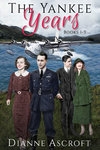
Meanwhile, as you wait for the sale week to arrive, you can enter the Dunkirk Rafflecopter Giveaway to win a signed copy of one of the books included in the sale. Eleven titles are included in the giveaway (you might notice that one of them is The Yankee Years Books 1-3). Enter the Dunkirk Rafflecopter Giveaway.

Dunkirk-rafflecopter-500x500-300x300

Posted in Archives, June 2017, Uncategorized | Tagged , , , , , , , , , , | Leave a comment

Last Saturday in Belfast

It’s been a hectic week: plugging away to meet a writing deadline, the usual work and chores, and baling hay. I spent a couple evenings helping to bring in hay bales at the beginning of the week which left me with little time for anything else those evenings and aches and pains for a couple days afterwards. So it’s only today that I have a chance to sit back and reflect on last Saturday in Belfast.

Dianne Belfast Book FestivalI was delighted to be included, with approximately 40 other writers, in Women Aloud NI’s event at the Belfast Book Festival in the Crescent Arts Centre. We presented an afternoon of readings from our diverse range of writings and the variety and quality of the material was absolutely staggering.

If you’d like to hear more about the event, hop over to Fermanagh Writers’ blog: here.


group Belfast Book Festival

Posted in Archives, June 2017, Uncategorized | Tagged , , , | Leave a comment

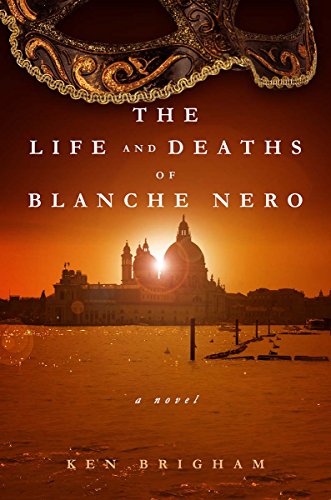
A Peek Into The Life and Deaths of Blanche Nero

Today Ken Brigham is visiting Ascroft, eh? to tell us a little about his new novel, The Life and Deaths of Blanche Nero.

Welcome Ken. Thanks for joining me today. Let’s get started, shall we?

Tell us about your novel.

KB: This is Blanche Nero’s story. It is a historical novel only in the sense that, long Blanche Nero coverafter the fact, Blanche’s persona, experiences, and behaviors were strongly influenced by historical events that largely preceded her existence. At 15, Blanche watched her father electrocuted for a brutal and inexplicable murder. Left with her emotionally remote mother who worked as a nurse, Blanche became pretty much totally responsible for the course of her life. She did well with that charge. She became a trauma surgeon and spent her professional life at Charity Hospital in New Orleans. She did well professionally, but wasn’t good at personal relationships. Sex was good, but emotional attachments were painful and difficult. She was haunted all her life by the enigma of her father and when hurricane Katrina destroyed Charity hospital and essentially ended her career, she went to Venice, her father’s birthplace, hoping to discover more of herself and life by writing down her history and exploring the place where it all began for her father. She meets an aging count who is dying of AIDS who introduces her to his special perception of Venice and who eventually solves the riddle of her father. As the count dies, Blanche weeps for him and is overwhelmed with a new realization of who she is and the depth of her emotional strengths. So the book is the story of Blanche’s emotional and physical journey punctuated by cataclysmic acts of man and of God, eventually arriving at an understanding of who she is.

What prompted you to write about this historical event?

KB: I didn’t write about the historical event as the central theme of the book. This is Blanche Nero’s story. The importance of Italian fascism and the second world war to the story is how those events (both actual and fictional) influenced who Blanche became and informed her eventual resolution of her enigmatic life. Of course Katrina and New Orleans were also seminal events for Blanche and that material is what I could learn from multiple accounts that are widely available.

How closely did you stick to the historical facts? If you used them loosely, how did you decide whether to deviate from them?

KB: The particulars of the depicted historical events are as factual as I could determine. However, as is often true of history, there are sometimes several versions. That is certainly true of Mussolini’s final days. The version I chose was the one that best integrated into the fictional story of Blanche Nero’s father and how, many years after the actual events, Blanche became collateral emotional damage of the second world war.

What research did you do for this book?

KB: Much of the work is based on my personal experiences over the course of a long career in academic medicine (e.g. med school, residency, treating critically ill patients in large teaching hospitals) and most of the places are places I know personally. The New Orleans episodes including hurricane Katrina are based on research into those events and places, mainly from material available on various internet sites. Of course, the WWII history and some details of Italian Fascism, Mussolini, etc. come from researching that period, including books and other materials. I relied heavily on materials available on the internet for the most part.

Do you use a mixture of historic figures and invented characters in the novel? Which is more difficult to write? Which to you prefer to write and why?

KB: Interesting. In fact, both kinds of characters are at least partly fictional. One can only know historical figures from second-hand (or more remote) accounts, so a lot of the character is invented by the author’s imagination. In some ways it is easier to totally invent a character, but in other ways it is easier if you have at least a framework of facts to embellish. If pressed, I’d have to say that I like inventing characters from whole cloth. That process requires thinking about human nature and the details of personality and behaviors – a philosophical exercise that can be revealing.

In an historical novel you must vividly re-create a place and people in a bygone era. How did you bring the place and people you are writing about to life?

KB: Most of the places I write about I know from personal experience and (with the exceptions of hurricane Katrina and WWII) the times are times I have known. The personal factor makes it easier, I think, to convey a sense of reality. For fictional people, I think details of conversation, behaviors, and to a lesser extent, appearances that resonate with the reader (hey, I know somebody like that) can breathe some life into fictional characters. Likewise, places, if based on real places, have to be consistent in detail with the actual place. Insertion of details that are real can help to make the fiction believable.

There often seems to be more scope in historical novels for male characters rather than female characters. Do you prefer to write one sex or the other. And, if so, why?

KB: As I have found true of real life, strong women usually make more interesting fictional characters than men. For example, I think Blanche Nero would be much less interesting as a man than she is as a woman. I see no reason why historical novels (or any other genre) should have more scope for male characters.

Thanks for answering my questions, Ken.

For more information about Ken Brigham visit his website . You can also follow him on Twitter. For more information about The Life and Deaths of Blanche Nero visit the book’s Amazon page.

Blanche Nero authorAbout Ken Brigham: Ken is emeritus professor of medicine at Emory University. He is widely published in the scientific literature and has authored or coauthored two previous novels and two nonfiction books. He lives with his wife, Arlene Stecenko, in midtown Atlanta.

Posted in Archives, June 2017, Uncategorized | Tagged , , , , , | Leave a comment