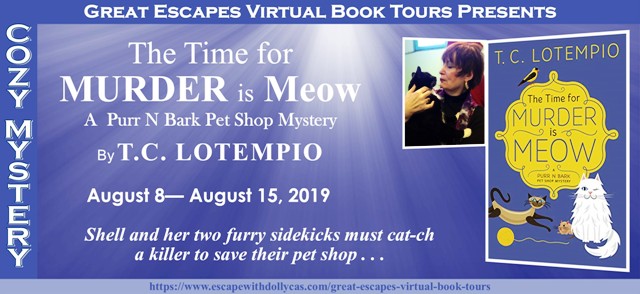
Today T.C. Lotempio is visiting Ascroft, eh? to tell us about The Time for Murder is Meow, the first novel in the Purr N Bark Pet Shop mystery series.
Welcome, T.C. Let’s get started, shall we?
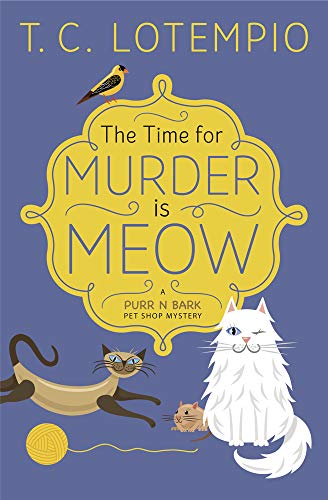 Tell us about your novel. Is it part of a series? If so, please tell us about the series too.
TCL: The Time for Murder is Meow is the first in the Pet Shop series. It’s about Crishell, “Shell” McMillan, a former actress who inherits her aunt’s pet shop and decides it’s time for a career change. When the woman who was giving her a hard time about donating her aunt’s poster collection to the local museum is found dead, Shell is tagged as suspect #1 and she and her former co-star Gary, have to work hard to clear her name.
Where did the idea for the mystery that is central to the story come from?
TCL: I’d been reading a few blogs by agents and one mentioned they’d like to see a good mystery that centered around a movie memorabilia shop, so I wrote that. Then an editor wanted me to change the setting to a pet shop, so I did that. Then the editor got let go, but my agent managed to place the book with another publisher.
Is there a theme or subject that underlies the story? If so, what prompted you to write about it?
TCL: It’s about being able to re-invent yourself, which is what I did myself. After years of slaving at dead end jobs, I finally caught a break and am doing what I love to do – write.
How do you create your characters? Do you have favourite ones? If so, why are you partial to them?
TCL: I always try to put a little bit of myself and people I know into all of my characters. Do I have a favorite? That’s like asking a mother to pick her favorite child LOL. But we all have favorites, and I confess I’m partial to Nick, the tubby feline hero of the Nick and Nora series.
How do you bring to life the place you are writing about?
TCL: I try to visualize myself in each scene, acting it out.
What research do you do to provide background information to help you write the novel?
TCL: It depends on what I’m writing about. I like to do research on small towns to get a feel for what I can put in the background of the book, for example, I’ll research local bookstores, libraries, coffee shops, etc.
Is there anything else you’d like to tell readers about the book?
TCL: If you’re in the mood for a spirited heroine, a good mystery and two feisty felines, this is the book for you!
Thanks for answering my questions, T.C., and good luck with The Time for Murder is Meow, the first book in the Purr N Bark Pet Shop Mystery series.
Readers can learn more about T.C. and her writing by visiting her website and her blog.
The novel is available at the following online retailers:
Amazon B&N IndieBound
Here’s an excerpt from TIME FOR MURDER IS MEOW:
“After I hung up from Max I flopped down in the worn chair behind the register and leaned back, my hands laced behind my neck. Max’s parting words bothered me more than I cared to admit, and a twinge of guilt arrowed through me at the thought I might possibly cost Gary this job. Kahlua hopped up on my lap and swatted my chin with her paw. “You’re right, Kahlua,” I said. “Max might have been exaggerating, hoping to play on my sympathy. Gary’s a big boy and a good actor. He’ll push through no matter what the role.”
It was high time I thought about what was best for me for a change. As Aunt Tillie used to say, “If you don’t put yourself first, it’s a sure bet no one else will.” Well, it was high time I did that. I’d put everyone else’s needs above mine, far too often, most recently with disastrous results. I glanced at my hand – the empty third finger of my left hand, specifically – and a small sigh escaped my lips.
Everything happens for a reason.
A mental picture of Patrick rose in my mind’s eye, and I resolutely pushed it away. I’d been so certain he was the one. I’d spend hours in my trailer between scenes, fantasizing about the perfect life we’d have together and then, in one afternoon, it had all come crashing down. I’d flung my four-carat diamond ring at Patrick and the script girl he was in bed with, stormed out of the apartment and never looked back. A month later the show was cancelled, and three weeks after that I was on a plane to Fox Hollow. And now here I sat, sorting through boxes of catnip balls and doggie chew toys. Go figure.
The bell above the shop door tinkled, jostling me out of my reverie and reminding me once again I’d forgotten to lock the door. “I’m sorry, we’re not open for business yet,” I began, and then stopped short. Three people stood grouped in the doorway, two women and a man. One woman was short and stout. She had flame colored hair (think Lucille Ball, only REDDER) teased up off her head and anchored with what had to be at least a pound of hairspray. She wore an aqua and orange flowered caftan a size too small which served to accentuate her generous frame instead of hiding it. Her age was hard to judge but I placed her as approximately ten years older than myself, late forties to mid-fifties. The man was around the same age. He had a brown beard shot with streaks of grey, and kind eyes behind large, tortoise framed glasses. His jeans were neat and pressed, and held up by multicolored suspenders with a thread of glitter running through them.
The other girl was a good bit younger than either of her companions. I placed her a bit younger than myself, late twenties, early thirties tops. She had long, luxurious dark brown, almost black hair that flowed across her shoulders like a waterfall. I couldn’t see her eyes behind the massive Jackie O sunglasses she wore, but I was betting they were the same color as the hair. Her slender frame was accentuated by the skintight Capri jeans and tank top she wore. Toenails painted a bright blue peeped out from flip-flops of the same color. The girl carried a massive basket wrapped in yellow cellophane.
“Welcome to Fox Hollow,” they chorused, almost as if they’d either rehearsed it or else done it a million times before. It was hard to tell which. “We know you’re not open yet,” the redhead added. “But we saw the light on, so we figured maybe this was as good a time as any.” She held out her hand. “Rita Sakowski. I run the coffee shop up the block. Sweet Perks.”
“Oh, yes.” I gave an enthusiastic nod. “I did notice your shop. I’m rather a coffee nut. Sorry I haven’t had time to stop in yet, but I’ve been busy.”
“Oh, we know,” Rita gushed. “You’re Crishell Marlowe, the actress, Tillie’s niece. I’ve always loved that name. It’s so unusual. How did you think of it, or did some Hollywood bigwig do it for you?”
“Nope. If anyone’s to blame, it’s my parents.” I took the hand she shoved in front of me and let her pump it up and down. “They couldn’t decide between Shelley and Christine, so they invented Crishell. It’s kind of a mouthful for most people, though, so I go by my nickname. Shell.” I paused. “I should also mention I’m using my real last name now. McMillan.”
“Oh.” Rita dropped my hand abruptly. Her smile faltered just a bit and then it was back in place. “Well, I have to tell you everyone in Fox Hollow is just thrilled you’ve decided to keep Tillie’s legacy alive.”
I smiled back. “It’s my pleasure.” I waved a hand around the store. “I’ve been taking inventory. I wanted to open it next week, but I doubt I’ll be ready much before the end of the month. As you can see, there’s still a lot of work to be done. I have to restock a lot of items, and, of course, get some pets in here.”
Rita nodded. “Of course. Tillie did let things slack off a bit those last few months. I guess we should have been quicker to take that as a sign something was wrong. Your aunt never slacked off. Never.”
We were all silent for a few seconds, and then the man reached out and took my hand. “Well, I’m pleased to meet you, Shell McMillan. I’m Ron Webb. Webb’s Florists. My store is right next door to Rita’s.” He grinned. “Sure comes in handy during the slow hours when I need a cup of java or a fresh baked scone to pick me up.”
The brunette reached up to brush a strand of hair from her glasses. I noted the blue polish on the fingernails had added glitter. “And I’m Olivia Niven,” she said. “My claim to fame is running the dance academy on Main Street.” She wrinkled her nose at me and looked pointedly at my feet. “Do you dance, Shell?”
“Not very well. I turned down Dancing on Air because I have two left feet. My co-star, Gary Presser was on last season though. He came in second.”
“I know. I voted for him. He got robbed.” Olivia looked me up and down. “I bet I could make a passable dancer out of you,” she laughed and flicked her hand dismissively. “If I can train the Boswell twins to win last year’s annual competition, I can train anyone.”
“That’s true,” Rita’s red hair swayed to and fro as she nodded. “Talk about left feet, those girls had ‘em, and now, well, you should see them foxtrot.”
Olivia shot me a mischievous grin. “Come by the studio. My girls will be thrilled to meet you. The boys even more so. They were all big Spy Anyone fans.” She shifted the basket to her other hand and whipped off the sunglasses, and I saw her eyes were indeed the same color as the hair, maybe even a shade darker. “So,” she reached out to tap the top of the basket. “We just came over to give you this small token to welcome you to the shop community, and to offer any help you might need.”
Rita gave Olivia a small nudge, and the younger woman held out the basket to me. Through the cellophane I saw cookies, cakes, an assortment of gourmet teas and coffees, and a small plant.
“Some treats Rita, Ron and I put together,” Olivia said, with a sidelong glance at her companions. “To be honest, it was mostly Rita. Enjoy.”
“Thanks.” I had to grip the basket hard. It was really loaded down. “This was very nice of you.”
Rita waved her hand carelessly. “Oh, don’t mention it sweetie. We all loved your aunt, and this store is one of the most popular in Fox Hollow. When the tour buses come through, they always make a stop here. Nothing people like better than to take a little souvenier home to their pets. Oh, and you might want to give Kathleen Power a call. She knits the most darling doggie and kitty sweaters and booties. Your aunt used to sell them for her all the time, on consignment.”
“Thanks, I’ll do that.” I smiled. “I hope I can live up to my aunt’s reputation.”
“I’m sure you will, dear.” Rita hesitated and then added, “I have to say, we were all surprised when we heard that you would be moving here and taking over the store.”
“Oh, don’t be so coy, Rita,” Olivia cut in. She turned to me. “We were shocked. After all, Fox Hollow’s no Hollywood.”
I nodded. “Thank God for that.”
Now that her arms were free, Olivia crossed them over her well endowed chest. “So, you’re really planning on staying and making a go of this? Or is this just a pit stop before your next series?”
Apparently Olivia wasn’t the type to pull any punches. Personally I found that refreshing after living in the phony Hollywood community for so long. “I assure you, I’m here to stay. I’ve retired from show business.”
Olivia’s perfectly arched eyebrow skyrocketed. “Retired? Really? I would think that would be hard. Isn’t it in your blood? I mean, your mother’s an actress too, right?”
I shot her a wry smile. “If that’s true, then I want a transfusion.”
“I was sad to hear about your series,” Rita cut in. “I always watched Spy Anyone. It was one of my favorite shows.”
“Mine too,” said Ron and Olivia nodded. “I watched it for your co-star,” Olivia said with a shrug. “I hope he’s not retiring from show business too.”
“Gary? I doubt it. He’s too much of a ham.”
Olivia leaned one arm on the counter. “Frankly, I’m disappointed. I thought your moving here had something to do with that breakup of yours, you know with that director—OW!” She rubbed at her side and glared at Rita.
“No sense in rehashing things I’m sure Shell must be sick of hearing, right Shell?” Rita said smoothly.
“Oh, for pity’s sakes, the woman lived in Hollywood, the gossip capital of the world. She’s used to it, aren’t you Shell?” Olivia demanded.
“Now now Olivia, don’t put her on the spot,” chided Ron. “She might not want to talk about it.”
“Oh, don’t be silly Ron. Shell’s a public figure. Her life’s been an open book for years,” snapped Olivia. “Besides, I’m curious about this retirement. What made you decide to give up the bright lights to follow in your aunt’s footsteps?”
“Those bright lights aren’t all they’re cracked up to be,” I said. “When you’re on a hit show, your life isn’t your own. As for taking over Aunt Tillie’s business, well, I’ve always loved animals. I think if I hadn’t been pushed into going into acting, I probably would have gone for a career in veterinary medicine. And I feel I owe it to my aunt. She was always there for me when I was growing up. One of my biggest regrets is not having had much contact with her before she passed. No one in our family even knew she was ill.”
Rita made a sympathetic noise. “Don’t beat yourself up over that, dear. No one did. Tillie could be quite close-mouthed when it came to certain things, and her health was one of them. I doubted she’d have ever told you anything anyway. Tillie never liked folks worrying or fussing over her.”
“But she did enjoy fussing over others,” Olivia put in. “Take her roommate, for example.”
My head swiveled in Olivia’s direction and I let out an astonished gasp. “Roommate? My aunt’s lawyer didn’t mention anything about her having a roommate.”
“No?” Olivia shrugged. “Maybe it slipped his mind.”
“Kind of an important detail to slip up on, don’t you think?” I placed my hands on my hips. “Are you sure about this? I mean, I find it a bit hard to believe my aunt would take in a boarder. She didn’t need the money, and as you’ve already pointed out, she valued her privacy.”
Olivia chuckled. “That’s because you never saw the two of them together. He doted on your aunt, and she was a sucker for him.”
He. A male boarder. A sudden thought occurred to me. “Were my aunt and this boarder involved?”
“Oh, absolutely!” Olivia nodded. “There was nothing Tillie wouldn’t do for him. He had her wrapped around his little finger. Or maybe I should say paw.”
“Paw?”
Eyes twinkling, Olivia reached toward the basket I’d set on the counter, undid the cellophane and crinkled some of it between her fingers. “That should bring him running, see! There he is now.”
I turned and caught a blur of white out of the corner of my eye. The next instant, the blur streaked past me and with one graceful leap landed on all fours right in the center of the counter.
“Oh my God,” I cried. “What is that?”
“Merow,” said the blur. “Owww.”
The others started to laugh. “That,” choked out Olivia. “Is the store mascot and your aunt’s roomie.
“Shell, meet Purrday.”
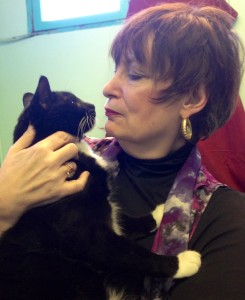 About T.C. Lotempio: While Toni Lotempio does not commit – or solve – murders in real life, she has no trouble doing it on paper. Her lifelong love of mysteries began early on when she was introduced to her first Nancy Drew mystery at age 10 – The Secret in the Old Attic. She and her cat pen the Nick and Nora mystery series from Berkley Prime Crime and the Cat Rescue series from Crooked Lane. Her latest, the Pet Shop Mysteries, makes its debut August 8 with The Time for Murder is Meow.

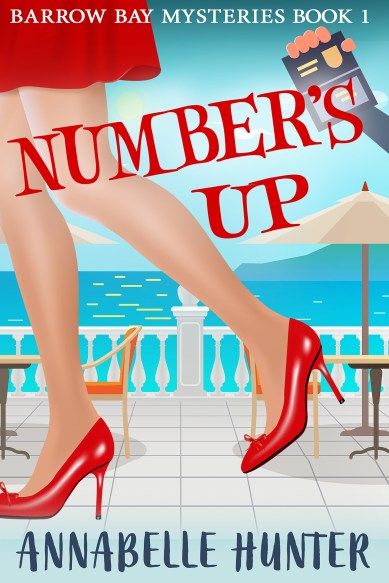 Step one — the idea. Most times this just comes to me. I’ll be watching something or reading, and a thought comes to me. Most times it is in no relation to what I’m doing, but I’m not picky. Then I think about it, scratch out some notes and, if I think it’s good, I grab a notebook and start world building. Or, since I’ve been focusing on Barrow Bay, the funny moment comes, and I start creating a crime around it.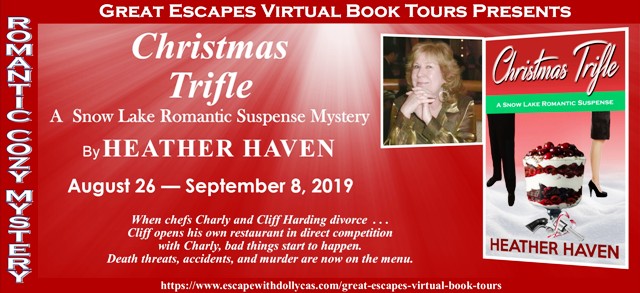
 I also love my niece, Charly. In Christmas Trifle, Book One of the Snow Lake Romantic Suspense Novels, I am what you could call the truth-sayer. It’s a role I take on reluctantly. But when Charly and her husband, Cliff, start acting like a couple of knot heads, I have no choice but to get involved.
 About Heather Haven: In the midst of writing her fourteenth novel, Heather has also written short stories, comedy acts, television treatments, ad copy, commercials, and plays. She has won numerous awards for her Silicon Valley-based Alvarez Family Murder Mysteries; Manhattan-based WWII Persephone Cole Vintage Mysteries; Ringling Brothers’ Circus mystery noir, Death of a Clown; and Corliss and Other Award-Winning Stories. She has two romantic suspense series: Love Can be Murder Mystery Novellas with Lee Alvarez and Gurn Hanson, the Nick and Nora Charles of Silicon Valley, and the new Snow Lake Romantic Suspense Novels, of which Christmas Trifle is Book One.


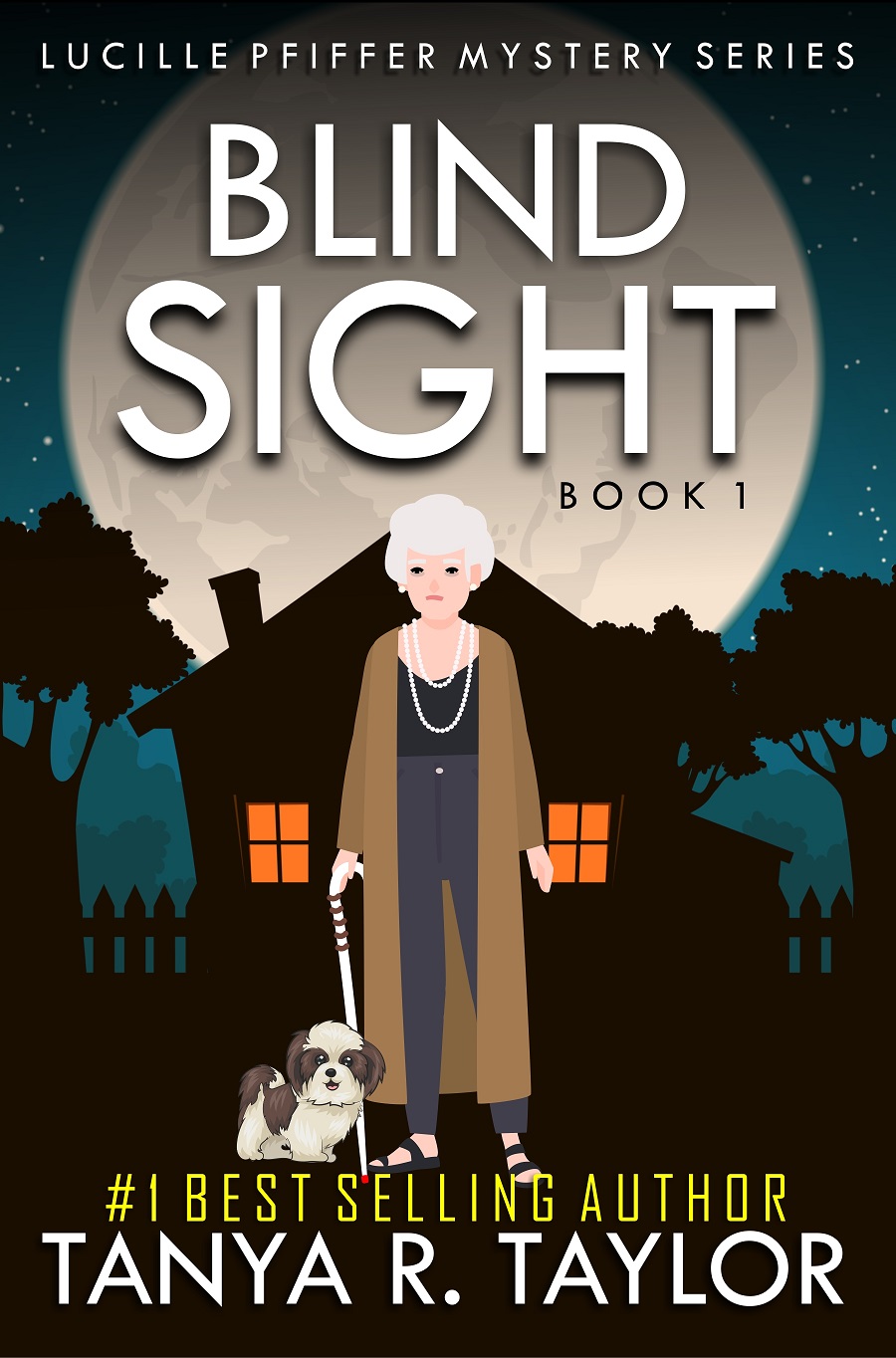 TRT: Lucille Pfiffer is a blind woman who’s also a heroine. Her determination to solve the mystery surrounding the death of a beautiful young lady in book one – BLIND SIGHT – is crucial to the right person being brought to justice. In book two – BLIND ESCAPE – she finds herself entangled in a murder mystery, but also becomes a target for extortion. Each book will have an exciting plot that readers can devour and many more books are planned for this series.
 About Tanya R. Taylor: Tanya has wowed readers with her riveting plots and compelling themes. She is the author of several #1 bestsellers on Amazon and published her first book titled: ‘A Killing Rage’ as a young adult. She has worked in the Financial arena and is also a seasoned ghostwriter. Her book ‘Cornelius’ climbed to #1 in the Teen & Young-adult Multi-generational Family Fiction category. And her supernatural, suspense/thrillers – ‘CARA’ and ‘INFESTATION: A Small Town Nightmare’ are multiple times #1 international bestsellers. Tanya writes in various genres including Paranormal Romance, Fantasy, Thrillers, Science-fiction, Mystery and Suspense. She has a passion for the welfare of children.
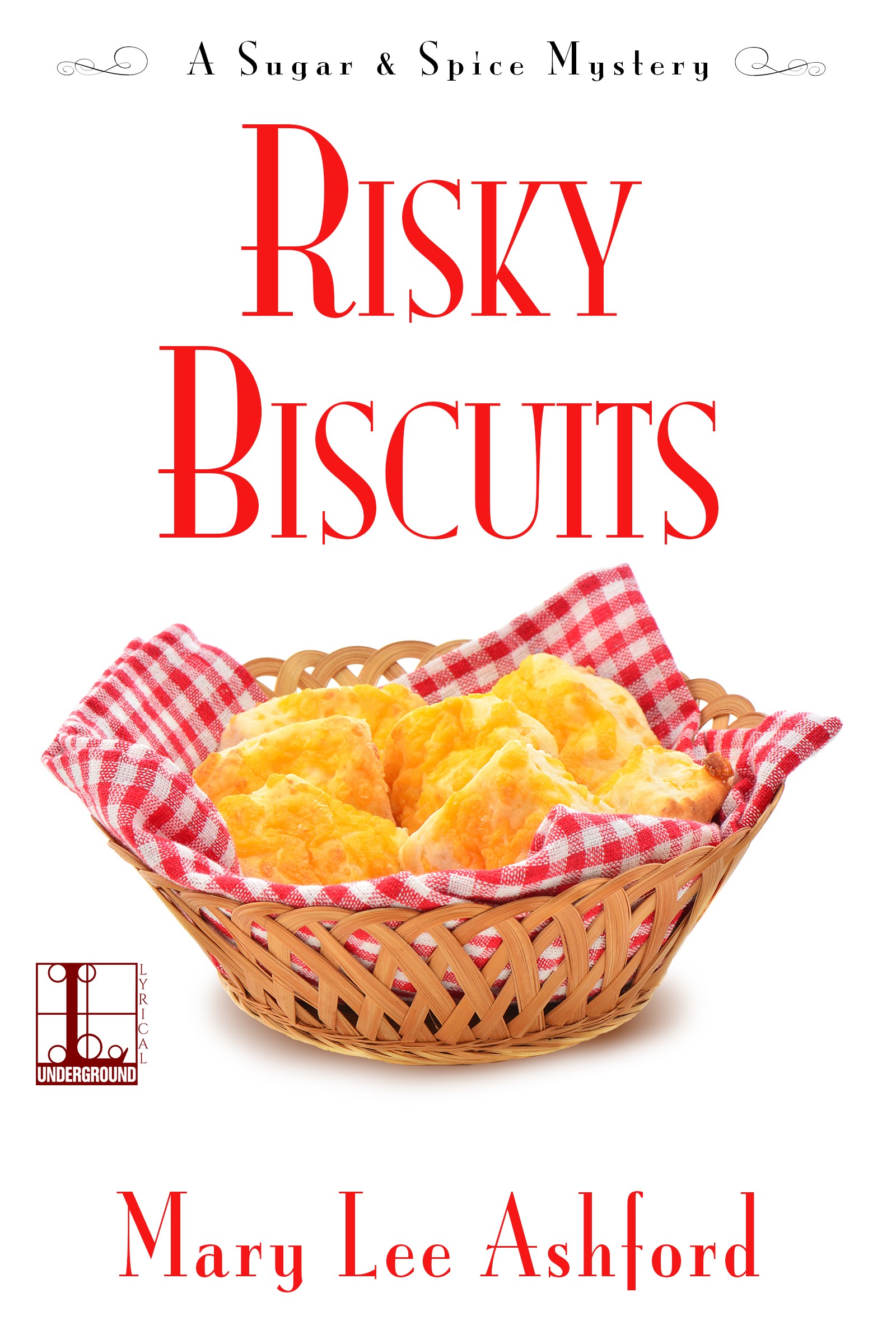 MLA: Thanks for asking! In Risky Biscuits, Sugar Calloway and Dixie Spicer launched their community cookbook business a few months ago and now have a few solid clients. They’ve taken on The Crack of Dawn Breakfast Club who want to put together a collection of their recipes as a fundraiser to fund refurbishing a shelter at the city park. But things go awry when the key organizer of the group is missing and later found dead. Suddenly Sugar and Dixie find themselves in the midst of a murder investigation that involves secrets both past and present. and more sticky situations than, well, a sticky bun. So, while they are collecting recipes they are also collecting clues much to the chagrin of local law enforcement.
 About Mary Lee Ashford: She is a lifelong bibliophile, and avid reader, and supporter of public libraries. In addition to writing the Sugar & Spice mystery series for
 so big on the public speaking and asked me if I could take today’s post. I’ve never had a problem with the limelight, probably because my mother has been sticking me in etiquette classes, pageants, and town events for as long as I can remember. My mother, Deidra, loves being the center of attention and really embraced her role as mayor’s wife when my father, Gregory, was elected mayor of our little coastal town.
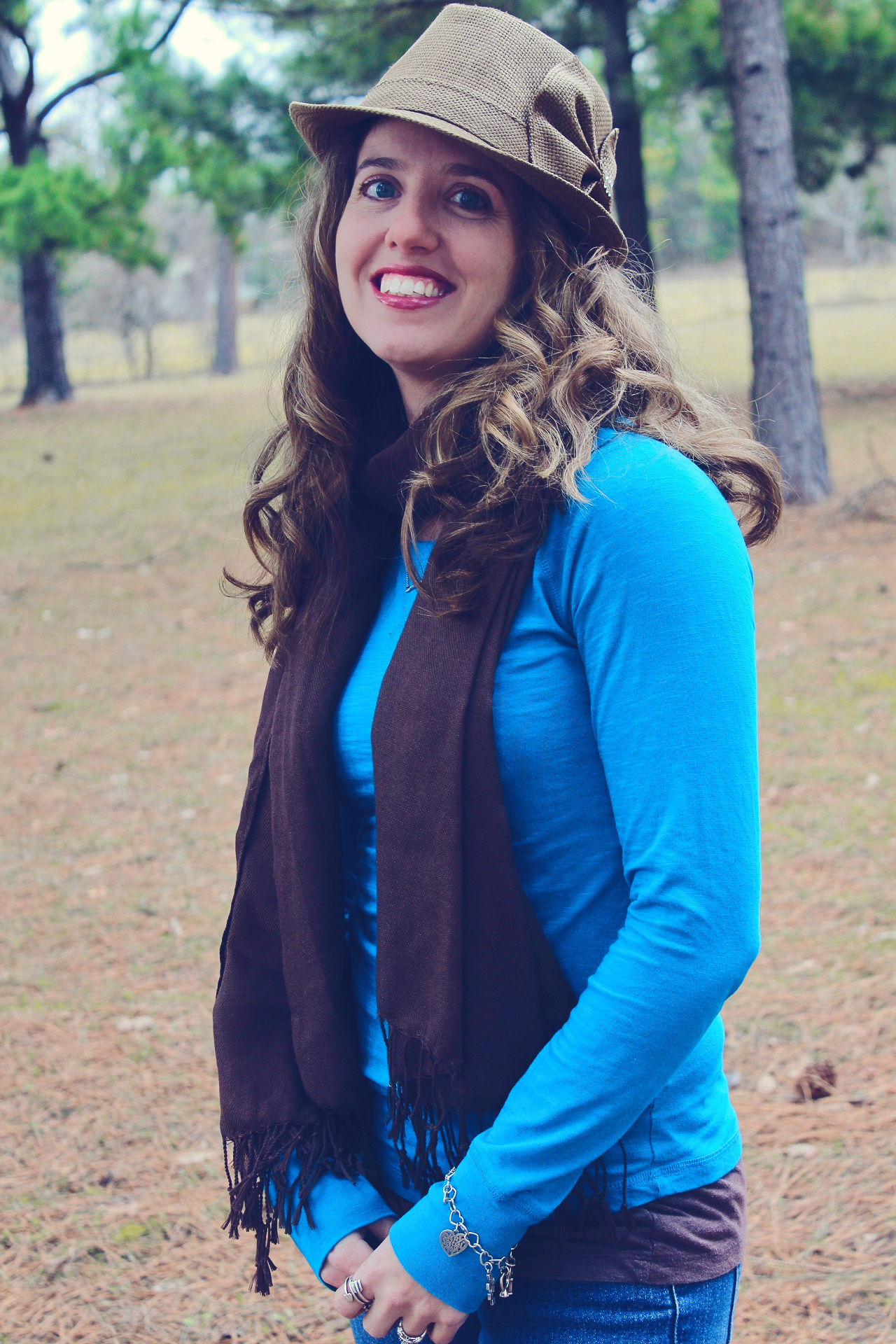 About Katherine Brown: Katherine is a Texas girl, a lover of books, and a weaver of words. Her first official publication was of two children’s books in 2017, which has now grown into five books of the School is Scary series; however, she likes to think her career as a writer started when she sold her parents newsletters of articles about school and poetry for fifty cents per copy as a pre-teen. Married to a wonderful husband and mom of a smart, spunky stepdaughter, Katherine enjoys spending time with family and reading as many new books as she can get her hands on. Her YA series, the Ooey Gooey Bakery Mystery series, is ramping up in 2019 with book 1 released in March and book 2 was released June 1, 2019.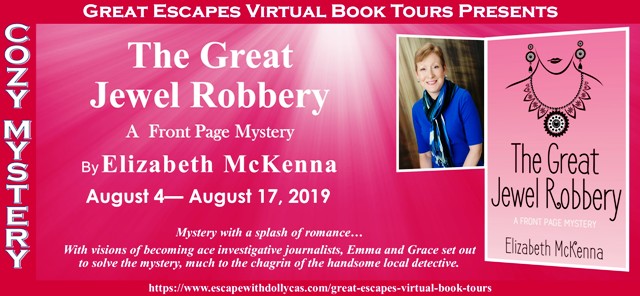
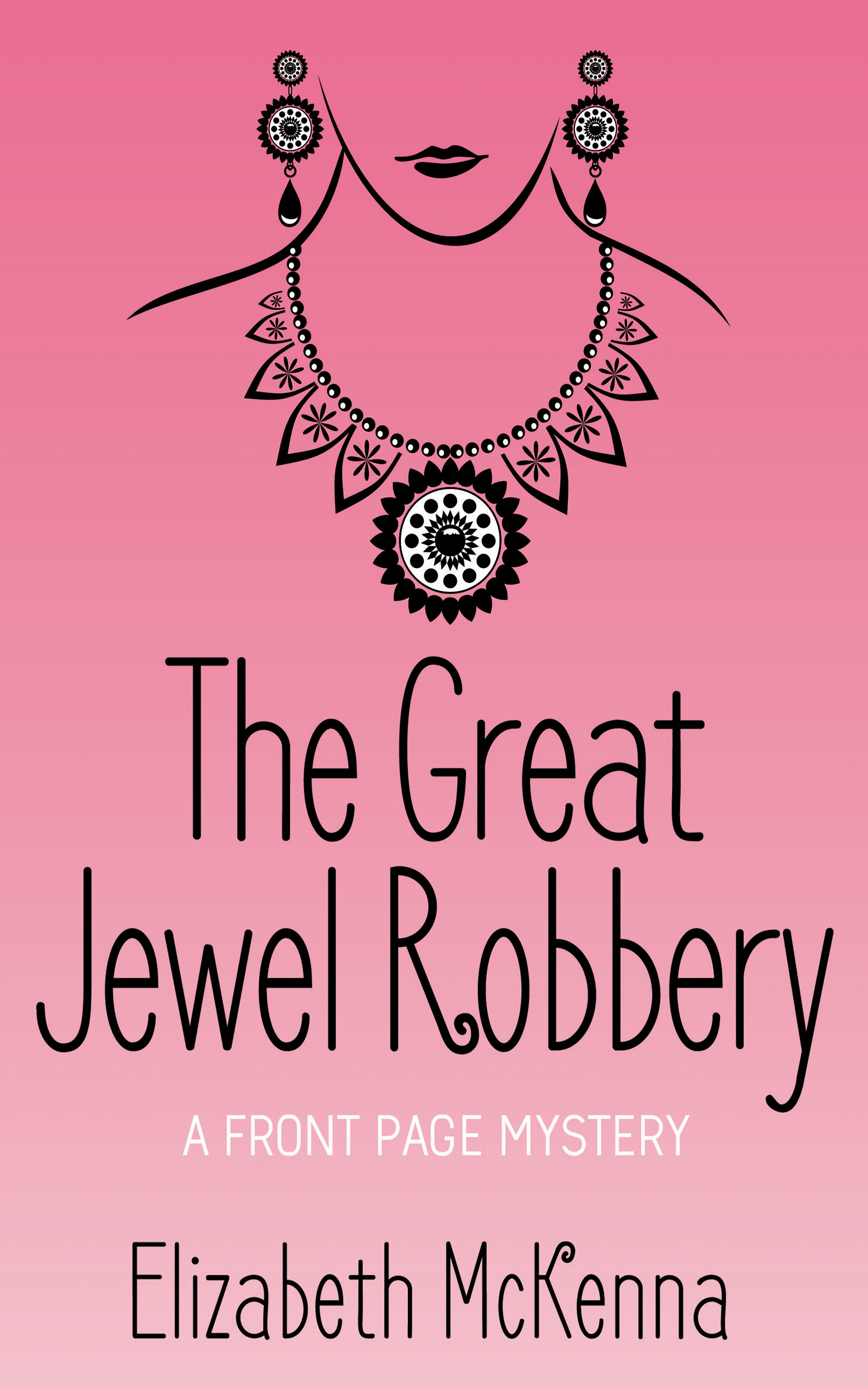 EM: The Great Jewel Robbery is book one of a new cozy mystery series called A Front Page Mystery. The story is told by Emma, a sports reporter for the Chicago Tribune. Her best friend and roommate, Grace, is also a reporter but for the Life & Style section of the newspaper. Grace is covering a charity gala at a lakeside mansion when one of the auction items, a multimillion-dollar necklace, is stolen. Emma is on hand as Grace’s “plus one” for the event, and they decide to investigate the crime to further their careers.
 About Elizabeth McKenna: Elizbeth’s love of books reaches back to her childhood, where her tastes ranged from Nancy Drew and the Hardy Boys to Stephen King’s horror stories. She had never read a romance novel until one Christmas when her sister gave her the latest bestseller by Nora Roberts. She was hooked from page one (actually, she admits it was the first love scene). She combined her love of history, romance, and a happy ending to write
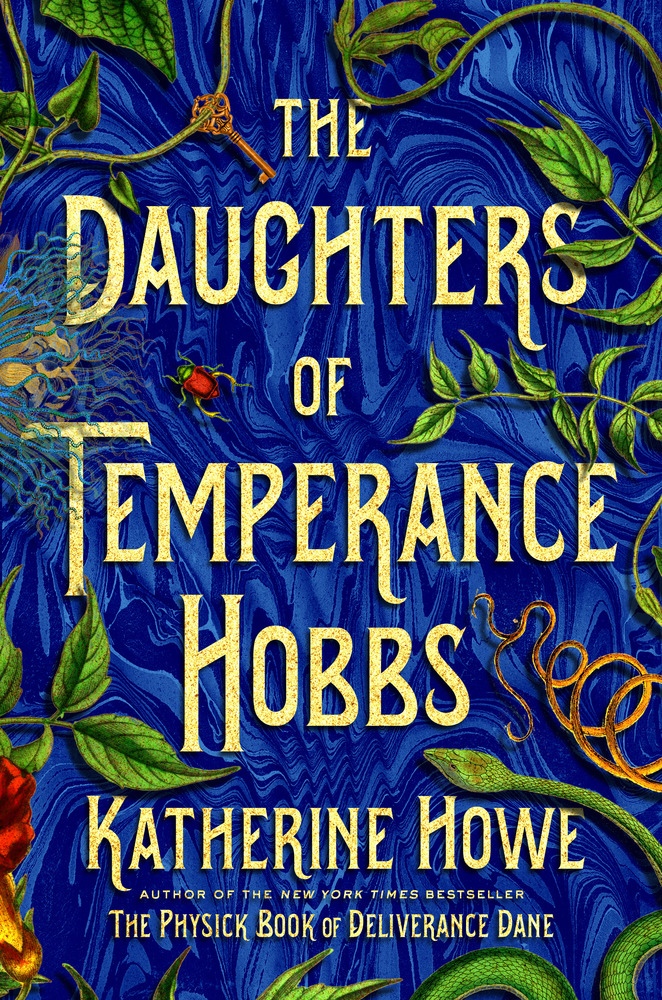 Katherine Howe returns to the world of The Physick Book of Deliverance Dane with a bewitching story of a New England history professor who must race against time to free her family from a curse.
 About Katherine Howe: She is the author of the New York Times bestsellers The Physick Book of Deliverance Dane and The House of Velvet and Glass, as well as the young adult novels, Conversion and The Appearance of Annie van Sinderen. She served as editor of The Penguin Book of Witches and her fiction has been translated into over twenty languages. Descended from three women who were tried for witchcraft in Salem, she and her family live in New England and New York City, where she is at work on her next novel.
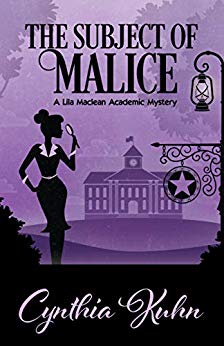 CK: The Subject of Malice is book four in the Lila Maclean Academic Mystery series. They are traditional/cozy/humorous mysteries featuring an English-professor-turned-amateur-sleuth.
 About Cynthia Kuhn: Cynthia writes the Lila Maclean Academic Mysteries: The Semester of Our Discontent, The Art of Vanishing, The Spirit in Question, and The Subject of Malice. Honors include an Agatha Award for best first novel and Lefty Award nominations for best humorous mystery. She blogs with Chicks on the Case and is a member of Sisters in Crime, Mystery Writers of America, and International Thriller Writers.