Richard H. Hardy and The Infinity Program

Today I’ve invited novelist, Richard H. Hardy to join me on Ascroft, eh? to answer a few questions about his recently released novel, The Infinity Program.

Welcome Richard. Let’s get started, shall we?

Tell us about your novel.
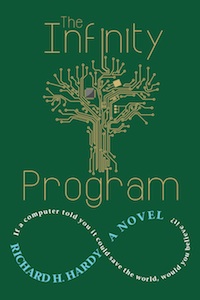
Infinity coverRH: The discovery of an alien quantum computer disrupts the lives of Harry Sale, Jon Graeme, and Lettie Olson.  As Harry Sale cracks the alien code, his breakthroughs threaten to bring havoc to the rest of the world.  Both Jon and Lettie pay a big price for Harry’s discoveries.  Under the very noses of those who are trying to stop him, Harry forges ahead, trying to unleash a technological singularity.  But one big question remains:  Is Harry programming the computer or is the computer programming him?

What is the theme of the story and what prompted you to write about this subject matter?

RH: There are actually a number of different themes woven into the fabric of The Infinity Program:  the individual versus the society; the importance of addressing major environmental problems; the decimation of the Earth’s natural resources; and the plight of women at male-dominated IT companies.  These are all issues I have given a lot of thought to over the years.  I think environmental concerns are fundamental to our survival as a species.

What research did you do for this book?

RH: I did quite a bit of research for The Infinity Program.  I read many articles and books on quantum computers, hyper-computers, and cryptography.  I also did a little reading about the Theory of Numbers.  But readers need not be concerned about all the technicalities—in The Infinity Program it’s the story that counts.

How did you bring the place and people you are writing about to life?

RH: I worked at a High-Tech company for over 26 years.  I tried to give a truthful account of the peculiar environment of an IT company.  Some aspects of my story, in particular the sexual harassment of Lettie, were based on accounts given to me by women who had worked at large IT companies in Boston and New York City.

Do you prefer to write one sex or the other. And, if so, why?

RH: Writing about women is much more of a challenge to me.  I found as I wrote the book that I had a lot to learn.  Fortunately, some women along the way, including my wife and my editors at Camel Press, helped me get on track when I fell short.  I would have to say I prefer to write about women characters although I find it very challenging.

Thanks for answering my questions, Richard. You’ve given me glimpses into the IT world and made me curious. Readers who are equally curious can find Richard on his website, Facebook and Goodreads pages and The Infinity Program on its Goodreads page and retail sites, including Amazon and Smashwords.

Hardy imageAbout Richard H. Hardy: He was born in Glasgow, Scotland, during a week of relentless bombing raids just before the close of World War II. The day he was born an incendiary bomb fell on the church across the street from where he lived, so he is fond of saying that he entered the world with a big adrenaline rush. His family later moved to England and then on to America.

After college Richard bounced through a series of temporary jobs as he traveled around the country, wanting nothing more than to write fiction. A job driving a library van allowed him free time to write several short stories and work on a novel.

He and his wife moved to New Hampshire, where he took an entry level job at a software company. He was soon promoted to the technical writing department and ended up producing over 500,000 words of online documentation. After a few years he was promoted to the programming department and ended up as the Senior EDI Programmer, creating EDI maps and writing UNIX scripts and troubleshooting on AIX systems throughout the U.S. and Canada.

After he retired, he started writing fiction again. The Infinity Program is his first published novel.
Posted in October 2014 | Tagged , , | 2 Comments

FLive Festival With Fermanagh Writers

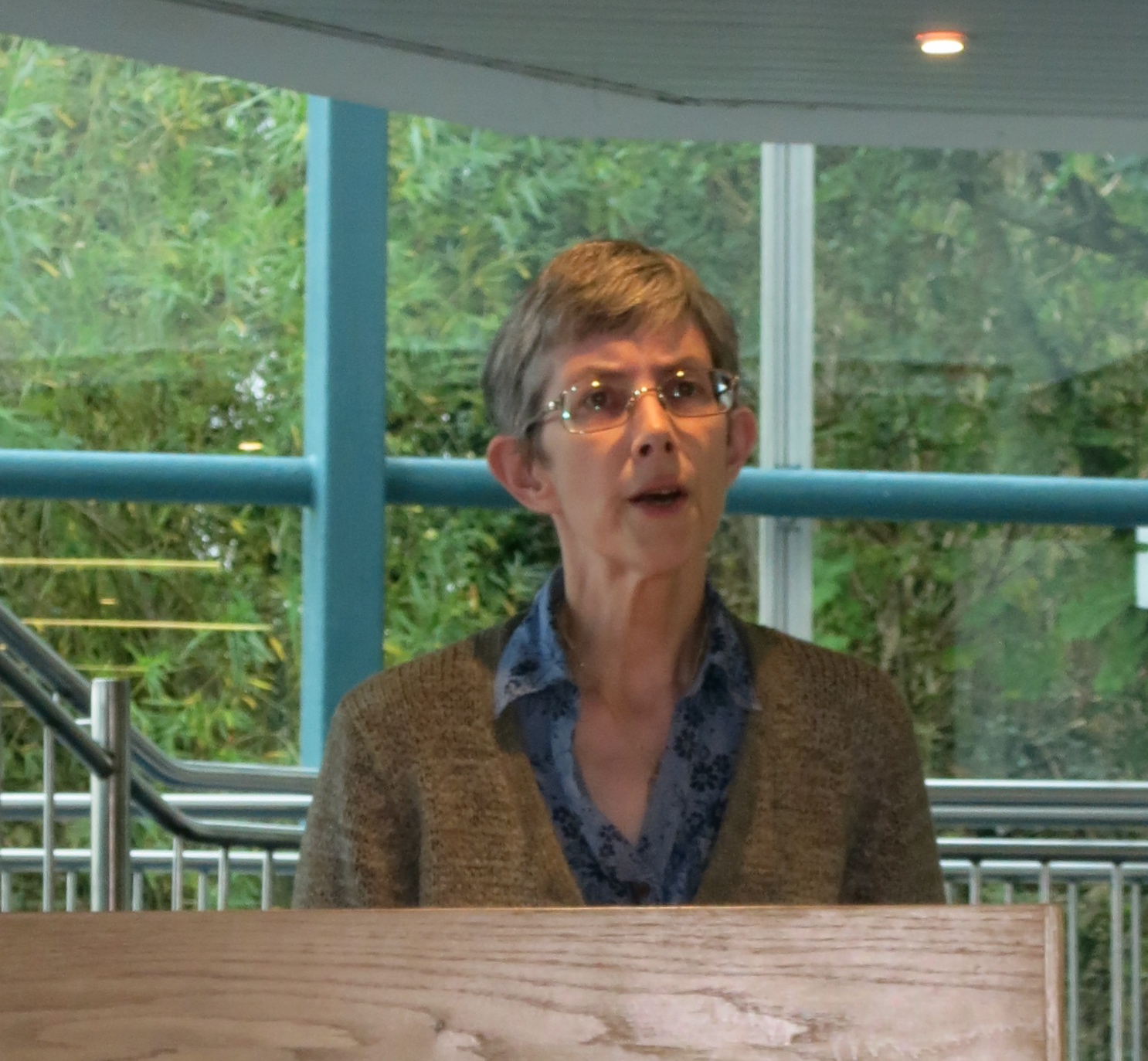
Last Friday evening I joined fellow Fermanagh Writers’ members as we performed at the Ardhowen Theatre in Enniskillen as part of the FLive Festival. It was a lovely evening and the theatre beside Lough Erne was a beautiful backdrop for our stories and poems.

FLive Dianne1I don’t often read my work in public and I wasn’t full of enthusiasm as I had been battling a sore throat and terrific headache all week (it’s fizzling out now – only a stuffed up nose and cough remain). But I was there. I chose an amusing anecdote and some poetry to read – nothing that would be too taxing in my debilitated state. Since the material was familiar to me so I didn’t have to worry about ‘my lines’ and the audience was appreciative, I really enjoyed my brief time in the limelight. It was fun to perform the material and watch the audience’s reaction. I don’t often have such instant feedback. I’m looking forward to doing it all again next year – but without the cold.

If you’d like to read more about our performance at the FLive Festival, hop over to Fermanagh Writers’ website.

Posted in Uncategorized | Tagged , , , | Leave a comment

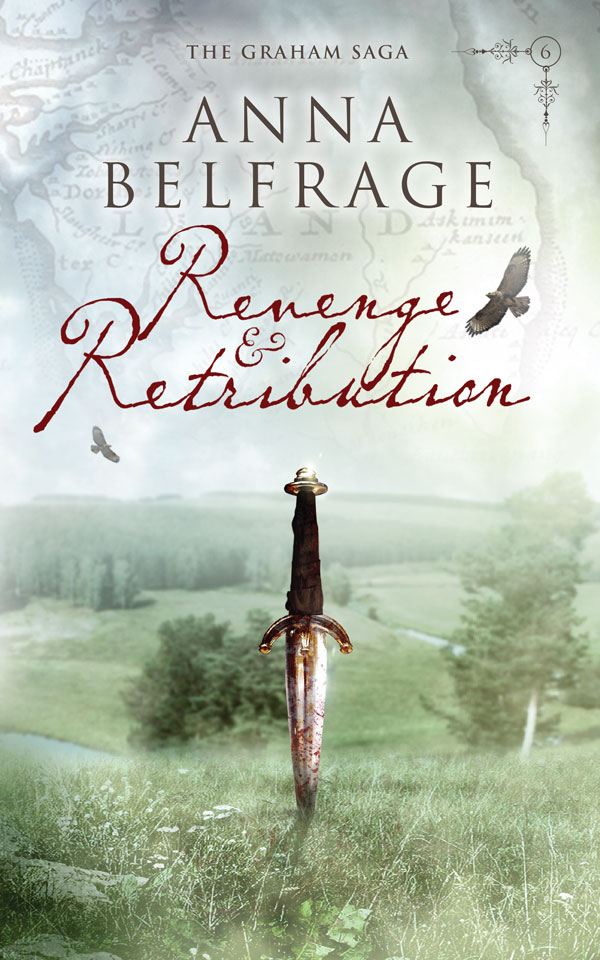
Relishing Revenge and Retribution

I recently received a copy of Revenge and Retribution by Anna Belfrage in exchange for an honest review. It’s number 6 in an eight book timeslip historical fiction series set in the seventeenth century. This is the second book I’ve read in the series; I reviewed Book 5, Serpents in the Garden, in April.

02_Revenge & Retribution coverThe publisher, Silverwood Books, describes Revenge and Retribution as, “the sixth book in Anna Belfrage’s time slip series featuring time traveller Alexandra Lind and her seventeenth century husband, Matthew Graham.

Life in the Colony of Maryland is no sinecure – as Alex and Matthew Graham well know. But nothing in their previous life has prepared them for the mayhem that is about to be unleashed upon them.

Being labelled a witch is not a good thing in 1684, so it is no wonder Alex Graham is aghast at having such insinuations thrown at her. Even worse, it’s Matthew’s brother-in-law, Simon Melville, who points a finger at her.

Not that the ensuing hearing is her main concern, because nowadays Alex’s entire life is tainted by the fear of what Philip Burley will do to them once he gets hold of them – there is no longer any ‘if’ about it. On a sunny May afternoon, it seems Philip Burley will at last revenge himself on Matthew for every single perceived wrong. Over the course of twenty-four hours, Alex’s life – and that of her family’s – is permanently changed.

As if all this wasn’t enough, Alex also has to cope with the loss of one of her sons. Forcibly adopted by the former Susquehannock, Samuel is dragged from Alex’s arms to begin a new life in the wilderness.

How is Alex to survive all this? And will she be able to put her damaged family back together?”

Revenge and Retribution is well written with a plot that keeps the reader’s attention. I was once again intrigued by the storylines of each of the main characters and enjoyed picking up the threads of their lives from where I had left them in the previous book.

Unlike Serpents in the Garden, this book does not sail back and forth between seventeenth century London and the American wilderness. It stays in the New World but the varied settings in town and countryside which the author describes vividly are more than enough to capture the reader’s imagination.

Characters are, of course, central to any story. I find the characters in this series believable and engaging and get immersed in their stories. I enjoyed following the developments in Sarah’s and Ruth’s lives this time and meeting the new character, Fr Munoz. After getting to know him in the previous book, I keenly felt the loss of one of the Graham boys. I did not like Alex’s wily brother-in-law, Simon Melville, nearly as much in this book as I did in the last one even though I understood the motivation for his actions; I was rooting for Alex.

It wasn’t difficult to pick up the threads of the story even though this is the sixth book in the series. Details from previous books are seamlessly woven into the novel and explained so that the reader isn’t confused. It’s possible to read Revenge and Retribution as a standalone book or as part of the series.

As in Book 5, once again all the strands of the story come together for a satisfying conclusion. The confrontation with the Burleys, that is a culmination of a conflict that has developed over several books, occurs in this book, at the place in the series where the reader is ready to have this issue resolved. But, although the story finishes with the Graham family on an even keel and recovering from the horrors they have faced, a glimpse into the first chapter of the next book assures me that there’s more to come. It seems that I’ll need to get the next novel and keep reading.

I can honestly recommend this novel to anyone who enjoys historical fiction, fantasy/time-slip or just a good story.

For more information about the author visit her website and her Facebook page. Revenge and Retribution can be found on Amazon and Goodreads.

Anna-Belfrage-150x150About Anna Belfrage: Anna was raised abroad, on a pungent mix of Latin American culture, English history and Swedish traditions. As a result she’s multilingual and most of her reading is historical – both non-fiction and fiction.

She was always going to be a writer – or a historian, preferably both. Instead she ended up with a degree in Business and Finance, with very little time to spare for her most favourite pursuit. In between juggling a challenging career she raised four children on a potent combination of invented stories, historical debates and masses of good food and homemade cakes. Nowadays she spends most of her spare time at her writing desk. The children are half grown, the house is at times eerily silent and she slips away into her imaginary world, with her imaginary characters. Every now and then the one and only man in her life pops his head in to ensure she’s still there.

Posted in September 2014 | Tagged , , , , | Leave a comment

How Do You Sum Up Your Novel?

It was my turn today to write the weekly blog post for Writers Abroad’s website. I was in London over the weekend attending the absolutely wonderful Historical Novel Society’s UK conference and I didn’t have much time to put into a blog post – or time to consider what to write. So how did I decide the topic? I had a meeting scheduled with an agent while I was at the conference and she wanted a tagline from me that would sum up my novel. This spurred me to research how to write a tagline – and the blog post followed from there. If you’d like to find out what I learned pop over to Writers Abroad’s blog and read the post.

Posted in Uncategorized | Tagged , , , | Leave a comment

Liv Thomas Knows Two Heads Are Better Than One

Several months ago I read a heartwarming and engaging novel, Beneath An Irish Sky, and I enjoyed its fresh take on Irish society and life. The novel is written under the pen name Isabella Connor. Isabella is actually two authors, Liv Thomas and Val Otaneanu.  Liv lives in the south of England and Val lives in British Columbia, Canada. The two writers have never met but they worked together to produce their debut novel. Liv is joining me today to answer a few questions about Beneath An Irish Sky.

Welcome Liv. Let’s get started, shall we?

What is the theme of the story and what prompted you to write about this subject matter?
Irish Sky cover
The theme of Beneath an Irish Sky is basically about a young man’s fight for justice and recognition…not easy for a naive young Traveller, when his adversaries are wealthy and powerful. The young man – Luke – isn’t aware that there’s a lot he doesn’t know, or that some of what he has been told, isn’t the truth.
The idea for the story just appeared like one of Joseph’s dreams…no idea what prompted it. It was inspired by actor Joe McFadden when he was in a brilliant mini-series called Sex Chips and Rock and Roll. He played a young Irishman who had a bit of a chip on his shoulder, and who had suffered discrimination. Without warning, came the thought that it would be really good to see him playing another Irishman with issues, and the Traveller idea came along with it – how about an Irish Traveller who has a wealthy British father, and suppose the father didn’t know etc. etc. The basic idea really did just fall into place as though it was already there, like something under the sofa, just waiting to be found.

What research did you do for this book?
We gleaned what we could from the internet, and then contacted someone with Traveller connections – thank you, Richie – who was very helpful and corrected us on a few things.

How did you bring the place and people you are writing about to life?
By believing that the characters, and some of the fictional places, were actually real. It’s surprisingly easy to do this when you live with them for so long. And visiting some of the real places, Limerick and Ennis, was a great help, and we had advisors from both Cheshire and Ireland – take a bow Sue O’Reilly and Brigid Killen.

Do you prefer to write one sex or the other. And, if so, why?
I don’t mind either, but I do like writing from the male pov. Maybe because it’s one way of making a man exactly what you want him to be. 🙂

How do you co-ordinate working with another person on your books?
Emails, telephone calls, and multi-coloured documents, with colour coding for comments, changes, additions etc. We didn’t discover ‘track changes’ until the novel was actually finished and at the editing stage. We were so green!

Thanks for taking the time to answer my questions, Liv. I was intrigued to hear that Joe McFadden’s role in Sex, Chips and Rock and Roll sparked the idea for the novel as that series was one of my favourite television programmes several years ago. Interesting to see what you’ve done with it! I know the two of you will release your next novel, An Irish Promise, in November and I look forward to seeing it in print.

Readers can learn more about Liv and Val at their website and will find Beneath An Irish Sky on Amazon US and UK as well as other retail outlets.

Posted in August 2014 | Tagged , , , , , , , , | 2 Comments

Without A Word Of A Lie, I Loved Lies Told In Silence

Recently I had the pleasure of reading Lies Told In Silence by M.K. Tod. It’s a well written, poignant novel and as I read I lost myself in the story, not even bothering to make notes for my Historical Fiction Virtual Tours review. In fact, I was so captivated by the book that I immediately bought Tod’s first novel, Unravelled, which is the companion to this novel and I am now immersed in the Canadian soldier, Edward Jamieson’s story.

02_Lies Told in Silence CoverThis is how the publisher summarises Lies Told In Silence: “In 1914 Paris half the city expects war while the other half scoffs at the possibility. With knowledge gained from his role at the War Department, Henri Noisette fears that Germany may soon attack Paris. He therefore sends his wife, mother and two younger children to Beaufort, a small village in northern France. By late 1914, instead of a safe haven, Beaufort is less than twenty miles from the front. As war unfolds, Henri’s daughter, Helene, grows up quickly and in 1917 falls in love with Edward Jamieson, a young Canadian soldier.

The novel examines love and loss, duty and sacrifice and the unexpected consequence of lies.”

Lies Told In Silence is a romance and a coming of age story set against the backdrop of World War I. The story is told mainly from Helene’s perspective but we do also gain insight into the lives of her parents and her grandmother, revealing how their past experiences have shaped their lives. I empathised with all three generations of Noisette women, watching their relationships with each other develop and their bonds strengthen throughout the course of the war. The dynamics of their relationships are timeless and I found their intertwined experiences especially touching. I found Helene’s first love, Edward Jamieson, an appealing character but rather remote. This isn’t surprising as we only know him through Helene. Each of the main characters is noteworthy but there are also many memorable secondary characters who leave a clear impression in the reader’s mind: the reliable Gaston, the melodramatic Germaine and the pig farmer Monsieur Garnier to name a few.

The story flows effortlessly and at  a steady pace between a gentle but realistic coming of age story, an exhilarating romance and a gripping war drama. All the elements come together to form a page turning plot. One of the central themes of the book is that love which develops gradually can be satisfying and enduring. As Helene matures she learns that more than romantic love matters and she must decide how to balance responsibility and passion. It’s a realistic, no nonsense approach to a romantic tale. The happy ending isn’t what you might expect and doesn’t come without heartache to counterbalance it.

As a backdrop to the emotion and drama of the story the author vividly paints beguiling images of the French countryside and small town life as well as harrowing scenes of the battlefields. She is skilled at creating the background details that bring the story to life using all the senses. This includes incorporating the nuances of social convention and the mores of the period into the story.  I was so captivated by the town of Beaufort that I was rather disappointed to find that it exists only in the author’s mind.

Lies Told In Silence is a poignant, realistic portrayal of life and love and I thoroughly enjoyed it. I can easily recommend it to anyone who enjoys historical fiction or just a good story.

Readers can learn more about M. K. Tod on Facebook, Twitter, and Goodreads. Lies Told In Silence is available on Amazon US and UK as well as other retail outlets.

M.K. Tod Lies told silenceAbout M.K. Tod: Mary has enjoyed a passion for historical novels that began in her early teenage years immersed in the stories of Rosemary Sutcliff, Jean Plaidy and Georgette Heyer. During her twenties, armed with Mathematics and Computer Science degrees, she embarked on a career in technology and consulting continuing to read historical fiction in the tiny snippets of time available to working women with children to raise.

In 2004, she moved to Hong Kong with her husband and no job. To keep busy Mary decided to research her grandfather’s part in the Great War. What began as an effort to understand her grandparents’ lives blossomed into a full time occupation as a writer. Mary has an active blog – www.awriterofhistory.com – which discusses all aspects of historical fiction and includes author and reader interviews. Additionally, she is a book reviewer for the Historical Novel Society. Mary lives in Toronto where she is happily married with two adult children.

Posted in August 2014 | Tagged , , , , | 3 Comments

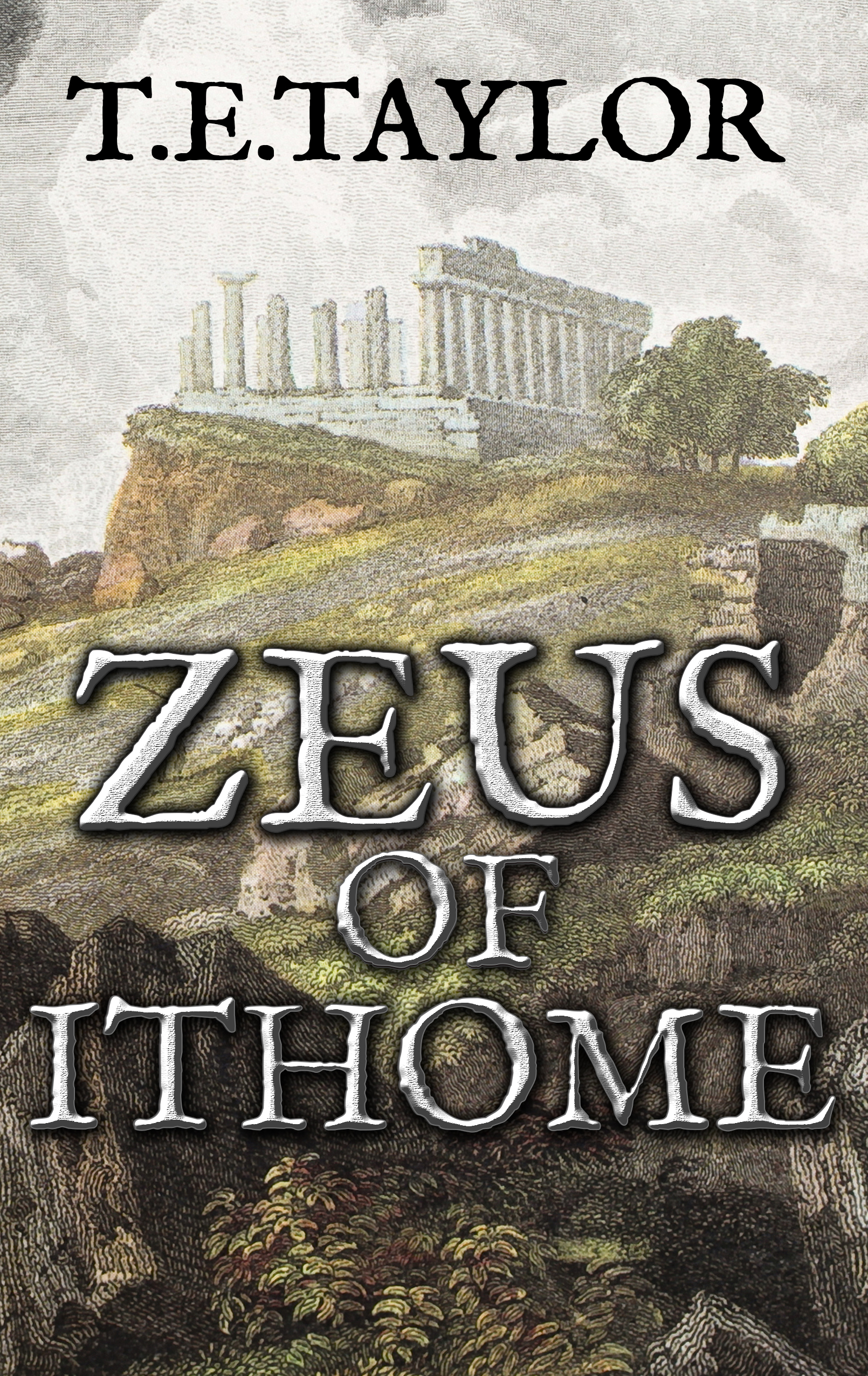
Zeus of Ithome: Step Into The Ancient World

Today we’re stepping back into the ancient world. I’ve invited Tim Taylor, author of Zeus of Ithome, to visit Ascroft, eh? to tell us a little about his novel.

You’re very welcome here, Tim.

Let’s get started, shall we?

Tell us about your novel.

Tim Taylor coverZeus of Ithome recounts the true story of a revolt (in the 4th century BC) by the Messenian people in southern Greece against the Spartan overlords who had kept them as slaves for three hundred years.  The tale is told through the personal story of Diocles, at the start of the novel a seventeen year old Messenian ‘helot’ slave.  After an encounter with the Krypteia – a band of Spartan assassins who kill uppity or unwary helots – he is forced to flee, leaving behind his family, his sweetheart Elpis and everything he knows.  On Mount Ithome, the ancient sanctuary of the Messenians, he encounters Aristomenes, an ageing rebel who still cherishes dreams of revolt.  The pair travel north towards Delphi to obtain advice from the oracle.  On his journey, Diocles discovers that there are others in Greece who believe it is time that the power of Sparta was broken, and whose help will be vital when the time comes to return to Messenia and begin their revolt in earnest.  (I will stop there, rather than spoil the end of the book for anyone who might be interested in reading it!)

What prompted you to write about this historical event or era?

I was reading about the Messenians in a book about Sparta.  I was already aware of them, but as I learned more about what happened to them and the fact that they managed to preserve their sense of nationhood through centuries of slavery, it seemed to me that their story was crying out to be told.

How closely did you stick to the historical facts? If you used them loosely, how did you decide whether to deviate from them?

As I say in the historical note at the end of the book, “I have tried to remain within the bounds of what is consistent with the historical evidence, whilst unashamedly interpreting it in the way I felt best suited the story”.  Only once did I deliberately write something which conflicts with the historical sources – and that was a case where the source was not believable anyway.

There is nothing wrong with books which explicitly alter history to explore ‘what if.. ’ ideas, but if something purports to be a historical novel in the fullest sense, I feel it is important that it should stick reasonably closely to the known facts – or, where the facts are not fully known, to be consistent with a plausible interpretation of the evidence (though the occasional minor liberty may be forgivable).  But whatever space exists between the known facts is fair game for the author’s imagination.  The great thing about ancient history is that there is usually a lot of space to play with here.

What research did you do for this book?

I already had a reasonable knowledge of ancient Greece, having studied it at university, though was not familiar with the particular events that feature in the novel.  I read the ancient sources:  Pausanias, Diodorus Siculus, Plutarch and others, and a couple of modern books about the period.  I also did lots of research on the internet as I was going along.  This was particularly useful for places.  I had visited some of the locations featured in the book, like Delphi.  For the others I researched the lie of the land using Google Maps and Google Earth, following my characters’ progress through the terrain virtually.

Do you use a mixture of historic figures and invented characters in the novel. Which is more difficult to write? Which to you prefer to write and why?

Most of my characters are fictional, but four historical people appear in the novel, although one of them features only briefly and another is someone about whom very little is known.  However, the Theban politician and general Epaminondas plays an important role both in my novel and in the real events of those times.  Historical characters take a little more effort, because you need to read up on them, but I wouldn’t say they were any more difficult or less enjoyable to write.

In an historical novel you must vividly re-create a place and people in a bygone era. How did you bring the place and people you are writing about to life?

I agree that bringing a place and time to life through the lives of your characters is central to historical fiction and part of what makes it so rewarding both to read and to write.  I tried to do this firstly by making sure I had a good knowledge not just of the historical events and places but of the details of everyday life: what they ate, what they wore, what they believed, how they travelled and fought.  Then I tried to put myself in the place of my characters, living those lives, having those beliefs and to imagine what it would have been like to live through and participate in those events.  They are a mix of universal aspects of human nature and the specific idiosyncracies of that society.  Their religious beliefs, in particular, seem very strange to modern people, but were very important in their lives.

There often seems to be more scope in historical novels for male characters rather than female characters. Do you prefer to write one sex or the other. And, if so, why?

In this case there was indeed less scope for female characters, as ancient Greece was for the most part a very male-dominated society: women were in general excluded from public life.  Thus it would have been difficult to give a female character a prominent role in the historical events Zeus of Ithome depicts whilst remaining true to the period.  There are, nevertheless, some important female characters in the novel, who feature strongly in the human story weaved around the history.

I think it is important to be able to create convincing characters of both sexes.  I don’t think gender in itself is a significant factor in what makes a character fun to write – that comes from their personality – though I guess that, as a man, I have to think a little bit harder when writing for female characters (though that’s no bad thing).  After Zeus, I did feel the urge to place a woman more centre stage, and in the novel I’m currently writing (which is set in the modern era) much of the narrative is from the first-person perspective of a female character.

Thank you for your very informative and interesting answers to my questions, Tim. Your story sounds intriguing.

Many thanks for inviting me onto your blog, Dianne, and for those thought-provoking questions!

Readers can learn more about Tim by visiting his website and his author page at Crooked Cat Publishing, as well as his Facebook and Twitter (@timetaylor1) pages. Zeus of Ithome is available on Amazon US & Amazon UK as well as other retail outlets.

Tim Taylor imageAbout Tim Taylor: Tim is an author based in Yorkshire, UK.  He writes fiction, under the name T. E. Taylor, academic non-fiction and poetry.

Posted in August 2014 | Tagged , , , , , , | Leave a comment

Pinky and Bear Are Back

A couple years ago I read and reviewed The Big Show Stopper by Ken Dalton and I thoroughly enjoyed the zany detective tale. The next year I read The Tartan Shroud and found it equally entertaining. So, when I was asked to review the latest book in the Pinky and Bear series, I happily agreed. And I wasn’t surprised that I enjoyed it just as much.

Dalton’s detective stories are light hearted romps with snappy dialogue, lots of action and a cast of outrageous characters who often upend a few stereotypes as they bumble to their clients’ rescue.

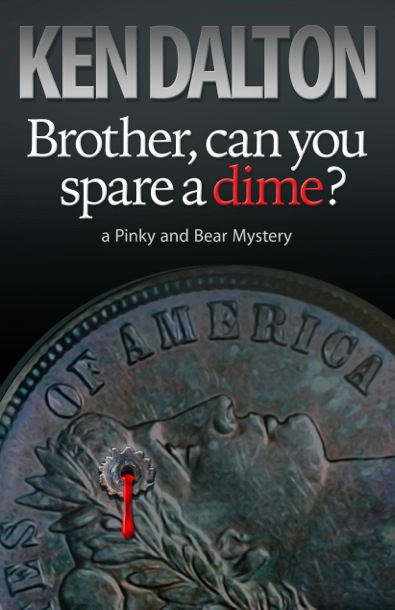
Brother coverHere’s the publisher’s description of Brother, Can You Spare A Dime?: “Bear’s planned afternoon of beer and baseball is interrupted by a phone call from a man he hardly remembers from their years at Elko High. So begins the tale of a cold-blooded murder and the theft of a dime worth two million dollars!

Faced with bi-coastal murder suspects, Pinky hands Bear and Flo the sweaty task of tracking down one of the suspects along the hot, humid North Carolina shoreline while he chooses to pursue the other on the Kona coast of Hawaii. But Pinky, after imbibing too many Mai Tai’s with a bevy of sky-goddesses, and a moved-up court date, is forced to return to Carson City, sans suspect.
Bear and Flo hit pay dirt and, with the identity of the killer in hand, they fly across the Pacific Ocean to the smoggy Beijing airport where they meet Joe, the uncle of Pinky’s Chinese secretary. The enigmatic Joe quotes Confucius and Shakespeare as he purposefully guides the dynamic duo to their final destination— oxygen sparse Lhasa, Tibet.”

Like the previous Pinky and the Bear novels I’ve read, the story is told mainly from two viewpoints: the sophisticated and unscrupulous lawyer, Pinky Delamont, and his bumbling but honest redneck private investigator, Bear Zabarte. The main characters still outrageously and unselfconsciously ignore any attempts to pressure them into political correctness. Pinky hasn’t learned a thing that would improve his morals but he has learned to hide this better and Bear is no wiser than he ever was. The reader is privy to their thoughts and understands the self-seeking, and occasionally noble, motives behind their every action. I enjoyed seeing Bear and Flo developing their confidence and assertiveness in this story so that they are better able to handle their employer. The recurring cast of zany, eccentric characters is one of the strongest aspects of the series.

The story is set in the United States, China and Tibet which added a different twist to this novel. As they found themselves in Scotland (The Tartan Shroud), the main characters were once more out of their comfort zone and this was guaranteed to lead to a few misunderstandings and lots of laughs. Bear is certainly not a seasoned traveller and I enjoyed observing him develop a tenuous grasp of Confusion (Bear’s word, not mine) and Chinese philosophy.

Like Dalton’s previous books, the humour is what makes this novel. It swings from amusing to absolutely farcical but fits perfectly into the story. Once again he has delivered crime fiction without too much grit and lots of laughs. I’m not sure what Confusion would say about it but I imagine he might agree that Brother, Can You Spare A Dime? is a fun read.

The author is running a Cliffhanger Contest: Brother, can you spare a dime? ends with a question that  is a prize winning cliff hanger that defies all logic. Let Ken know how you would answer the question and he will choose the two answers he likes the best. Both winners will receive a complete paperback set of his Pinky and Bear mystery series, each one personally inscribed:

The Bloody Birthright
The Big Show Stopper
Death is a Cabernet
The Tartan Shroud
Brother, can you spare a dime?

Email your cliff hanger answer to ken@kendalton.com and in a couple of months Ken will post the winners’ names on his Facebook page.

For more information about Ken Dalton and his novels visit his website, Facebook page and Goodreads page. The novel is available Amazon US & UK as well as other retailers.

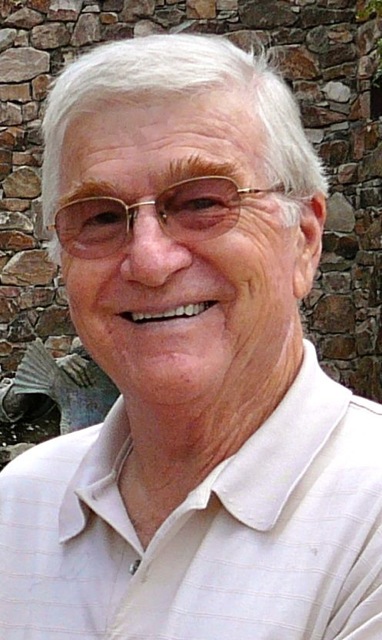
Ken Dalton Bio Photo 4-23About Ken Dalton: Ken was born in 1938 at Hollywood Hospital. He grew up in Los Angeles with his parents, his older sister and younger brother. In a turn of bad luck, the dreaded Polio virus attacked Ken at the age of five. By the age of sixteen, after eleven years of operations, therapy, and braces to mitigate the effects of Polio, Ken’s luck changed when he met the girl of his dreams. A few years later they married, produced three wonderful children, and settled into a happy life in Southern California. In 1966, Ken and his family moved to the green hills of Sonoma County where they bought a home surrounded with apple trees. Some time later he designed, built, and operated a small winery that produced award winning Cabernet Sauvignon and Chardonnay. Then, in a moment of madness, he began writing. His first article was published in Golf Illustrated. Many more golf articles followed in national and regional magazines including Golf Magazine and Fairways and Greens. Eventually Ken felt the urge to write his first novel. Now, after the publication of The Bloody Birthright, The Big Show Stopper, Death is a Cabernet, and The Tartan Shroud, Ken has published his latest Pinky and Bear mystery, Brother, can you spare a dime?

Posted in July 2014 | Tagged , , , | 2 Comments

Want To Know What I’m Working On?

Recently I’ve taken part in a couple ‘hops’ on Facebook where I’ve shared information about what I’m currently working on. I thought those posts may be of interest to my blog readers so I’d like to share them with you here.

Five Things About The Main Character of My Current WIP

  1. Mike didn’t believe in ghosts until he arrived in Northern Ireland.
  2. Mike never considered enlisting in the army until the attack on Pearl Harbour and, as he prepares for battle, he wonders whether he really is cut out to be a soldier.
  3. Mike grew up in Georgia next door to his best friend, Johnny Baker. The Irish-American Roman Catholic and southern Baptist are an unusual combination but inseparable friends.
  4. Mike has a burning desire to learn the secrets of his mother’s Irish childhood before his unit ships out from where they are stationed in Northern Ireland to continental Europe.
  5. Mike only ever wanted to do his bit in the war and get home again until he met Ellen Corrigan. As he prepares for battle his mind is full of conflicting thoughts and desires and he doesn’t know how much longer he has to sort them out.

Five Things About My Current Work(s) In Progress

  1. I didn’t go out on the waves or take up gambling but I did learn about sea angling, the gaming industry and post-polio syndrome in order to ghost write a memoir I’ve been working on.
  2. A real life incident that took a different turn than the story I’ve written was the inspiration for my recent flash fiction, Knowing You. The piece will be published in the September issue of the new online magazine by Writers Abroad.
  3. As part of my research for An Elusive Enemy, a World War II novel I’m working on, I visited a haunted house not far from where I live.
  4. Since I couldn’t find much information about training exercises in Northern Ireland during World War II, I created my own obstacle course. Luckily it’s only on paper so I won’t have to subject myself to tackling it.
  5. As part of my research for An Elusive Enemy, I spent a morning in the grounds of Colebrook Estate, an aristocratic country house about a mile from where I live. The grounds aren’t open to the public so I got a look behind the scenes at a private estate.

I hope you found the posts interesting. Check back here regularly to find out more about my upcoming novel, An Elusive Enemy, as well as other projects I’m working on.

Posted in July 2014 | Tagged , , , | Leave a comment

The Queen’s Exiles Reviewed

I read The Queen’s Exiles by Barbara Kyle a couple weeks ago and I enjoyed it immensely. So I’m delighted to review it as part of its Historical Fiction Virtual Tour.

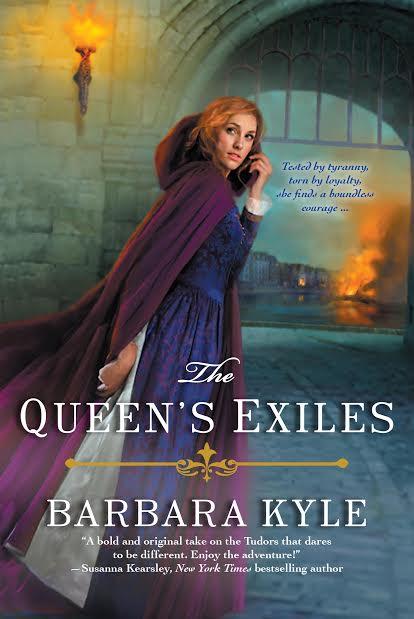
The Queen's ExilesThis is what Kensington Publishing says about the novel: “Europe is in turmoil. A vengeful faction of exiled English Catholics is plotting to overthrow Queen Elizabeth and install her cousin Mary, Queen of Scots on the throne. And in the Netherlands the streets are red with the blood of those who dare to oppose the brutal Spanish occupation. But amid the unrest, one resourceful young woman has made a lucrative enterprise. Scottish-born Fenella Doorn salvages crippled vessels. It is on one of these ships that she meets wealthy Baron Adam Thornleigh. Secretly drawn to him, Fenella can’t refuse when Adam enlists her to join him in war-torn Brussels to help find his traitorous wife, Frances—and the children she’s taken from him. But Adam and Fenella will put their lives in peril as they attempt to rescue his young ones, defend the Crown, and restore a peace that few can remember. With eloquent and enthralling finesse, Barbara Kyle illuminates one of history’s grimmest chapters. The Queen’s Exiles breathes new life into an extraordinary age when love and freedom could only be won with unmitigated courage.”

I found The Queen’s Exiles an absorbing, entertaining story and, even though I had plenty of time to finish it before my review was due, I grabbed every chance I could to slip back into the story for a short while, reading a few pages at a time whenever I had a few minutes free. I couldn’t leave the book down for long.

The plot and the characters drew me equally. I knew little about this episode in Tudor history until I read this novel. Kyle’s portrayal of it roused my empathy for the human suffering caused by the conflict between Britain and the Netherlands under Spanish control. The story flows well and there’s rarely a let up in the action. At the same time, Kyle balances well her descriptions of places and events with the action itself. I could see each scene in my head and felt that the action was happening around me. I had to keep turning the pages.

Kyle’s characters are also realistic. I especially liked and rooted for Fenella Doorn, empathising with her difficult choices and the hardships she endures. She is such a well drawn, dynamic character that it’s hard for me to believe she only played a minor role in a previous book in the series. I hope she will reappear in subsequent novels. Fenella is a very conscientious, moral person and that made her choices extremely difficult and, until near the end of the story, I couldn’t see how she might ever be able to be with the man she loves.

I find that I have less to say about this book than some others I have reviewed. That doesn’t indicate that I was not impressed by it. I think the brevity of my review reflects that I was not left with any unanswered questions or ends that weren’t satisfactorily tied up. I felt that the story was told exceptionally well and I couldn’t have wanted more from it. I was completely satisfied when I got to the last page though I was sad to leave Fenella.

I can easily recommend The Queen’s Exiles to anyone who enjoys historical fiction, romance in any era or just a good story.

For more information about Barbara Kyle visit her website. You can also connect with Barbara on Facebook, Twitter, and Goodreads. You can learn more about the novel on its Amazon US & UK pages and the first chapter of the novel is available to read here.

Mikhail PetgraveAbout Barbara Kyle: She is the author of the acclaimed, internationally-published Thornleigh Saga novels which follow a middle-class English family’s rise through three tumultuous Tudor reigns.

She was a speaker in 2013 at the world-renowned Stratford Festival with her talk Elizabeth and Mary, Rival Queens and is known for her dynamic workshops for many writers’ organizations and conferences. Before becoming an author Barbara enjoyed a twenty-year acting career in television, film, and stage productions in Canada and the U.S.

Posted in July 2014 | Tagged , , , , | Leave a comment