Today I’m welcoming Phyllis Schieber, author of Strictly Personal, The Sinner’s Guide To Confession and Willing Spirits, to Ascroft, eh?. After her first novel for young adults Phyllis has concentrated on ‘women’s fiction’ for the mature woman. I’ll let Phyllis tell us a bit about her background.
 Phyllis: “The first great irony of my life was that I was born in a Catholic hospital. My parents, survivors of the Holocaust, had settled in the South Bronx among other new immigrants. In the mid-fifties, my family moved to Washington Heights. The area offered scenic views of the Hudson River and the Palisades, as well as access to Fort Tryon Park and the mysteries of the Cloisters. My first novel, Strictly Personal, for young adults, was published by Fawcett-Juniper. The Sinner’s Guide to Confession, was released by Berkley Putnam and in March 2008, Berkley Putnam issued the first paperback publication of Willing Spirits.”
Phyllis, please tell us how you create your stories and how writing fits into your life.
Phyllis: “Perhaps it is because I began to read early and never stopped that it feels as though what happens in books makes much more sense than what happens in real life. Books are simply a written record of the writer’s truth, and I have the wonderful job of delivering that truth to my readers. When a story begins to take shape in my consciousness, I always worry if it is a story worth telling. Is it original? Is it interesting enough? Once I move past that stage and allow myself to be swept along by the characters and their needs, I settle down to the real work of making the story come to life. I am in charge now, but not really. The story is in charge. I am merely its voice. I almost never grow tired of being a writer. There is always something that inspires me, or evokes a memory, or sparks an emotion. I sometimes have this image of myself holding a huge magnet, watching as all my thoughts and dreams come twirling at top speed, drawn to the magnet, eager to be captured and finally uncovered.
Recently, I watched the documentary “Man on Wire,” the breathtaking film about Philippe Petit, the twenty-four-year old French self-trained wire walker who pulled off the “artistic crime of the century” in 1974 when he walked and danced on a wire suspended between the two towers of the World Trade Center. For forty-five minutes, Petit performed a high-wire act without a safety net or a harness, mesmerizing the crowd that had gathered on the sidewalk 110 stories below. While I was fascinated by Petit’s skill and the daring feat that continues to amaze, I was perhaps even more taken with his attitude and response to the hordes of reporters who asked the same question over and over: “Why did you do it?” Petit’s frustration is almost as exquisite as his exploit. He responds, “Here I do something magnificent and beautiful and people ask why. There is no why.” And such is the response of that rare individual: a true artist, the person who creates and performs for the sake of art.
 I am no Philippe Petit. I know why I write, but I understand what he means when he says, “There is no why.” If someone were to ask me why I write, I would have to say, “Because I have no choice.” In the years between the sales of my books, I continued to write, and I would have continued even if my agent was unable to sell The Sinner’s Guide to Confession. I write because I am a writer. I write because it is the way I make sense of the world. And I write because whatever I see or hear or experience has the potential to be translated into narrative. I notice the way a woman holds her bread at the edge of her husband’s plate, so his beans will not spill over. I record the most subtle exchange of looks between friends when someone else at the table mentions a name. I am aware of how a mother and daughter resemble each other as they shop together in a department store. When I attend a dinner for a friend and the hostess tells the story of how her previous home burned down, I am eager to leave and jot down the details because it is likely I will want to use not only the story, but the narrator’s wonderful tone and good humor as she tell about the unfortunate event. I will be sure to make mention of her crisp blue eyes and her throaty laughter. Often when I ask someone if he or she noticed something that was so apparent to me, I get a quizzical look. Always, however, I am the one who is perplexed. How is it possible that such an unusual expression, or such a surprisingly harsh tone or such an unexpected movement could go unnoticed when it is as plain as anything to me? I am always listening, always looking and always writing in my head.
One of the most important lessons I have learned as a writer is that I am not unique. I remember once many years ago, I had a meltdown and phoned my writing teacher of many years, the late Hayes Jacobs. I wailed, “I’ll never be successful. I don’t have any talent. I’m wasting my time in your seminar. There’s no point.” He listened without interruption. When I was done, he said, “You too, eh?” I laughed, but I felt better immediately. Apparently, all writers anguish at one time or another. The life of a writer is a solitary one and often frustrating. Still, I celebrate that it is my daunting destiny to recreate my perceptions, and then put them in a form that makes sense to others. Sometimes I struggle, and sometimes the words seem to dance onto the page. When the words dance, a rare occurrence, I worry that it is too easy. There seems to be a happy medium. Writing is always a consequence of extremes. Mostly, however, I feel blessed that I am able to string words together in a way that has an impact on others. The ability to make someone laugh or cry, or even both, is a thrill that little else surpasses.
I am always on the lookout for a new story, an anecdote that can be turned into a novel, a few lines in the newspaper that catch my attention, or the way a couple holds hands on the train, staring wordlessly ahead. Something must have just happened. I study them surreptitiously for the duration of the ride, wondering, imagining, and planning. It is the beginning of chapter. There really is no why.”
Thanks for joining me today, Phyllis, and giving us an insight into your thoughts and experiences.
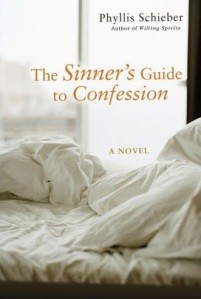
About her books: The Sinner’s Guide To Confession: Kaye and Barbara are longtime friends, now in their fifties. Ellen, who is several years younger, develops a friendship with the other two women years later, solidifying this close-knit group. The three women are inseparable, yet each nurtures a secret that she keeps from the others.
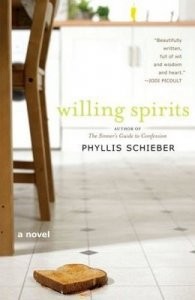
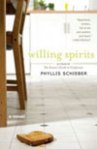 Willing Spirits: Jane Hoffman and Gwen Baker, both teachers and in their forties, have a friendship that helps them endure. Years after Gwen is abandoned and left to raise two sons alone, she finds herself in love with a married man. After Jane is humiliated by her husband’s infidelity and Gwen must face her own uncertain path, the two women turn to each other.
Now, as each is tested by personal crisis, Jane and Gwen face new challenges-as mothers, as daughters, as lovers. And in the process, they will learn unexpected truths about their friendship-and themselves.












 dianneascroft.com