
Several times last week I featured short stories in a variety of genres for National Short Story Week. During the process of looking for contributors to those blog posts, I met Pearl Goodman. She has written about her experiences growing up as the child of Holocaust survivors in When Their Memories Become Mine. Since her book didn’t fit into my theme for the week, I asked her to visit this week and talk about the book.
Thanks for joining me today, Pearl. Although my questions are designed for fiction authors, they also have some relevance to your memoir. Let’s get started, shall we?
Tell us about your novel.
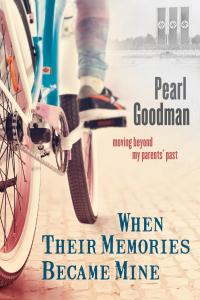 PG: Funny you should say novel because I actually came to the writing thinking as a novelist, using myself as the main character, and the events of my life as the story line. Another phrase for it is creative non-fiction. The “novel” aspect is very important because it implies a literary style and structure which is what I was using to artfully craft actual incidents. As someone who writes in the short story form, these became chapters in the book. They are arranged to move chronologically but they can also stand alone.
What prompted you to write about this historical event?
PG: The war in Europe from 1939-45 keeps entering our discourse, even so many years later, all over the globe. In this book, the story takes place during the ‘60s and ‘70s in Toronto, Canada, in a different era, country, and culture, yet still affected by those traumatic years. There’s no mistake there. Experiences are not confined to dates and times. We are learning more and more about how trauma defies integration and how it gets transmitted to future generations. My story is a microcosm of that process, demonstrating in very palpable ways how that transmission passes to a child growing up with Holocaust survivor parents. As she comes of age, she becomes conscious of her own reality, which is difficult enough, plus there exists an underlying, disturbing influence that is ever-present but hard to grasp. As a psychotherapist, I hope that my story can shed light on so many other traumatic events that people have endured, to raise awareness about these issues and to become more sensitive to why these experiences are so hard to overcome.
How closely did you stick to the historical If you used them loosely, how did you decide whether to deviate from them?
PG: Great question! Much of what I wrote was from actual memory. Readers seem to be struck by that, but how I understand it is, it was my way of making sense of my world. I tried to manage the inconsistencies I encountered as a child, to put them into a form, in order to stem the chaos. My ability to remember was the vehicle for that process. Not that I relied on my memory solely! I also checked my facts. With my parents’ story it was a little more challenging. My brother and I learned about their terrible tragedies, but the stories were always told in fragments. It was as if I was given a stick doll which then I’d have to flesh out and clothe. Again, cross-fact checking helped. The inventive device I used was to pair what was happening to me in the present with my parents’ story from the past, to show how these connected and what the impact was; they were written as if they were occurring simultaneously. I also used the past tense for the present episodes in my life, and the present tense for my parents’ past to show how trauma looms and lingers.
What research did you do for this book?
PG: The research for me was threefold. First was thinking back and remembering who I was, how I felt, and what I thought. In the words of well-respected UK/Canadian author, Kathy Page, the book is about “how a child of survivors has risen to the difficult task of excavating and articulating a family history that is both intensely personal and historically relevant.” Secondly, for the experiences my parents told me about, I cross-referenced those with Google, my resident historian. What I found was that my parents’ accounts were accurate, though their stories when I first heard them sounded inconceivable. Thirdly, my psychotherapy training also informed the writing, not so much analytically, but empathically and insightfully.
Do you use a mixture of historic figures and invented characters in the novel. Which is more difficult to write? Which to you prefer to write and why?
PG: For me the plot drives the need for characterization and it’s the same in reverse. I know that’s a confusing answer. Some person has to further the narrative. If there’s a historic event in the story I am telling, there were people there at the time, obviously. I can only imagine and express in writing what they might have said, and I will shape their words to be true to history. That’s a kind of invention but it’s housed in what actually took place. When I think about all the stories I have written over the past two decades, I have no preference actually for historic figures or invented ones. I find that sometimes I write the kind of mixture we are discussing here, which is more fact than fiction, and then I write pure fiction at other times. It depends on what the inspiration has been. For example one day, a colleague was wearing a blouse with the collar showing and resting on the lapels of her blazer. That one image reverberated in my mind, and became the basis for a short story which figured a minor character in similar attire, but other than that, there was no similarity whatsoever.
In an historical novel you must vividly re-create a place and people in a bygone era. How did you bring the place and people you are writing about to life?

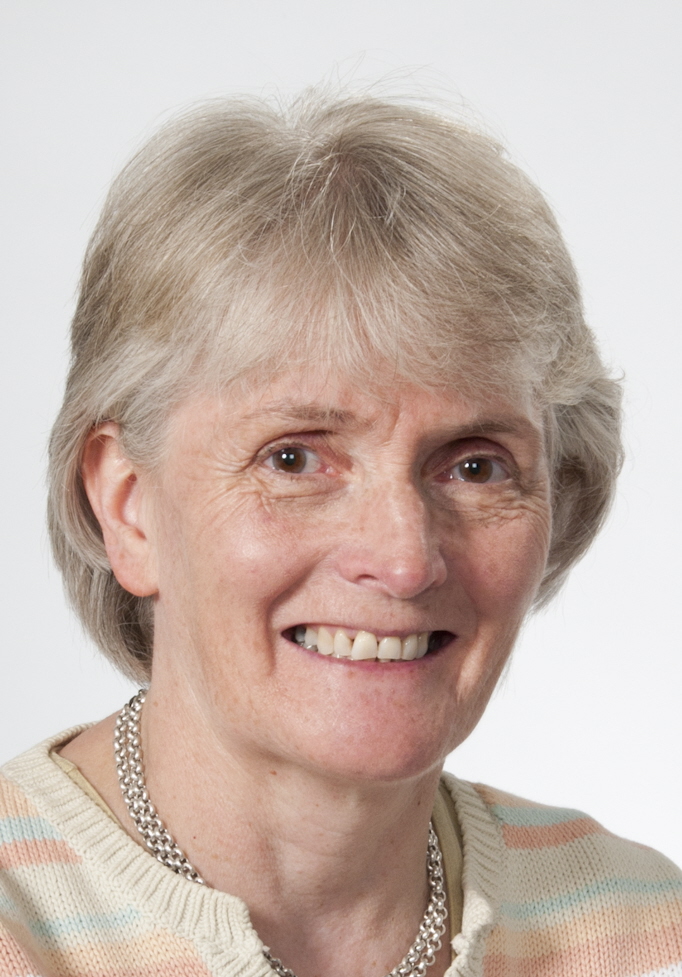
Pearl Goodman
PG: One of the ways I can describe it is to say that I was given a rough sketch and I had to determine the lines, and colour it in, which was an exciting process. Having the facts is just the beginning. A writer has to make the telling come alive. I naturally think and write metaphorically, and I believe again it’s because it’s a connecting device. It conveys the idea that two unrelated things are very similar. The metaphor helps with continuity and universality. In my book, American pop culture references abound. In my early life, Television was a major teacher of mores and lifestyle, and served as a counterpoint to my immigrant parents’ sensibility. In addition, I used those references when comparing WW2 war propaganda to the American advertising industry. Also, the device of writing about my parents’ past in the present tense helped make everything more vivid, more grating, more visceral, more experiential. In my own story about coming of age, I used a lot of comic relief to create a foil for my parents’ tragedy, and to “wrestle” in literary form with whether my issues were petty or not compared to my parents’.
There often seems to be more scope in historical novels for male characters rather than female characters. Do you prefer to write one sex or the other. And, if so, why?
PG: Again I would say, it depends on the inspiration and on the historic event. At the risk of going into a discussion about gender, the choice of a male or female protagonist, at least in the past, told a very different tale. It comes down to what story you are choosing to tell. Personally, I have written from both points of view. And even if the protagonist is male, surely there is a female or two who weighs in, and vice versa. In fact, I like to make my “lesser” characters as compelling as possible, sex/gender notwithstanding.
Thanks for taking the time to answer my questions, Pearl.
PG: Thanks for these thoughtful questions. It was a pleasure to delve into the answers.
Readers can learn more about Pearl by visiting her Facebook, Twitter and Amazon pages.
 Today I’m featuring wartime stories. This week is
  On the eleventh hour of the eleventh day of the eleventh month…
 This second story in the collection is about a well known incident during the reign of Basil II (grandson of the above Constantine and Helena, so we know Helena got her way). It involves one of his soldiers, Manuel Comnenus, and the siege of Nicaea. He was sent to defend the city against a rebellious general. Although the city walls were strong and kept the general out, it was running low on food and the people were facing starvation. The story tells how Comnenus tricked the general into thinking the city had plenty of food, but that Comnenus just wanted to get out and back to Byzantium so he could free his (imaginary) brother from the emperor’s clutches. The general fell for the trick, Comnenus, his soldiers, and the people of Nicaea were able to leave the city in peace, and the general’s rebellion soon collapsed.
 .June 1942: Pearl Grainger’s life is much more exciting and fun since the Allied troops arrived in County Fermanagh, Northern Ireland. Although she has to steel her nerve to help her brother, Davy, on smuggling runs across the border to the Republic of Ireland, she’s out dancing several times each week and meets an RCAF seaplane navigator, Pilot Officer Chuck Walker who quickly becomes special to her.
 This story is a short companion piece to one of the major characters in Logue’s series of novels, set during the English Civil War, and it’s the story of how one zealous and rather handsome young Puritan gentleman loses his faith, his beauty, but not, quite, his hope in the service of the Army of Parliament in the first battle of the wars.
 or use any other Irish cliché. But I am featuring Irish tales today. This week is
  Set in Ireland and America, as well as Paris, Rome and Mexico, the stories in the collection map the lives of parents and the boundaries they cross. Ní Chonchúir’s sinewy prose dazzles as she exposes the follies of motherhood as well as its triumphs. And once again she spotlights the contradictions and fierce loves that shake up the life of the family. The story ‘Letters’ sees an Irish mother cling to love of her son, though he abandoned her in New York, where loneliness is alleviated only by letters she cannot read.
 In this short story, a knight seeking the truth about occult mysteries arrives in medieval Dublin, on the trail of the ultimate secret of alchemy. In a muddy street, he finds what looks like the goal of his quest: an old alchemist who knows the key to the secret. What is the truth behind the Elixir of Life?
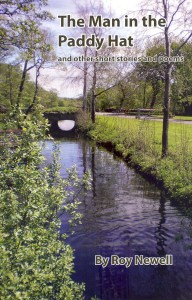 A collection of fourteen sketches of Irish life, most of which have a thread of humour running through them. Also included, for good measure, is a number of poems to amaze and delight readers. Proceeds from the sale of the book are donated to Parkinsons UK. To order a copy (£5.99 + postage), contact the author via email:
  Eire, 1600 BCE, the Atlantic Bronze Age. Connery the Great: his reign brought gladness and prosperity the likes of which were never again seen in the northern isles. His murder was a great misdeed of which people still speak. Enter the dark and fractured world which young Connery must navigate. Based on the ancient tale from western Europe’s oldest myths, The Destruction Of Derg’s Hostel.
![DA-DSTH-Amazon[1]-new](https://dianneascroft.com/wp-content/uploads/2014/03/da-dsth-amazon1-new.jpg?w=200&h=300) A collection of half a dozen short stories, most of them rooted in Ireland. Tales of outsiders who discover they belong, a humorous slice of life yarn, heartwarming love stories and a tale of taming fear. The shadows are on the wall, in the heart and clouding a woman’s memories while tangible foes tramp through the physical landscape.
A collection of half a dozen short stories, most of them rooted in Ireland. Tales of outsiders who discover they belong, a humorous slice of life yarn, heartwarming love stories and a tale of taming fear. The shadows are on the wall, in the heart and clouding a woman’s memories while tangible foes tramp through the physical landscape.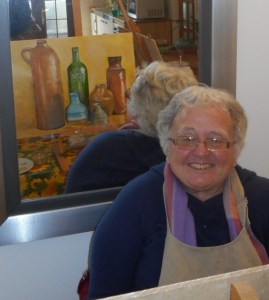 Before I get to the short stories, I want to first pay tribute to one of our members, Doreen Porter, who passed away earlier this week following a heart attack. Although we knew that Doreen had suffered from health setbacks, after cancer treatment a couple years ago, she had bravely got on with her life, baking, painting, playing Scrabble online and of course, writing. She was a central member of Writers Abroad and produced the WA magazine. Doreen didn’t write short stories as such. Her work is more humorous anecdotal tales as illustrated by her look at living in France:
 The book is an A to Z of the more quirky aspects of living in France. It’s an affectionate and humorous look at the country. An alphabet of French adventures, from meeting a family of Belgian hitchhikers having a bad day, to the trials of getting a phone installed and the quirks of driving in France. From finding a parking space to the perils of French bureaucracy.
 Waking up after a brutal werewolf attack, telepath Tasha Grant finds herself a prisoner of The Facility, an organization carrying out illegal research into the paranormal. She dreams of freedom, a normal life, and going home, but after eight long years, she believes it will never happen. Her life changes with the arrival of the stunningly gorgeous Jack, the latest unwilling guest of The Facility. Passion flares between them, but Jack refuses to share his body or his mind.
 This is her first collection of short stories. Some of them have been published in a variety of media including popular magazines, anthologies and online story sites. The remainder have been on a mixture of long lists, shortlists and honorable mentions and have finally found a home here in ‘Reflections’.
 Bertie Connolly is sitting in his dugout in late December 1914, writing to his parents. He recounts the strange tale of the Christmas Truce 1914, when German and British soldiers came out into no-man’s-land, forgot for a few hours that they were at war and treated each other as fellow men.
 Four romance stories that take place in the golden season known as autumn. In Patchwork Autumn, Marty Cutter finds herself drawn to Dr. Patrick Brady, the new man in town, but who is the lady he is hoping will move to Montana? In October Spell, Jilly MacPherson still lives in the shadow of her great aunt’s reputation. As Halloween approaches, will it keep Adam Spencer at arm’s length? Bus Ride to Love finds Ellen Curtis taking the long way home, only to meet Douglas Maddock, a man who may make her think about changing her life. Lauren Patterson finds that her grandfather’s Legacy of Love may lead to a building a new legacy with Matthew Brenner.
 Jessica’s whole life is her job. She lives and breathes her work as a nurse. Even her few friends are colleagues. Outside of work, she lives alone on the edge of town, and hasn’t had a relationship in years.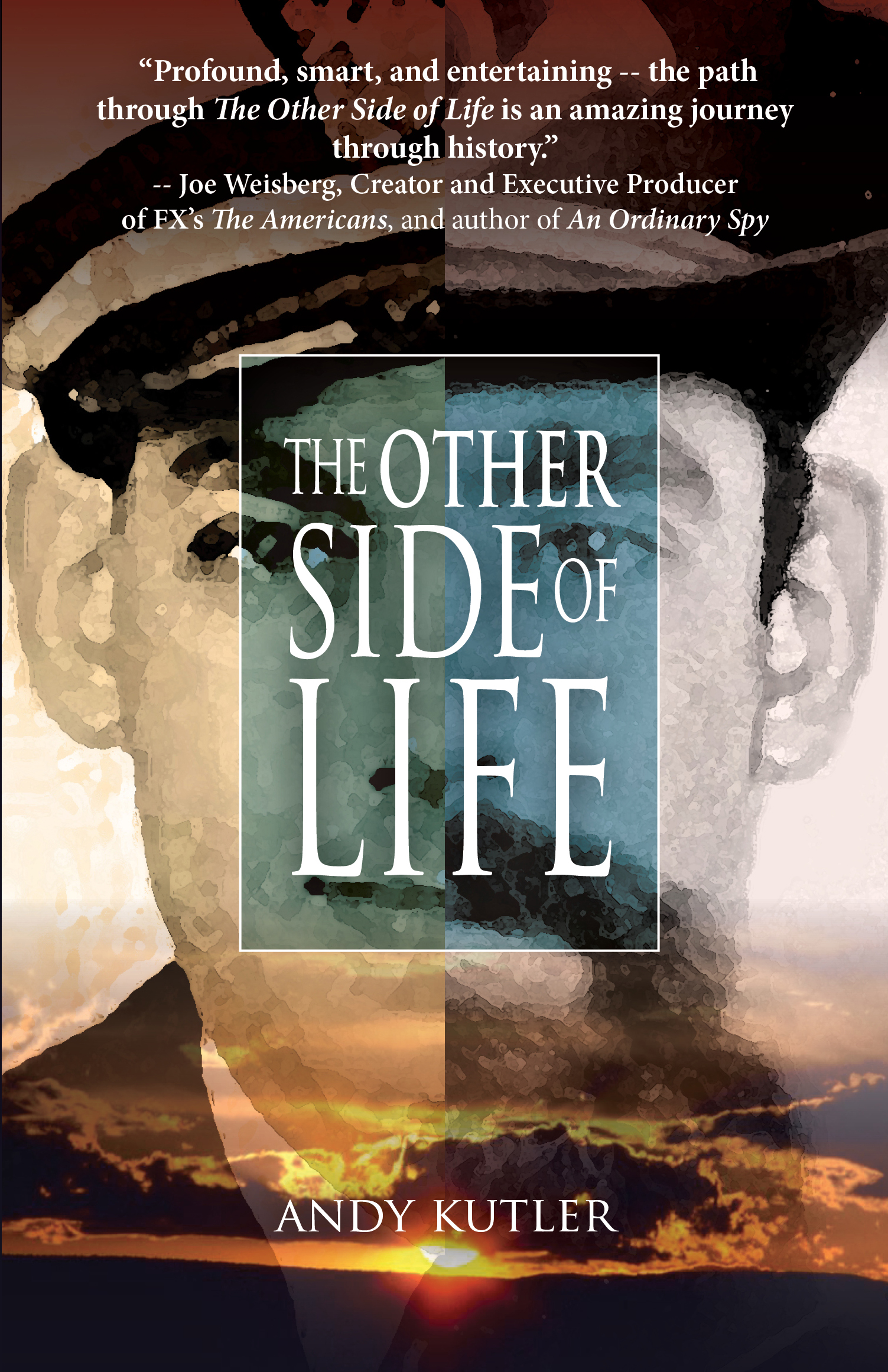









 dianneascroft.com