Kenneth Weene Studies His Characters

Today I’m welcoming Kenneth Weene to Ascroft, eh? to talk about how he used his psychology training in writing his second novel, Memoirs From The Asylum. His first novel, Widow’s Walk, was published in 2009.
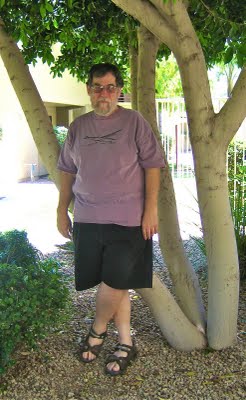
Ken is a New Englander by upbringing and inclination and his career – primarily in New York – included teaching, pastoral care, and psychology. Throughout his career Ken has also been devoted to writing. He started writing poetry to help him deal with mid-life. He soon branched out to include short stories, plays, and essays. His poetry has appeared in a number of magazines and on the web. His essays have been picked up by a few newspapers, especially on Long Island, New York, where he was living. An anthology of Ken’s work, Songs For My Father, was published 2002. A psychologist by profession, he has also published a number of papers in that field.

 Happily married for thirty-four years, the Weenes have one “adopted” son and two grandchildren. His wife, Rosalyn Weene, is a well known painter whose work has been shown in Europe and throughout the United States

Making Sense

Using my training as a psychologist in the writing of Memoirs From the Asylum

by Kenneth Weene

If there is one think I’ve learned from years working as a psychologist, it is that we humans are story-creators. Because we need to understand – to explain to ourselves and to communicate to others, we use our language skills not simply to record events but to interpret them.

As a novelist I think a great deal about the stories my characters are creating and what they are telling us about their lives. I ask myself some simple questions about a character, questions that seem to flow from my psych training.

The first question I ask is how does the character tell his/her story. What is the character’s voice? For example, in Memoirs From the Asylum there is one character, a black adolescent, Jamul, who tells his story in snatches of song, lyrics taken from Jimi Hendrix. He accompanies these lyrics on air guitar; what could be more telling of his disconnection from society’s reality, his immersion in a world uniquely his own, his realization of his own racial identity? The power of his method of telling his story also helps to set the reader up to really appreciate it when they finally read Jamul’s own words.

The second question I ask is what makes a character’s story unique. The answer to that may include biological factors; certainly mental illness includes the biological. One of the saddest characters in Memoirs is Mitch, a professor whose intellect has been stolen by Alzheimer’s. However, the biological issues are not the ones that make for great storytelling for a novelist. Characters need to have stories that challenge us to make sense along with them.

In Memoirs From the Asylum I use focus on three characters who are trying to tell their stories in the world and trying to make sense of who they are.

One is a narrator who is dealing with his own fears and whose ability to maintain a coherent life story is hindered by the suicide of his closest childhood connection, his cousin. In a sense this is the most autobiographical of my characters. As I explain in my author’s afterward, I, too, had a cousin commit suicide. I will leave the details for you to read in Memoirs.

The second focal character is Marilyn, a catatonic schizophrenic, who plays out her desperate attempt to make sense of her life by watching a pastiche of events unfold within a crack in the wall opposite her bed. The world she is trying to understand is more primitive than the narrators and is filled with things about which people have forbidden speaking. Her hallucinations, if you insist on using that word, reflect the chaos of the child trying to come to terms with the world into which he is helplessly born.

Dr. Buford Abrose is a resident, new to the asylum and expecting to become a polished psychiatrist. Yet he, too, like all of us is trying to make sense of his personal story. Because he is more in touch with the world as it is, Buford is perhaps least able to deal with what doesn’t make simple and clear sense. It is Buford who is in the end perhaps most deserving of our pity, for he is caught in the world as we expect it to be while trying to navigate in the world as it sometimes just is.

Memoirs From the Asylum has both tragic and comedic qualities. How could it be otherwise when it is about the inner world of characters, about their psyches? Could I have written this novel without a background in psychology? I don’t think so. I think the non-psychologist would have become too caught up in events and would not be able to appreciate the real strength of these characters, that they are in the end making sense of chaos. 

About Memoirs From The Asylum: This tragi-comedic novel takes the reader inside the asylum, inside the worlds of three central characters: a narrator who has taken refuge from his fears of the world, a psychiatrist whose own life has been damaged by his father’s depression, and a catatonic schizophrenic whose world is trapped inside a crack in the wall opposite her bed. This is the interwoven story of their lives, a story that includes love, sexuality, violence, deaths, celebrations, circuses, and surprising twists. As the plot unwinds, the reader learns a great deal about the nature of futility, frustration, and freedom.

Posted in July 2010 | Tagged , , , , , , | 2 Comments

Kenneth Weene Discusses Writing Memoirs From The Asylum

Tomorrow Kenneth Weene, author of Widow’s Walk, will join me as my guest blogger. His post will discuss how he used his psychologist’s training to write his second novel, Memoirs From The Asylum. He will also pop into Ascroft, eh? throughout the day to answer any questions readers may have after reading his post. 

About Memoirs From The Asylum: This tragi-comedic novel takes the reader inside the asylum, inside the worlds of three central characters: a narrator who has taken refuge from his fears of the world, a psychiatrist whose own life has been damaged by his father’s depression, and a catatonic schizophrenic whose world is trapped inside a crack in the wall opposite her bed. This is the interwoven story of their lives, a story that includes love, sexuality, violence, deaths, celebrations, circuses, and surprising twists. As the plot unwinds, the reader learns a great deal about the nature of futility, frustration, and freedom.
Posted in July 2010 | Tagged , , , , | Leave a comment

Peer Into ‘Keeping The Wolves At Bay’

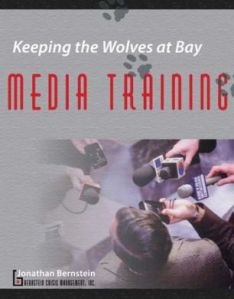
Today I’m featuring an excerpt from Jonathan L. Bernstein’s new book, Keeping The Wolves At Bay: Media Training, a book that deals with developing media savvy.

Bernstein’s professional background undoubtedly qualifies him to provide this training. President of Bernstein Crisis Management, Inc., he has varied professional experiences, including public relations, crisis management, journalism, and covert military intelligence operations. He is a regular guest commentator and expert source for national media outlets and PR Week described him as one of 22 individuals nationwide in America “who should be on the speed dial in a crisis”.

Here’s the excerpt he’s chosen from Keeping The Wolves At Bay: Media Training:

“Believe it or not, reporters would probably find it as scary to be in your mind as you would to be in theirs.  The catch is that they’re paid to be in yours and will do their best to get there.

Reporters may, in fact, come into interviews with a bias – personal, based on their own experiences and belief system, or “employer-based,” reflecting their media outlet’s political leanings, attitude towards certain types of organizations, etc. However, with rare exception, they are not usually out to “get you.”  They’re merely doing their job and trying to receive as much recognition for it as possible.  Just like you, right?

A reporter wants a story that’s newsworthy, that appeals to his/her editor and audience.  There is a journalistic code of ethics at www.spj.org/ethicscode.asp, but it allows for behaviors you may or may not deem acceptable while in pursuit of a story.  And journalists probably don’t review that code very often.

Your job is to tell your side of the story.  You are in conversation; you have to know to whom you’re speaking.  The reporter is asking you questions he/she thinks the audience will want answered.  That means you must speak through him/her to your stakeholders, giving them what you want them to know in terms that will be meaningful to them.

By employing the information in this manual, you will improve your ability to balance a story – but remember that “balanced” does not equate to “the story came out the way it would have come out if you had written it.”  It means you got a fair shake, even if people who completely disagreed with you also were treated fairly. By definition, a totally balanced article is still only 50% “your side” of the story.  And true balance is as rare as honest politicians.

You may find this surprising coming from the author of a media training manual, but as a crisis management professional  I advise clients that the traditional media is not your most important stakeholder group, because it is the least reliable means of accurately communicating information. However, media outlets are an important stakeholder group and one gateway to those who matter most to you – typically your employees, customers, investors, community leaders, the general public, etc.  In some specific situations, such as natural disasters, the traditional media can be a particularly important method of getting your messages out.  And it’s true that whether you cooperate or not, reporters will write their stories – so why not do your best to optimize the results?”

The publisher describes the book as “an accessible, enjoyable book for anyone who may have to deal with the media, whether face-to-face, by phone, or online. Keeping the Wolves at Bay: Media Training brings readers the best of Bernstein’s nearly three decades of crisis management and media training experience, written in a style that’s both entertaining and informative.”

They invite you to join them on Jonathan Bernstein’s virtual tour this summer – for much more information about the tour, the author and the book, visit – http://bookpromotionservices.com/2010/04/28/keeping-wolves-bay-tour/.

Posted in June 2010 | Tagged , , , , | 2 Comments

Keep The Wolves At Bay

Do your work or leisure activities put you in the media spotlight? Many people have contact with the media – in person, by phone or online – in the course of their duties or extracurricular pursuits. ‘Putting your foot in your mouth’ when talking to the media may be disastrous for you or your organisation so media savvy is an increasingly necessary skill. Experienced in public relations and crisis management, Jonathan Bernstein has written an entertaining, informative book about this subject.

Join me on Friday, 25th June when I will feature an excerpt from Bernstein’s new book, Keeping The Wolves At Bay: Media Training.

Posted in June 2010 | Tagged , , , | 1 Comment

Enniskillen Spring Book Fair

It looks like summer has come to Fermanagh so I know you’ll want to be outside to enjoy it – but don’t forget to take a book with you. Stop by the Enniskillen Spring Book Sale and get prepared for summer!

ENNISKILLEN SPRING BOOK FAIR

Cathedral Hall, Hall’s Lane, Enniskillen

Saturday, 29th May, 11am – 5pm

The Fermanagh Authors’ Association celebrates five years in existence this year by holding a Book Fair in The Minor Cathedral Hall, Hall’s Lane, Enniskillen on Saturday 29th May from 11 until 5. This is a great opportunity to buy the works of local authors including association members John Cunningham, Bryan Gallagher, Vicky Herbert, Seamas Mac Annaidh and me.

In total, members of the association as individuals have now published about 80 books plus three anthologies of the group’s work ranging from things historical, to short stories and creative writing, and poetry. These volumes form a series known as The Fermanagh Miscellany. Money earned by the group from hosting the book fair will be used to help fund the cost of printing their next annual anthology.

Numerous booksellers including Craobh Rua Books, Bardic Books, Ulster Local History Trust, and Armagh Diocesan Historical Society have taken tables to give people an opportunity to buy books old and new. Local historian Jack Johnston’s Border Books will be there and also Ian Butler, a local writer, will bring a selection of books from his online bookshop, Handibooks. 

Customers will find many interesting, and sometimes rare, items among the books on sale. Jim Vallely of Craobh Rua Books, one of the foremost antiquarian and secondhand dealers in Ulster, has a wide range of books on Irish history as well as prints and maps. Gerry Devlin of Bardic Books has a first edition of the Irish classic, The Ferret Fancier, for sale as well as a complete set of the first series of Ulster Archaeology, a copy of McKenna’s Devenish and books by William Carleton. Local writer Dermot Maguire is selling a pristine copy of the out of print Passing Of Time by Henry Glassie and also a special boxed edition of Shirley’s History of Monaghan.

There’s something for just about everyone so don’t miss the book fair!

Posted in Archives, May 2010, Uncategorized | Tagged , , , , , , , , , , , , , | 1 Comment

I’m Visiting Mike Angley Tomorrow

Recently I hosted Mike Angley, author of the Childfinder Trilogy on an exchange visit to Ascroft, eh? Tomorrow I’m completing the exchange as I join him on his blog.

Join us as I answer his questions about Hitler and Mars Bars and what spurs me to write. I think it will be interesting to put together two writers who feature children in their novels  – but in very different settings. Mike writes mysteries and I write historical fiction. Find out what we have in common when we chat on his blog.

So don’t forget to stop by http://childfinder.us/2010/05/hitler-and-mars-bars-an-intriguing-title-by-an-interesting-author-dianne-ascroft-who-visits-the-child-finder-trilogy/ tomorrow!

Posted in Archives, May 2010, Uncategorized | Tagged , , , , | Leave a comment

Welcome To Ascroft, eh? Blog Joggers

Thank you for stopping by Ascroft, eh? Please explore all this blog has to offer – from author interviews to news about Hitler and Mars Bars and also the Fermanagh Creative Writing Group to just my rambling thoughts.  Then jog on over to

www.ImmortylRevolution.blogspot.com

and sample all that this fantasy writer’s blog has to offer. If you would like to visit a different blog in the jog, go to http://blogjogday.blogspot.com.

Hope you’re enjoying Blog Jog Day – I promised you wouldn’t need your sneakers, didn’t I?!

Posted in May 2010, Uncategorized | Tagged , , , , , | 5 Comments

V E Day Was The Beginning

Today is the 65th anniversary of Victory in Europe Day (VE Day). On May 8th, 1945 the Allies formally accepted the unconditional surrender of Nazi Germany and Europe celebrated the end of the war. They had good reason to celebrate but, even so, their troubles were not over yet. Although the war had ended, people still suffered and experienced hardships. On the continent they endured hunger and food shortages which were made worse by an exceptionally cold winter that year. Food and clothing continued to be rationed and many waited anxiously for news of loved ones missing during the war. Often we forget that the heartache didn’t end just because the war was over.

A few years ago I did some research into this period and it led me to a fascinating story about the Irish Red Cross’ little known humanitarian aid initiative, Operation Shamrock. The endeavour aided German and French children after World War II, transporting more than 400 German children across Europe to Ireland to escape the appalling conditions in their homeland. The children were fostered by Irish families where they regained their health and strength before returning to their families in Germany. It was a touching story and completely new to me.

I began reading what little material I could find about this humanitarian aid effort and spoke to people who had been involved in the endeavour. As a history lover I was thrilled to uncover information about events and people that aren’t mentioned in history books. It was almost like discovering a lost civilisation. As I delved into the subject and learned all I could about it, images and impressions of the people and events swirled around in my head and a story began to take shape. My historical fiction, Hitler and Mars Bars, resulted from my research. The novel’s main character, Erich, is timeless – a gutsy but vulnerable child who tugs at readers’ hearts but Operation Shamrock provided a unique backdrop for his story.

On the anniversary of VE Day I’ll remember the importance of the celebration and also that the story didn’t end there. I’ll also remember the people who suffered and struggled on Europe’s subsequent long road to recovery.

Posted in May 2010, Uncategorized | Tagged , , , , | Leave a comment

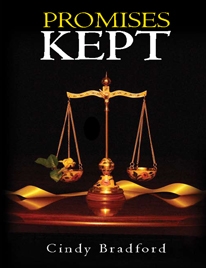
My Thoughts On Promises Kept

Yesterday author Cindy Bradford joined me to talk about her novel, Promises Kept.  I had read the book before it was released and I’m adding my thoughts about the novel today.

Promises Kept, the sequel to Keeping Faith, is the continuing story of Faith O’Brien. The book opens as the novice lawyer attempts to bring to justice a priest who abused her father when he was a boy. Pitted against a veteran defence lawyer, she has a steep learning curve for her first case. But she successfully prosecutes the abuser, winning her case and the respect of the senior partners in the law firm she recently joined. She also wins the respect and love of her colleague at the firm, Tyler England. As the story continues its focus shifts to their love story and the life they make together. The novel reaches its climax when the couple are confronted with a battle for one partner’s survival.

 I enjoyed Promises Kept and found myself turning the pages to find out what happens next. The tension of the legal case quickly drew me into the story. I became absorbed in the dramatic courtroom proceedings and willed Faith to win her case.  

The middle segment of the book allows the reader time to catch his breath and deepen his knowledge of the characters and their lives. The main characters are firmly rooted in Texas. Without being caricatures, they gave me an insight into a region and its people which I know little about. They speak and act in accordance with their culture, yet each character, from Faith and Tyler to their extended families, is distinct and interesting. Faith is an especially well drawn, strong heroine who carries the story.

The pace picks up again in the final segment. Life for Faith and Tyler takes an unexpected, devastating turn. The final pages barrel towards the climax without time for anything except the main chain of events.

The book’s plot is an engaging one but I felt that it could have been better paced. The opening scenes progress at a speed appropriate to the courtroom action depicted and grip the reader. But the middle section develops more slowly than I would have liked. While time for character development is essential, I would have preferred a shorter middle section; fewer details could still provide adequate insight into the characters. The dramatic events in the final section felt a bit rushed to me. Expanding and slowing this section would improve the overall pace.

The story is told mainly through dialogue. This writing style keeps the story moving forward but I would have liked more description and action to vary the pace and supply necessary details unobtrusively.

Despite my preference for a different writing style than the one the author uses, I enjoyed the book. Promises Kept presents a memorable heroine, living a challenging life. Faith has triumphs and heartbreaks and I rooted for her throughout the novel. She caught my interest sufficiently that she won’t just fade from my memory. She has stepped off the page and into my mind; I would love to know what happens to her next.

Posted in May 2010 | Tagged , , , | 3 Comments

Cindy Bradford and Promises Kept

Today I’m joined by author Cindy Bradford. She is on a virtual tour to promote her second novel, Promises Kept. I’ve asked her to talk to us about how the theme of the power of the human spirit runs through the novel. But first I’ll let her tell us a bit about the book:

Cindy: Promises Kept is Faith’s story, an unforgettable young woman whose life’s journey has been filled with uncertainty, of searching for people and answers that others take for granted. Compassionate and courageous, she never gives up, showing strength and character beyond her years. It is also the story about the power of the human spirit, of family, friends and love.

As I’ve said, you’ve told me that the power of the human spirit is a theme in the novel. Can you tell me more about this, Cindy?

Cindy: Albert Schweitzer wrote, “In everyone’s life, our inner fire goes out. It is then burst into flame by an encounter with another human being. We should all be thankful for those people who rekindle the inner spirit.”

In the first book, Keeping Faith, Faith is the catalyst, the inspiration, the force that gives Patrick back his life and rekindles his inner spirit. Without her, he is on a hopeless venture where he can find no true happiness. When she comes into his life, that all changes. First as a teenager and then as a young woman, her personal strength and fortitude allow her to open closed doors and soften hardened hearts for many who are caught in Patrick’s tangled web of confusion and cover-up.

But it is in the second book, Promises Kept, that Faith truly comes to grips with life and who she is as a person. It is only then that she discovers her boundaries and limitations. For so long she has focused on helping everyone else, until she suddenly has to stand back and look at herself. As her shift of consciousness begins, her softer side unfolds, but her inner fire begins to wane. She is alone again with only her thoughts and hopes. She realizes that somehow she must work to find balance and harmony in a life filled yet again with uncertainty and confusion.

The writer Bernard Williams once claimed, “Man never made any material as resilient as the human spirit.” He must have known Faith because she certainly displays this fighting, survival technique, but it does not come without inner strife and outward questioning. For the first time in her life, she doubts that she has what it takes to go on, but just as she was the one person in the first book who awakened Patrick’s soul, there is a single human being who can do that for her. It may surprise you who that individual is and how she responds.

I invite you to join me on the Promises Kept virtual tour and every comment you post on the tour posts – will get you an entry into a drawing for a copy of the first book in this series – Keeping Faith. Visit http://bookpromotionservices.com/2010/03/02/promises-kept/ for the complete schedule. For more details about me, Cindy Bradford, visit –www.KeepingFaithTheNovel.com and www.DocCBradford.com/my-books

Thanks for joining us today, Cindy. I read Promises Kept a few weeks ago (before it was released) and found myself slipping into Faith’s world, wondering what would happen next. I’ll post my review of the book tomorrow. I wish you every success with the novel and on your tour.

Cindy Bradford, Ph.D., is the author of Keeping Faith and Promises Kept. She lives at South Padre Island, Texas, and spends several months a year in Ruidoso, New Mexico. She is a retired public school educator and university professor. She often incorporates her knowledge of wine into her writings and shares the beautiful places she has visited with her readers. www.doccbradford.com

Posted in May 2010 | Tagged , , , , | 8 Comments