Reasons For Writing Short Stories

A writer friend of mine often says that he wants to create edgy writing. Another writer friend says she’s not sure what he means. I think I know what he’s talking about but I decided to look up ‘edgy’ in Dictionary.com.

Here’s the 3 definitions it gives: 

  1. nervously irritable; impatient and anxious.
  2. sharp-edged; sharply defined, as outlines.  
  3. daringly innovative; on the cutting edge.

I imagine my writer friend doesn’t mean ‘nervously irritable’ or ‘sharp-edged’ writing. So he must be referring to ‘daringly innovative’. He’s passionate about developing this writing style but I’m afraid I don’t share his enthusiasm. And I doubt the short stories in my collection, Dancing Shadows, Tramping Hooves, will be ever described as ‘edgy’. But that’s ok because I wanted these stories to captivate readers not because they are dramatically different but because their familiarity touches readers’ hearts.

I hope the characters’ struggles will resonate with many readers: negotiating mother-daughter relationships, letting down barriers to form new relationships, grappling with fear, dealing with past mistakes and embracing a new life in a strange land.  

Words like ‘heart-warming’, ‘uplifting’ and ‘cheering’ are sometimes considered old fashioned but they fit these stories. And the stories fit the magazines and anthologies they were originally written for. I sometimes explore the dark side of life in my writing but not in this book. These stories are the kind to be read when you want to be entertained and reminded that life is good. I hope they will leave readers with a warm glow.

I’m launching Dancing Shadows, Tramping Hooves today. For more information about the book visit it’s Amazon page.

Posted in June 2012, Uncategorized | Tagged , , , , , , , , | Leave a comment

Wondering About Vivaldi’s Muse

I read a review of Sarah Bruce Kelly’s Vivaldi’s Muse on the Historical Novels Society webpage page recently and I was immediately intrigued and wanted to know more about the story. Loads of questions popped into my head and I couldn’t resist adding the book is in my to-be-read pile. I’ve also invited Sarah to tell me a bit about the novel.

Welcome to Ascroft, eh? Let’s get started, shall we, Sarah?

Tell us about your novel.

Set in early 18th-century Venice, Vivaldi’s Muse explores the life of Anna “Annina” Girò, Antonio Vivaldi’s longtime protégée. Annina first falls under the spell of the fiery and intriguing prete rosso (red-haired priest) at a young age, when Vivaldi is resident composer at the court of Mantua, her hometown. Stifled by the problems of her dysfunctional family, she has long dreamed of pursuing operatic stardom, and her attraction to the enchanting Venetian maestro soon becomes inseparable from that dream.

What prompted you to write about this episode in history?

I’ve always felt a special attraction to Vivaldi’s music, and in graduate school I decided to write my thesis on Vivaldi’s opera career, which no other music scholars were working on at that time. My research revealed the little-known story of his 20+ year association with a young singer, Anna Girò, whose name kept popping up in the documents. The more I learned, the more fascinated I became with this mysterious and intriguing relationship.   

How closely did you stick to the historical facts? If you used them loosely, how did you decide whether to deviate from them?

In my “digging” for the truth, a wealth of evidence emerged that I realized provided almost all I would need to write a great story. So all the major events in the novel are historically documented, with a little poetic license taken here and there to spice up the story.

What research did you do for this book?

My research for Vivaldi’s Muse took over ten years, and involved trips to Northern Italy and parts of Austria. During this time I translated dozens of documents, anything I could find that would shed light on Anna’s life and the nature of her relationship with Vivaldi.  

Do you use a mixture of historic figures and invented characters in the novel. Which is more difficult to write? Which to you prefer to write and why?

All the major characters in Vivaldi’s Muse are historic figures. However I found it necessary to add a few fictional background characters to flesh out the story, such as a costume designer, gondolier, etc. These fictional characters were fun to create, and I was free to make them as colorful, and even comical, as I wished. The historic figures were more difficult to write, especially Vivaldi, because I was so concerned about finding his authentic “voice.” I feel I finally achieved this by reading every letter, and listening to every piece of music, he wrote. I really felt I got to know him that way, and eventually his character pretty much wrote itself. This ended up being the case with other historical characters as well, of which there are many. In general, I prefer to write the historic figures because I find them so endlessly interesting.

In an historical novel you must vividly re-create a place and people in a bygone era. How did you bring the place and people you are writing about to life?

I spent a great deal of time researching the operatic culture of the time, as well as customs of daily life in Venice and Northern Italy, etc. People often confuse the fashions and customs of the early 18th century with those of the late 18th century, even though they were vastly different in many ways. There has actually been very little written about early 18th-century Venetian culture, so I had to do a great deal of digging. My goal was to authentically re-create the distinctive culture of Venice in the 1720s and 30s. In bringing the Venice of that time to life, it helped a lot that the city is virtually the same now as it was then, so my sensory experience of that beautiful place was much the same as it would have been for the characters in my story.   

There often seems to be more scope in historical novels for male characters rather than female characters. Do you prefer to write one sex or the other. And, if so, why?

The story of Vivaldi’s Muse allows equal scope for male and female characters, since both sexes played significant roles in the Venetian opera world of that time. At first it was easier for me to write the female characters, but as I explained above, especially with Vivaldi, his voice slowly revealed itself for me and became a pleasure to write.

Thanks for answering my questions, Sarah. I’m even more eager to read the book now.

About Sarah Bruce Kelly: A native of Richmond, Virginia, Sarah Bruce Kelly lives on the South Carolina coast with her husband, Frank, where she spends her time writing, reading, teaching, and enjoying the sun and surf.

For more information, visit Sarah’s Amazon page.

Posted in June 2012, Uncategorized | Tagged , , , , | Leave a comment

Caught Up In Highland Storms

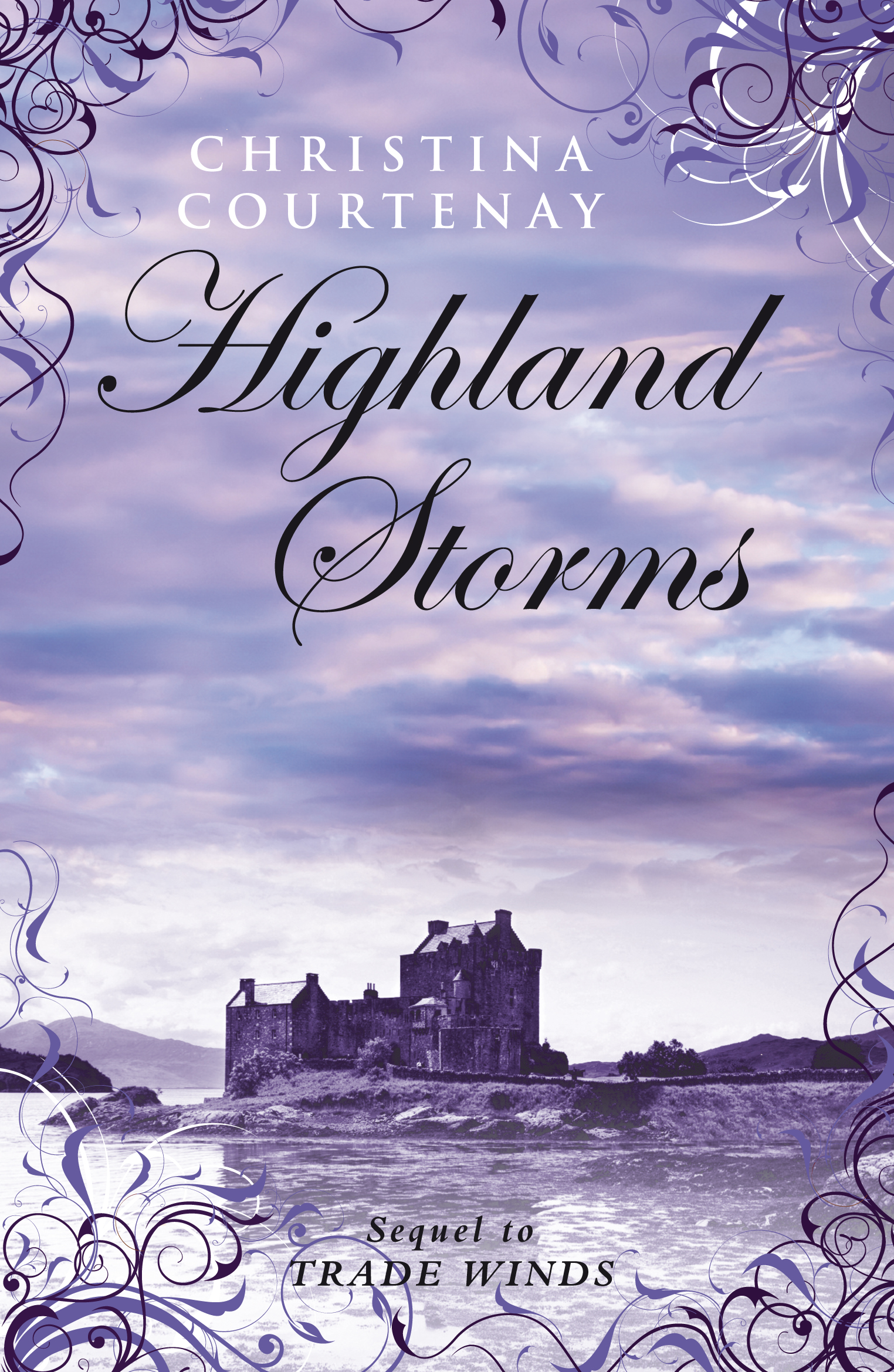
I’ve been trying to wade through my to-be-read pile lately and Highland Storms was at the top of the list. It’s the second novel I’ve read by Christina Courtenay. I enjoyed its prequel Trade Winds last year and so I was eager to continue the story of the Kinross family in this novel. And I wasn’t disappointed – the characters were real and appealing to me and I got lost in the story. It was a very entertaining read.

I’ve invited Christina to join me today to answer a few questions about Highland Storms. Welcome Christina. Shall we get started?

Tell us about your novel
Highland Storms is a historical romance and adventure story, set in Scotland in 1754.  It’s about a man who goes back to his roots, following what he sees as a betrayal by his brother and his childhood love. Brice Kinross needs a fresh start, but when he takes over the family estate in the Scottish Highlands, there’s trouble and he finds himself unwelcome. The estate has been badly managed, money has gone missing and someone wants Brice gone. He discovers an ally in the beautiful housekeeper, Marsali, but can he dare to trust her?

Marsaili is determined to build a good life. She works hard at being housekeeper and harder still at avoiding men who want to take advantage of her. But she’s irresistibly drawn to the new clan chief, even though he’s made it plain he doesn’t want to be shackled to anyone. And the young laird has more than romance on his mind. His investigations are stirring up an enemy.  Someone who will stop at nothing to get what he wants – including Marsaili – even if that means destroying Brice’s life forever …

What prompted you to write about this historical event or era? 

1754 was not very long after the Jacobite uprising, a period which has fascinated me for a long time. I’ve read a lot about it and I was particularly interested in the way the Highlanders were treated (or rather mistreated!) after the rebellion was quashed. The English seem to have been intent on erasing all Highland culture completely and some of the reprisals were extremely brutal. This left scars, naturally, and I decided it would be interesting to use this as the background for my novel. Although half Scottish by birth, the hero has grown up in Sweden, so he is to all intents and purposes an outsider, even though he’s officially the new clan chief of his father’s Scottish estate. I tried to imagine the sort of reception he would get from tenants who had just learned to mistrust anyone who wasn’t a true Highlander. How would he deal with that and overcome their prejudices? He would have to prove himself worthy of being one of them.

How closely did you stick to the historical facts? If you used them loosely, how did you decide whether to deviate from them? 

I tried to stick to the facts as closely as possible and the attitudes of the Highlanders at the time, as well as those of the English soldiers posted in Scotland to keep order. By 1754 things were calming down a lot though, so when I needed a villain I had to invent a particularly nasty English captain with a personal grudge in order to carry on the reprisals. I think in reality that probably wouldn’t have happened this late (although you never know!). 

What research did you do for this book?
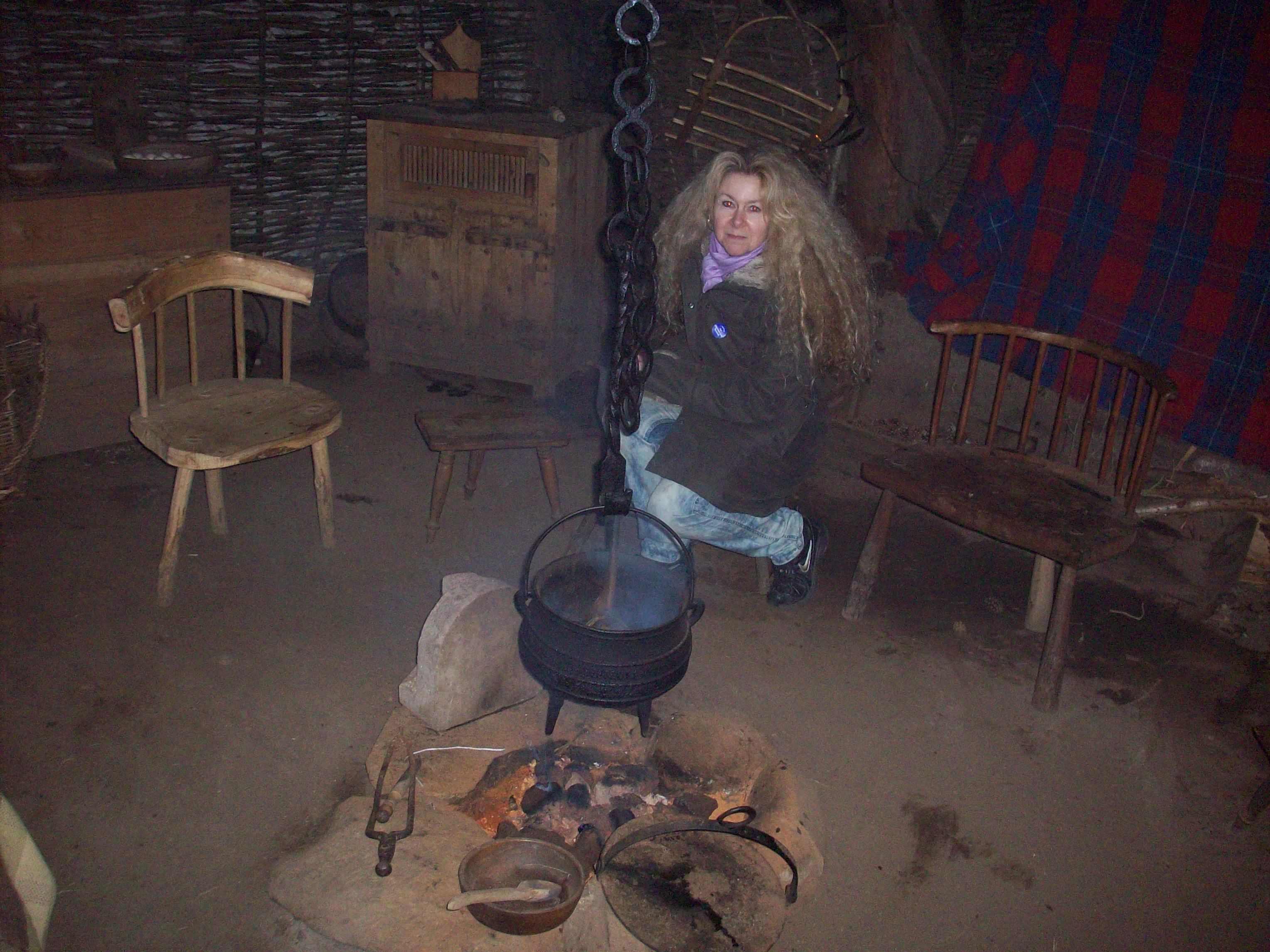
I did a lot of reading, obviously, about the Jacobite rebellion and its aftermath (I can particularly recommend a book by Maggie Craig called Bare-Arsed Banditti – love that title!). I also went to Scotland to research how people lived at that time, what they ate, wore etc. and I was lucky enough to find an outdoor museum, the Highland Folk Museum at Newtonmore near Kingussie. There they had old dwellings (or huts) built to show people what the houses used to look like and how they were constructed. I was able to go inside one and sit by the peat fire – it was quite dark in there (no windows) and it smelled strongly of wood smoke. But it was wonderful to be able to experience this for real and I used that in the book. I also visited castles, drove through the beautiful Highland glens and stuck my hand in a loch to see how cold the water would be.

Do you use a mixture of historic figures and invented characters in the novel?  Which is more difficult to write?  Which to you prefer to write and why? 

Although I have used real historical figures in other novels, in this particular one the characters are all imaginary. I find it easier to make them up, because if I use real people I’m afraid I won’t do them justice or perhaps even unintentionally insult them! If you only have imaginary people, they can go anywhere and do whatever you like, whereas using real ones means you have to know where they were at certain times and fit in with that. Makes it a lot more complicated!
 
In an historical novel you must vividly re-create a place and people in a bygone era. How did you bring the place and people you are writing about to life?

To a large extent, I used my own experiences during the research trip, and of course my imagination. When you go to the Highlands, it is quite easy to imagine yourself back in time because although some things have changed, there is a timelessness about the whole place that makes you feel a connection with the past.  I usually try to add little details to my stories to make them feel more authentic, like for example the washing scene. Back in the 1700s, I read that Scottish women did their washing by standing in pairs in big wooden tubs with their feet bare and sort of treading on the sheets or whatever they were washing. I thought this must have been quite a treat for the local men as the women had to hike up their skirts in order to do this, so I couldn’t resist including a scene like that in my novel. Other than that, it’s just a question of trying to get the facts right without making it sound like a history lesson!

Thanks for answering my questions so thoroughly, Christina. I think what you’ve said has given readers an insight into Highland Storms – and, if they are like me, they’ll now be eager to read the book. If they’d like to sample an excerpt from it first, they can click here.

For a chance to win a copy of Highland Storms, leave a comment on this post. The winner will be drawn on Monday.

Christina’s next book, The Silent Touch of Shadows, is due to be released on 7th July. Readers can learn more about Christina and her books by visiting her website, Christina Courtenay and can follow her on Twitter – @PiaCCourtenay.

Posted in June 2012 | Tagged , , , , , , | 2 Comments

Launching Into Summer With Books

This seems to be the season for book launches – I can barely keep up with them all. As I prepare to release Dancing Shadows, Tramping Hooves, a collection of short stories, as an Amazon ebook on 20th June lots of people I know are also releasing new books.

M C Scott’s Rome: The Eagle of the Twelfth was released on Thursday and I believe she is busy making the rounds of bookshops, enjoying readers’ appreciation of her work.

Ian Butler, a new author and a fellow member of Fermanagh Writers, is releasing his first novel, Burger Bar Dad, published by M P Publishing on 28th May. The book garnered interest at the London Book Fair recently and Ian is busy working on the sequel.


It’s a busy time but this weekend I’m taking time to reflect on Tuesdays At Charlie’s book launch at the Ardhowen Theatre on Thursday evening. It was a great evening – wonderful weather, an enthusiastic audience and entertaining readings by several members of Fermanagh Writers.  I was kept hopping during the evening making sure everything was running smoothly but now I intend to sit back and enjoy the memories. Click here to share them with me.

Posted in May 2012 | Tagged , , , , , , , , , , | Leave a comment

I’m Getting Launch Fever

It’s all happening next Thursday – there’s almost too much for me to choose from and I wish I could be in more than one place at once.On Thursday, 24th May Fermanagh Writers launches Tuesdays At Charlie’s and I’m really excited about it. We put lots of work into getting this collection right so now that the books have arrived – and none of them are printed upside down or in some strange, illegible font style – it’s time to celebrate. The launch details are on our group’s website at www.fcwg.wordpress.com. If you are in Enniskillen that evening – or want to come down – please join us!And while we’re launching Tuesdays At Charlie’s, the Alliance of Independent Authors is hosting their online launch. It starts at 8pm (GMT) and features a Q&A session called Ask Amazon with Thom Kephart, Amazon’s Community Outreach Manager. For more information about this event check out: http://allianceindependentauthors.org/campaigns.html.

Next Thursday really is the day for launches as it’s also the day that M C Scott’s Rome: Eagle of the Twelfth is published. I have to admit that I haven’t actually finished the previous book in the series, Rome: The Coming of the King, but I still have a week left…I am captivated by the world she creates – I just need a bit more time to spend reading. But I’m not really sorry I haven’t finished it yet – it’s good to know it’s still there to go back to as I enjoy getting lost in it.

Now how will I juggle all these events? Well, Rome: The Eagle of the Twelfth will automatically download to my Kindle – the wonder of pre-ordering! I’m not quite sure how I will juggle the other two though. If you see me checking my mobile frequently at the Ardhowen Theatre that evening I’m probably trying to keep up on what’s happening at the AIA launch while munching the most amazing mini-muffins that one of our members has promised to bring to the Fermanagh Writers’ launch. There’ll be wine, cheese & crackers and other nibbles too but the muffins are divine and shouldn’t be missed. But don’t tell anyone about them until I get my share! Hope to see some of you at the Ardhowen Theatre, Enniskillen at 7.30pm next Thursday.

If you are curious about how Tuesdays At Charlie’s all came together, read my post on Writing.ie about how we did it – and survived as a group. You’ll find the piece here:

http://writing.ie/writers-toolbox/getting-published/more-publishing-options/591-tuesdays-at-charlies-fermanagh-writers-group.html

Posted in May 2012, Uncategorized | Tagged , , , , , , | Leave a comment

Share Your Foreign Encounters With Us

My world seems to revolve around anthologies recently. I’ve been caught up in preparations for the launch of Fermanagh Writers’ first collection, Tuesdays At Charlie’s, for the past couple weeks and now I’m about to embark on helping to prepare Writers Abroad’s third anthology, Foreign Encounters.

Writers Abroad has opened submissions for Foreign Encounters. We want to hear from ex-pats or former ex-pats about the encounters they’ve had away from their home shores – with humans or animals. Author Julia Gregson will write the book’s forward and all proceeds will go to Books Abroad. For more information about our submissions call visit Writers Abroad’s website.

I enjoyed writing stories for last year’s book, Foreign Flavours, and also reading all the other submissions. I already have an idea for a story and I’m looking forward to this year’s book. But first I have to pitch in to make Tuesdays At Charlie’s launch a fun night then on to Foreign Encounters.

Posted in May 2012 | Tagged , , , , , , | Leave a comment

A Timely Piece For Ireland’s Own

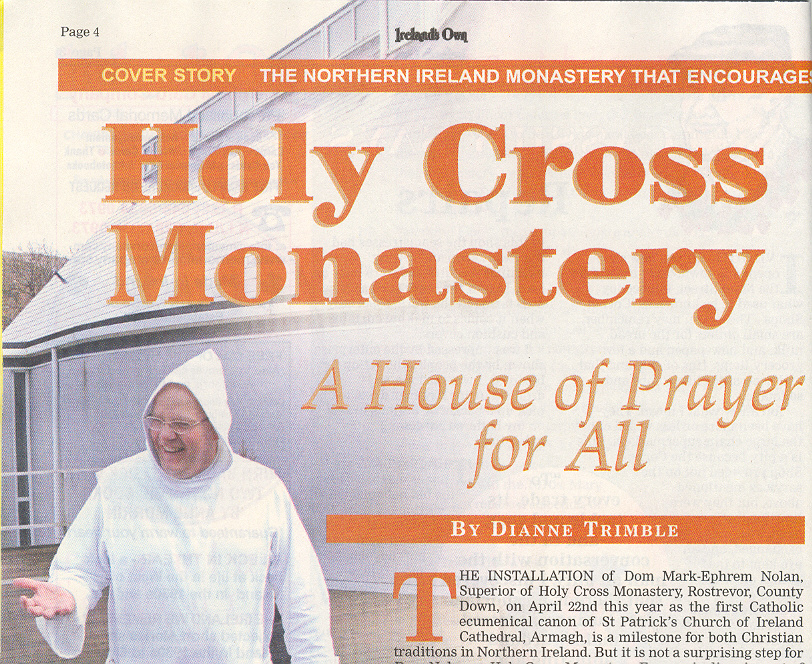
My piece in Ireland’s Own this week about Holy Cross Monastery in Rostrevor, Co Down is timely. More than a year ago I was intrigued by this new monastery that had been founded in the province and I went to visit and learn a bit about them. The resulting article appears in the magazine this week just as the monastery’s Superior, Dom Mark-Ephrem Nolan, was installed last Sunday as an ecumenical canon at St Patrick’s Church of Ireland Cathedral in Armagh. He is the first Catholic to hold this position in a Protestant church in Northern Ireland. The Ireland’s Own issue is on sale until Monday, 30st April.

Posted in April 2012, Uncategorized | Tagged , , , , , , , , | Leave a comment

Independent Authors Are Joining Together

I’ve got lots happening at home this week as our local writers group, Fermanagh Writers, has just received the first print run of our anthology, Tuesdays At Charlie’s, we’re running a Pub Quiz tonight to help pay for printing the book and we’re also hosting a writing workshop with Queen’s University creative writing tutor, Emily DeDakis on Saturday. Check out the group’s blog for more info about these events: www.fcwg.wordpress.com.

But I’m also excited about another venture: the launch of the Alliance of Independent Authors. When Orna Ross, author and former literary agent, first mentioned it my ears pricked up. Since I’ve been involved in self-publishing – myself and also with local writers’ organisations – for several years I was keen to hear about the organisation.

The Alliance of Independent Authors launched at the London Book Fair yesterday with an author Q & A on the topic of ‘How I went Indie — and Why’ with members Linda Gillard, Amazon No 1 Hazel Gaynor and New York Times bestseller Joni Rodgers and others. The aim of this session was to educate the media and publishing industry about some of the realities of this way of reaching readers.

Today is the online official launch of the organisation. Why don’t you pop over to www.shindig.com and join us? And don’t forget to visit the organisation’s own website: www.allianceindependentauthors.org.

For writers in the Dublin area, the organisation is holding their first Dublin branch meeting on Tuesday, 24th April, 6.30pm in the Library Bar, Central Hotel, Exchequer Street. Drop by if you’re in Dublin.

Posted in Uncategorized | Leave a comment

Can A Book Lead The Way To A Better Society?

Today John Philip Roath is joining me to answer a few questions about Utopian Frontiers, a book that he has edited and a project that he co-created with Mike Parsons. He wants to create a better society and this is how he’s doing it.

Welcome John. Shall we get started?

Please tell our readers about your novel, Utopian Frontiers.

JPR: First, allow me to share what inspired the project.

Back in the 70’s, I was working as an Employee Relations Supervisor for a mining company located up North near the Alaskan panhandle. It was a hard rock mine operation located in the Coastal Mountain Range system of mountains. The mine site was located up in the mountains, near a huge field of glaciers. A tunnel led from the mill and habitation area, going under 3 mountains and 2 glaciers just to get to the ore body.

How does 1000 inches of snow a year sound?

Newmont Asarco (an American based transnational mining conglomerate, although the mine was actually located in the province of British Columbia, Canada) had controlling interest of the property, and they had an architect draw up a conceptual design for a dome that would cover the mill and living quarters, making the community an enclosed environment, sort of a city out in the wilderness.

Yet even though the rising price of gold and copper residuals made the running of the mine profitable in the late 60’s and early 70’s, expense related to the dome made that investment a no go. We still drank water from glacial fed springs, breathed some of the cleanest air on the planet, witnessed the Northern Lights, and viewed mountains at night that seemed surreal, so clear and stark they were, as if supported by two by fours, a card board cut out of the original we were so blessed to stand in awe of.

When I moved back down South I immediately had eye problems related to air pollution but that’s another story.

I reconnected with my soon to be writing associate, Mike Parsons, and we picked up on mutual concerns, such as social/political/economic realities of the times. We discussed my experiences in a semi isolated corporate environment, lamented the condition of existing cities and related problems, and began to play “WHAT IF”.

Over time, Mike and I envisioned a research culture that promoted actualization through creative, constructive endeavors. The initial concept and entertainment vehicle (a screenplay at the time) was but a myth through which we would encourage and motivate, inspire/provoke others to consider options that would contribute to a better world. The futuristic research city we envisioned was conceived as a prototype for humane urban environments yet such lofty ideas need development…

With the passing of Mike, I inherited the task of advancing the cause, and in keeping with the myth (any and all who become involved are encouraged to be themselves and make a creative contribution).

 I have worked a day job ever since and only now have the opportunity of stepping up to the plate and letting the show take life.

So, with the encouragement and suggestions of friends and associates, eventually I contracted with BurmanBooks to publish a book. Drew Tapley was brought on board, tasked to convert the screenplay Mike and I had written into an updated version of the story in book form, with myself as Editor of the book.

The book Utopian Frontiers will hopefully, in turn, garner interest in making the film that Mike and I thought would best represent a full, dramatic, public exposition of the project, bringing us full circle.

Now then, here’s what your readers need to know about Utopian Frontiers, the book:

Utopian Frontiers is a fictional story about a secret, prototypical city located on the fringes of national parkland somewhere in the Americas. The city itself is the headquarters of a clandestine transnational research corporation dedicated to developing beneficial technologies in service to humanity. This unique research environment is where alternative social/political/economic/technological options are explored in the interest of the future well-being of environmental and ultimately, human integrity.

Recent and emerging world events indicate a growing mass movement demanding solutions to increasingly disturbing trends that have spawned social unrest. People need and want real solutions to real problems that threaten the very systemic basis of the democracies that claim to support and protect the peace and (so called) freedom which generations before us fought to preserve. Yet the entertainment media, to a great extent, continues to deliver trivialized adventure sagas and doomsday scenarios, whereas the public is in need of messages that imply optimism and hope for the future of humanity, delivered in an edutainment format.

The relationship between humankind and technology, a main theme of Utopian Frontiers, explores the positive applications of technology as a tool in the service of social humanity. The inevitable conflict between vested interests and vying priorities, the dramatic tension that ensues as the impact of change upon people’s lives becomes manifest, and the message of hope for the future integration of technologies with the social imperative: these are the major underlying themes explored by Utopian Frontiers.

Join a vacationing family as they inadvertently stumble upon this futuristic city, and witness their struggles as they attempt to come to terms with the challenge of self-fulfillment and actualization, and ultimately the very survival of life as we know it.

This is a timely tale about a secret, evolving society that suggests change to the basic nature of our global culture may ultimately have to include the co-opting of if not a total break from the very institutions and values that spawned and currently nurture us.

Intended to provoke meaningful discussion regarding the current “human condition”,

Utopian Frontiers will make you step outside of the box, expand the envelope of possibilities, and consider the very nature of our ways and why we must nurture the long journey to a better, more meaningful, inclusive way of life for one and all.

Utopian Frontiers is about researching options that will help deliver humanity to a healthier state of being, but not all “investors” agree with priorities… Want to know more about the ultimate challenges that confront the community? Read the book, and enjoy, celebrate, embrace, protect life as we know it!

What are the aims and goals of the Utopian Frontiers Non-profit organization?

JPR: As a non-profit corporation, Utopian Frontiers Foundation is obliged to operate under the approved Letters of Patent, as registered with the Province of Ontario, Canada.

Initially, I just copied the Letters of Patent into this document, but upon reflection, we considered that too staid, dry…

So, this is the answer from my heart and soul, and with a pinch of creative flair:

In a nutshell, as a non-profit entity, our goals are to organize or participate in environmental projects designed to preserve and protect flora and fauna, restore rivers and improve the urban environment in general. Lofty goals, wouldn’t you say? Be still your thumping hearts… Obviously, we aren’t anywhere near there yet. But, that’s not all.

Further, we intend to educate and increase the public’s understanding of the environment and its importance, by offering courses, seminars, conferences and meetings and by collecting and disseminating information on that topic.

OK, the seminars, conferences and meetings are a pipe dream for now, but they are a future intention. We have to start somewhere…

Eventually, we intend to develop and provide programs promoting the protection and preservation of the environment through re-use, reduction, recycling and recovery of waste. We also plan to educate institutions, industries, businesses and individuals about efficient waste management systems.

With luck, good communications skills, a compassionate readership and help in the field, in time, we’ll receive and maintain a fund or funds and apply all or part of the principal and income to charitable organizations that are also registered charities.

We started out doing this as a balm for our tortured souls. It’s therapy, a living myth that serves to prove we care and that our belief in humanity is worthwhile investing our time and effort. That is, instead of the opposite idea that we could batten down the hatches, hide under the bed, or turn misanthropic, not caring, turning away and just poo-pooing all the crap we see around us. Some people buy cars and/or collect things. We care about the planet and our fellow humane beings. Yes, I did mean to say humane, not just human…

This is a better approach than just being out against the powers that be, don’t you think? Adversarial relations are so entrenched in our culture, eh? Adversarial games (win/lose), politics, laws… A win-win relationship is where it’s at as far as we’re concerned, otherwise there’s always going to be someone left out, and that person or people, with nothing to lose, are of concern, because if you have nothing to lose, we have problems. 

Take the “R” off of the word revolution and you get evolution. We’re making our contribution to the peaceful evolution of human civilization, and we have academic credentials (I have an Honors BA in Human Resources Development with a major in Psychology, and our associates are literate, educated, concerned citizens). We feel very capable of bringing related research findings to your attention, at our expense, for the joy of doing so in the hope of reaching others who care for this planet as much as we do…

How does the book fit into the organization’s aims and goals?

JPR: The book is intended to publicly promote and launch the project, and serve as a fictional exploration of social/political/economic options open to humanity if we are to consider and accept our current systemic approach to civilization untenable in the long term.

Substantive change seems necessary if we are to escape the spiral of poverty and environmental destruction we are experiencing, but such change must be accomplished in peaceful ways. The last thing we need is anarchy, chaos and ruin. How are we to research and implement the necessary changes required if and when we transition from an elitist based to a more egalitarian form of society?

As already stated, the futuristic city, as presented in the book, serves as a prototypical research environment through which options are dramatically explored. Intentions are to convert the book into a feature length motion picture film and potentially a TV series through which an evolving community would serve to educate and entertain.

It is hoped that in due time, with the support of a growing community of like-minded individuals, the obligations as outlined in the Letters of Patent will be fulfilled. If there is a lack of interest and insufficient support, the corporation will be dissolved and accumulated funds, beyond costs, distributed among charitable organizations. It’s as simple as that.

So the book and related media works are intended to act as a catalyst for peaceful social change in the interest of the betterment of humankind.

Our website www.utopianfrontiers.com serves to promote the non-profit entity, the book, along with related music, and film/TV intentions, yet it also exists as a forum through which we will continue to post research findings that relate with the project and corporate theme: the relationship between humankind and technology as it pertains to environmental and human integrity.

As a final note, consider these thoughts: People like Paolo Solari and Jacque Fresco, both architects and visionaries, have envisioned and designed cities intended as models of future, more humane urban environments. We are but contributors and researchers out to bring about increased public awareness to options that may serve to deliver humanity to a healthier state of being. We are out to influence, perchance persuade others to consider options, to think outside the box. To that end, we trust the book and related current and future efforts help educate and enlighten.

Thanks for sharing with us your book and project, John. Readers who would like more information about Utopian Frontiers, the book, the organization or the music, visit http://www.utopianfrontiers.com. To learn more about the book and to get your copy, visit http://www.amazon.com/Utopian-Frontiers-Story-Drew-Tapley/dp/1927005124/.

Posted in March 2012, Uncategorized | Tagged , , , | 3 Comments

Captivated By Crime On A Cruiseliner

I’ve just finished reading Shore Excursion by Marie Moore and its humour and drama are still fresh in my mind. I put it at the top of my reading pile because I was asked to review it but it wasn’t hard to keep reading once I started as it’s a very entertaining book.

Shore Excursion is the first book in a new mystery series featuring amateur sleuth Sidney Marsh. The story follows Sidney, a Mississippi girl living in New York, who is the tour leader on a cruise through Scandinavia and Russia for a group of eccentric senior citizens, the High Steppers. This luxurious cruise is anything but routine. A killer is on board, targeting the High Steppers and quite possibly Sidney too.

When the crew refuse to treat suspicious deaths among the tour group as murder, Sidney decides to take matters into her own hands and launch her own investigation. She enlists the half-hearted help of her friend and business partner, the flamboyant and fun-loving Jay Wilson. Suspects abound. Are the captain and crew trustworthy?  Is another passenger targeting the group? Even the High Steppers themselves are not as predictable or harmless as they seem. The reader is kept guessing about the answers to these questions until the final pages of the story.

Although crime novels aren’t my usual reading choice, I often get asked to review them so I have a few under my belt now and have an idea of what to expect. This book was true to the genre. It moves at a quick pace and introduces many characters in passing. But, unlike some crime novels, there is one main protagonist, Sidney, and readers view events only through her eyes. I liked Sidney and especially enjoyed her funny and accurate observations about people and situations as the story unfolded. There were a few instances, at the beginning and end of the book, when Sidney spoke directly to the reader. I found this uncomfortable and felt that it jarred me out of the story.

With a large supporting cast, the only characters that I got to know were Sidney and Jay. Sidney’s tendency to blunder into dangerous situations made me wonder why she was so foolish but the author convincingly revealed her impulsiveness and made her choices credible. Her friendship and rapport with Jay was believable and helped to lift the characters off the page. Because there were so many minor characters to introduce the author wrote a scene where Sidney made a list of the tour group members and considered whether one of them might be the murderer. I thought this device was a bit contrived. I would have preferred the author to provide a few details about each minor character when they appeared in the story.

Set primarily on a cruise ship sailing from Scandinavia to Russia, the novel had lots of scope to jump from one locale to another. The place descriptions gave enough detail to set the scene but did not hinder the story. They added exciting backdrops but stayed in the background.

I’ve never been on a cruise ship so I gleaned an insight into this alien world and I enjoyed reading about the glamorous life the passengers experienced and the trials and tribulations of the cruise staff coping with them. There was occasionally too much detail about the workings of a cruise but this only distracted me momentarily.

I found the plot plausible and easy to follow. The action moved along at a pace that kept me reading but I didn’t solve the murders before the end. The only criticism I have of the plot is that the timeline seemed out of sync in one scene. While the ship was in Copenhagen Sidney went to a rendezvous arranged for around midnight in Tivoli Gardens but a few pages earlier it stated that the ship was due to leave port around midnight. Wondering about this discrepancy distracted me briefly.

Shore Excursion is a crime novel that focusses on people and relationships rather than violence and gore. There’s suspense, humour, romance and action. It entertained me and made me laugh while I also pondered ‘who dunnit’. I think this novel will especially appeal to women as it’s a good story about a strong female character with some crime and mystery thrown in.

For more information about Shore Excursion visit the author’s website. The book is also available to order on Amazon.

About the author: Marie Moore taught junior high science, raised a family, and worked for a small weekly newspaper, first as a writer and later as Managing Editor. She wrote hard news, features and a weekly column, sold ads, did interviews, took photos, and won a couple of MS Press Association awards for some of her stories. Shore Excursion is her first novel.

In 1985, Marie left the newspaper to open a retail travel agency. For the next 15 years, she managed her agency, sold travel, escorted group tours, sailed on 19 cruises, and visited over 60 countries. Much of the background of Shore Excursion comes from that experience.

She and her husband now live in Memphis, TN and Holly Springs, MS.

Posted in March 2012, Uncategorized | Tagged , , , , , , | 2 Comments