
Today I’ve invited Ana Brazil, author of Fanny Newcomb and the Irish Channel Ripper, an historical novel set in New Orleans’ gilded age, to Ascroft, eh? to tell us about her novel.
Welcome Ana. Let’s get started, shall we?
Tell us about your novel.
 AB: FANNY NEWCOMB AND THE IRISH CHANNEL RIPPER is a historical mystery set in 1889 New Orleans, Louisiana. Twenty-five year old Fanny is a typewriting teacher at a settlement house in the Irish Channel slums. She’s an intelligent, ambitious woman who wants to be a lawyer (impossible in 1889 New Orleans). When her favorite typewriting student is brutally murdered—much in the manner of Jack the Ripper’s crimes—Fanny enlists her well-connected employer Principal Sylvia Giddings and her sister Dr. Olive to hunt down the murderer.
What prompted you to write about this historical event? How closely did you stick to the historical facts? If you used them loosely, how did you decide whether to deviate from them?
AB: I’ve always been fascinated by how contemporary women and men reacted to Jack the Ripper and his murderous killing spree. I was originally going to set my story in London—and have the action take place in the Toynbee Hall Settlement House in Whitechapel—but then I realized that I really needed to write an American story. And so I set the story in New Orleans about six months after the Ripper’s supposedly last London murder. I started with those historical facts and my imagination took it from there!
What research did you do for this book?
AB: I studied history at Florida State University (in Tallahassee) and decided to write my masters’ thesis about “Social Voluntarism in Gilded Age New Orleans”. I lived in New Orleans for one very long, hot summer and spent almost every day researching in the archives of Tulane University.
While I was researching, I kept discovering smart, active women who were organizing charities, educating children, and yes, opening up settlement houses. I kept thinking, “These women are incredible! Someone should write a novel about them! Someone should write a murder mystery about them!”
In addition to my archival research, I read a lot of Gilded Age newspapers. But my favorite research was—and is—walking and gawking in the neighborhoods of New Orleans.
Do you use a mixture of historic figures and invented characters in the novel. Which is more difficult to write? Which to you prefer to write and why?
AB: Jack the Ripper was all too real and the mythology about his murders is used in the story. Writing about a real historic figure is tricky…especially if they are as infamous as Jack the Ripper. His story has been retold so many times, that I freshened it up by focusing on a copycat.
Fanny, Olive, and Sylvia are inspired by my research of late 19th century women. Newspaper editor Eliza Nicholson was a real New Orleans woman of the times (she also published poetry as Pearl Rivers) and I enjoyed introducing her into the story.
In an historical novel you must vividly re-create a place and people in a bygone era. How did you bring the place and people you are writing about to life?
AB: My husband and I visited New Orleans a few times while I was writing this book and were fortunate to tour (and fall in love with!) many of the buildings and neighborhoods mentioned.
I also dipped into some excellent 1880’s primary sources, such as the Historical Sketch Book and Guide to New Orleans and Environs (1885) and Soard’s Guide Book Illustrated, and Street Guide of New Orleans (also 1885).
There often seems to be more scope in historical novels for male characters rather than female characters. Do you prefer to write one sex or the other. And, if so, why?
AB: Women, please! My goal is to tell stories about women who assert themselves to reach their happiest path in life. That’s why I have three heroines. Or four, if you include Cousin Charlotte!
Thanks for answering my questions, Ana. I think readers are always fascinated by anything related to Jack the Ripper. My interest has been piqued by this interview and I look forward to reading the novel.
Before we wrap up, let’s give readers a taste of the novel with an excerpt: “Fanny hurried the boy through the dark halls toward the back of Wisdom Hall. She barged through the Infirmary door to find Olive looking up from behind a table of dark apothecary bottles.
“Well,” the doctor asked sharply. “What is it?”
Fanny put her hand gently on Liam’s shoulders, “He sa—”
“Murder!” The boy honked like a trumpet. “A girl’s been murdered in Conner’s Court!”
“Murdered girls don’t need doctors.” Olive scowled at Liam and returned two of the bottles to the cupboard behind her. “Even you should know that.”
“They said she was murdered…but somebody screamed for a doctor.”
Fanny pressed forward gingerly, having been told more than once that the Infirmary was Olive’s sacred soil, and entrance was by invitation only. “If there’s any chance she’s still alive, we must—”
“Of course we must.” Olive took a key from her pocket and turned the lock on the medicine cupboard. She grabbed her medical bag and passed the lantern on her desk to Liam. “Well, what are you waiting for?”
Readers can learn more about Ana Brazil by visiting her website and blog. You can also find her on Facebook, Pinterest and Goodreads. Fanny Newcomb and the Irish Channel Ripper is available at retailers online, including Amazon.
 About Ana Brazil: A native of California, Ana Brazil lived in the south for many years. She earned her MA in American history from Florida State University and traveled her way through Mississippi as an architectural historian. Ana loves fried mullet, Greek Revival colonnades, and Miss Welty’s garden. She has a weakness for almost all things New Orleans. (Although she’s not sure just how it happened…but she favors bluegrass over jazz.) The Fanny Newcomb stories celebrate the tenacity, intelligence, and wisdom of the dozens of courageous and outrageous southern women that Ana is proud to call friends. Although Ana, her husband, and their dog Traveller live in the beautiful Oakland foothills, she is forever drawn to the lush mystique of New Orleans, where Fanny Newcomb and her friends are ever prepared to seek a certain justice.

 BM
BM About Beverly Magid
 I love the buzz and glitter of Christmas: strings of coloured lights winking on the Christmas tree in ever-changing patterns; ornaments and tinsel in every imaginable, shiny colour; real or imitation pine wreaths, garlands and trees adorned with baubles; and the plethora of novelty items that serenade listeners with Christmas songs and carols.
 all of this. For the past couple of years, I’ve been writing a series of stories set during the Second World War in County Fermanagh – for those of you not familiar with it, it’s a county at the western edge of Northern Ireland bordering the Republic of Ireland. Most people in the western world are aware that the United Kingdom faced hardships during the Second World War, making their holiday celebrations frugal and treats rare and cherished. Conditions varied from place to place, and heavily bombed towns and cities fared worse than others.
 Northern Ireland was more fortunate than many other places and its celebrations continued much as they had before the war, with less disruption than other places experienced. In County Fermanagh there had always been some differences in the way Christmas was celebrated between town and country, and between Protestant and Roman Catholic homes, but overall Christmas was kept in the same way as it always had been in homes throughout the county during the war years.
 one. During the Second World War in County Fermanagh houses were decorated with holly and ivy, paper chains, and candles set in carved-out turnip bases. Children received simple gifts in their stockings on Christmas morning, and walked or rode in a pony and trap to church before returning home for the family dinner. In many homes a bird, usually a goose or a chicken if the larger bird couldn’t be obtained, graced the Christmas dinner table accompanied by available vegetables, including potatoes and turnips. The meat was cooked slowly in a range or a roasting pot hung on a crook over the fire. Ration coupons were saved to buy extra sugar, butter and other items but the coupons might not provide the woman of the house with all she required to bake a Christmas cake and other treats. A healthy black market trade both ways across the border with the neutral Irish Free State supplied the shortfall.
 during the war and many families invited servicemen stationed at the numerous army and RAF camps in the county to share their Christmas dinner. Their hospitality was amply repaid by the soldiers and airmen who brought treats such as tinned fruit or meat, chocolates and other luxuries. The American servicemen were particularly welcome guests as they raided their camps’ bountiful stores to bring choice items not available in the British military camps.
 Preparations for the festive season began a few days before Christmas Eve (not before Halloween as is now often the case) and the festivities continued throughout the twelve days of Christmas: from Christmas Day until 6th January or Little Christmas as it is often called. While Christmas was primarily a religious holiday, it was also a time to forget cares and enjoy life with family and friends.
 Although they were counterbalanced by the changes the servicemen brought to the county, both materially and socially, privation and hardship were part of the war years. But the adversity they experienced didn’t ruin their Christmas celebrations. The festive season had always been celebrated simply and they continued to enjoy it as they always had. Christmas didn’t lose its lustre during the difficult years of the war.
 I recently wrote a blog post for Mary Anne Yarde’s blog about
  the glitz of the modern festive season, there’s still so many simple things we can enjoy. Have you ever threaded popcorn onto a string to drape across the branches of your tree or made a paper chain to decorate your house? Do you sit in the dark with your favourite drink (with or without alcohol tipped into it) and watch the flames dance in your fire or watch a candle flicker tentatively on the mantelpiece? Have you breathed in the fresh pine scent as you made a Christmas wreath for your front door? Do you savour the smell of logs burning in the fire or the scent of cinnamon wafting from the oven? Have you gazed up at the stars twinkling in the sky then scanned the darkness for lights glowing in the windows of neighbouring houses? Do you stop to listen to buskers and carollers on the street singing carols and Christmas songs? Have you stepped outside after a fresh snowfall and listened to the crunch of the snow underfoot and marvelled at the beauty of the white blanket?
 What other simple holiday pleasures do you enjoy? As I said at the beginning of this post, I take a childlike delight in the glitz but I don’t need any of it to enjoy the holiday season as there are so many simple pleasures I enjoy too. Even if you are a fan of the glitz, why not take some time to enjoy the simple things this Christmas too?
 H.R.D:
 Helen
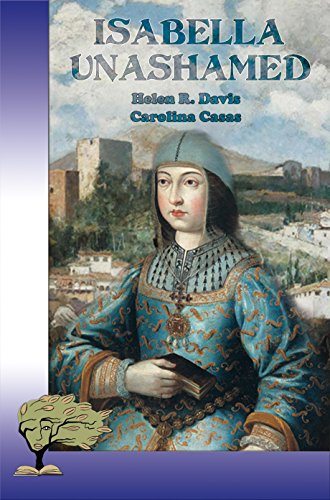
Helen Her debut novel “Isabella Unashamed” was co-written with the author of “Cleopatra Unconquered” & “The Most Happy”, Helen R. Davis, and it is a powerful alternative historical novel that asks the important question that has been on everyone’s mind: what-if? What if Isabella had taken a different route than the one she did following the surrender of Granada at the beginning of 1492.
 As I write, I hear the story in my head: the mood I want to create in the narrative passages and the sound of each character’s voice. I imagine most writers have clear ideas about how their stories should sound. Of course, this doesn’t mean that a reader will envision the story in exactly the same way as the writer. Each reader will have his own perception of it and that’s to be expected. But, listening to an audiobook gives the reader a chance to hear the story as the writer envisioned it.
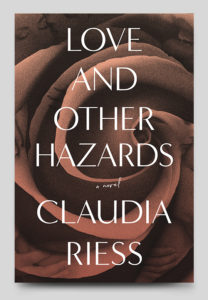 “Glenda Fieldston is at the Metropolitan Museum of Art with her seven-year-old daughter, Astrid, when Eugene Lerman comes walking by with his eight-year-old daughter, Meredith, a schoolmate of Astrid’s. The families spot each other, Glenda and Eugene engage in long-range cursory assessments, and then they go their separate ways.
 About Claudia Riess
 VC:
VC: About Vanessa Couchman
 intrigued and wanted to learn more. When my career wound down, I began a genealogy search at the National Archives since my grandfather was a Civil War Veteran. As I sorted through the yellowed pages of forms, correspondence and depositions, I discovered he was born in Indiana in 1840 as John Howard, (we knew him as Harvey Depew or H.D.) and the rumor was true! He had another family.
  organizational consultant for over thirty-five years. She taught organization psychology and founded The 3rd Act, a program whose mission supports positive aging. As she grew into her own third act, she started a genealogical journey to uncover the details of her grandparents’ lives, which culminated in her novel,





 dianneascroft.com