I’d like to welcome Kaaren Christopherson, the author of Decorum, to Ascroft, eh? this morning. Kaaren has written an intriguing tale set in the late nineteenth century in what is described as New York’s Gilded Age but I’ll let my guest tell us more about it.
Welcome Kaaren. Let’s get started, shall we?
Tell us about your novel.
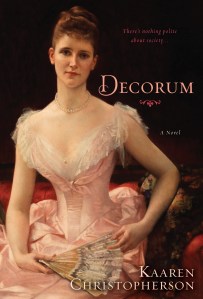 KC: Decorum is about a tycoon (Connor), an heiress (Francesca), a mistress (Blanche), and a gigolo (Edmund) who struggle to find happiness, power, and wealth amid deception, betrayal, bigamy, and murder in Gilded Age New York. Each character has his or her own challenges to overcome: though he has made his money, Connor yearns to break into the big league in New York business; Francesca is trying to move on with her life after her family has been killed; Blanche is trying to shake off her shady past and find security; Edmund, too, is looking for security—and control.
What prompted you to write about this historical period?
KC: When Connor O’Casey, Blanche Alvarado, and Francesca Lund appeared in my imagination, they were wearing Gilded Age fashions, so I never struggled to figure out what time period to portray. It was fascinating to watch these characters function at a time when the country was on the cusp of becoming modern. Horse-drawn carriages would soon be sharing the road with the first motor cars. Gas street lamps were giving way to electric lights. Only a relatively few households had telephones, so most communication that couldn’t take place face to face had to be done through letters and telegrams. Lots of plot twists can happen in the time it takes for a letter to arrive or for a horse to trot across town or to the next village.
How closely did you stick to the historical facts? If you used them loosely, how did you decide whether to deviate from them?
KC: Although Decorum doesn’t recreate specific historical incidents, recreating the look, the feel, the sounds, and smells of the Gilded Age in New York and the Canadian Rockies was essential if the reader is to be “transported” to another time. Though I invented some institutions, such as Venables Gallery and the Blue Iris Tea Room, they were based on actual places. When I do decide to deviate from actual places and invent them for the story, it’s usually because I want to insert some characteristic that helps support the story. So the gallery, for example, is a conglomeration of galleries and antiquities shops I found in my research with some unique features added so that the characters could move throughout the gallery in a way that was natural to the progression of the story. I did, however, make reference to actual events or people, such as Nellie Bly and her trip around the world.
What research did you do for this book?
KC: I began with several survey books about the period—mostly social history about how people lived (what they wore and ate, how they were educated, what work they performed), what technology was like (as it was known at the time), what discoveries had just been made, what political or economic forces affected ordinary people, how people traveled. I didn’t try to know everything. I tried to have a good grasp of what life was like and the limitations and opportunities the period had to offer so that when the characters were set in motion they began to act with credibility. Then I started writing and let the action and the characters dictate the next phase of research, which is largely the details—what to call items of clothing, what kind of carriage might be used for a particular event, how a dinner table is set. Researching the 1890s was very interesting because of the variety of material available, not just history books, but biographies and memoirs, photographs, engravings, paintings, novels from the period, all sorts of resources that helped me get closer to the characters and their surroundings. I also took advantage of historic home shows and what the museums and historic homes in New York and Washington, DC, have to offer for steeping myself in the period. One of my favorite resources was my great-grandmother’s etiquette book called Decorum, published in 1881. It not only gave me a wealth of information on the expected behavior of the period, but also gave me the novel’s title and organizing theme.
Do you use a mixture of historic figures and invented characters in Decorum. Which is more difficult to write? Which to you prefer to write and why?
KC: All the characters in Decorum come out of my imagination. This choice was deliberate; since I was new to novel-writing I wanted to concentrate on making fictional characters as real and three-dimensional as I could. I was keenly aware that introducing real people, especially well-known historical figures who already appear larger than life, might be difficult if all characters whether fictional or real were to be equally well-developed and balanced. So the first time around, I stayed with characters I invented. In another story that might be driven more by actual events, I might include actual historical figures; it would require lots of research to try to find the actual personality behind the history.
In an historical novel you must vividly re-create a place and people in a bygone era. How did you bring the place and people you are writing about to life?
KC: Many of the situations and their visual elements and descriptions in Decorum were inspired by studying engravings from fashion and news magazines of the 1880s and 1890s, photos of events and interiors, and American and European Impressionists. Trips to flea markets and antique shops yielded old cabinet photos that reminded me of the characters, as well as some of the items they may have used. Research on the internet yielded such things as descriptions of the original Metropolitan Opera House, the Tombs, and the Café Savarin, complete with menus. All these resources enhanced what I saw in my imagination and helped me describe it to the reader.
There often seems to be more scope in historical novels for male characters rather than female characters. Do you prefer to write one sex or the other. And, if so, why?
KC: I don’t prefer writing about characters of one sex or the other, but I do find it fascinating to watch different female characters from different backgrounds, with different personalities, experiences, motivations, and resources at their disposal tackle problems in the 1890s. So, for example, Francesca’s wealth and respectability gave her entre and acceptance into parts of society that Blanche, with her shady past, would have had a very difficult time entering. On the other hand, Francesca’s wealth didn’t shield her from a male-dominated world where her opinions could be easily disregarded and her options were few. Yet, like Blanche, if Francesca happened to make bad choices, society could be merciless. Readers can check out the wide array of female characters and their backgrounds through The O’Casey Chronicle the 1890s tabloid on my website: http://www.kaarenchristopherson.com/the-ocasey-chronicle
Thanks for answering my questions, Kaaren, and good luck with your novel.
For more information visit Kaaren Christopherson’s website. You can also find her on Facebook, Twitter, and Goodreads.
About Kaaren Christopherson: She is the author of Decorum—a  novel about Gilded Age New York—that began taking form in 1999 during a course on writing historical fiction. From that moment, Connor O’Casey (who had been rattling around in her brain for months) finally appeared one night and said, “All right, woman. Here I am. What are you going to do about my story?” So she began to put his words on paper, and he hasn’t kept quiet since. Soon Francesca, Blanche, Tracey, Vinnie, and the rest of the characters began arguing, gossiping, loving, and forming themselves into Kaaren’s first novel.
Kaaren has had a professional career writing and editing for over 30 years and is a senior editor for an international development nonprofit organization in Washington, DC.
She has written fiction since her school days, story poems, children’s books, historical fiction, and time travel, and continues to be active in writers’ groups and writing workshops. In addition to her career as a writer, Kaaren was the owner of a decorative painting business. She loves to travel and prowl through historical sites, galleries, and museums. She is active in several churches in DC and in her local Northern Virginia community, where she shares her home with feline brothers, Archie and Sammy.
A Michigan native, Kaaren received her BA in history and art and her MA in educational administration from Central Michigan University in Mt. Pleasant, Michigan.


 narratives of real events to reveal history for what it is: a tapestry of the fibers of individual lives through time. Building from the premise World War I, World War II, and the many other wars of the 20th Century were actually one prolonged human tragedy, the Threads series crosses the world to find individual stories exposing the facts, fictions and fallacies of armed violence. In Volume 1 the reader is whisked from the seats of a German cinema in 1915 and high over Pearl Harbor on December 7th, 1941 to under the water of the port of Alexandria, Egypt and on a rail line in East Prussia in 1945. Volume II builds off of its predecessor by taking us from the celebratory streets of Paris in the summer of 1914, under the coast of North Carolina in 1918, across the ocean to the evacuated beaches of northern France in 1940, and finally within the minds of both the liberated and the confined at camps in 1945.
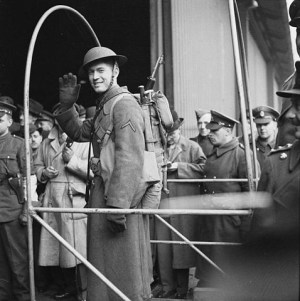 in the Second World War. Almost seventy-five years ago today the first ships carrying American troops docked in Belfast; these troops were the first US troops to arrive in Europe. The first enlisted soldier to officially step onto European soil was Private First Class Millburn Henke of the First Battalion, 133rd Infantry Regiment, 34th Infantry Division. Although other units had already disembarked in Belfast that morning before he came ashore at Dufferin Quay, he was chosen to represent the US servicemen and became the face of the ordinary soldier at the official welcoming ceremony. He was interviewed by reporters and posed for photographs, and the resulting newspaper articles were published across America, making him nationally famous.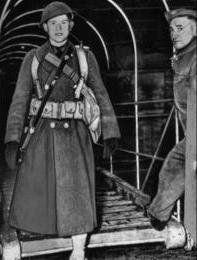
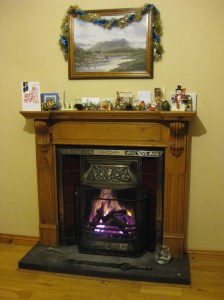 On Sunday night I left my comfy chair beside our fireplace to attend a concert in Belfast. Relaxing into my seat in the concert hall, I savoured I’m Dreaming of a White Christmas sung by a classical trio. I’m sure you’ve heard the song somewhere; it is considered the best selling single of all time. And it’s a song that always stirs memories for me.
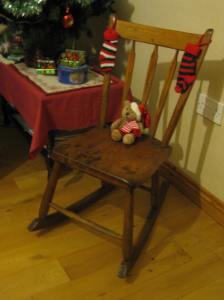 When we return home I’m greeted by a house festooned with decorations and other items that are intricately part of Christmas for me. Some of them I brought with me from my home in Toronto, including a set of colourful bells on a bright green braided rope that a Dutch aunt brought to Canada with her, fragile tree baubles that belonged to my mother and even the rocking chair that sat in our Toronto living room and was crafted at my grandfather’s farm in Western Canada long before I was born.
 writer, but the eras I knew and loved best – English and ancient Roman – seemed to be well-covered by writers better than I ever expected to be. One day, I picked up John Julius Norwich’s “A Short History of Byzantium” and found myself fascinated by this civilization. When I went looking for novels about them, however, I found precious few. Most of them seemed to be focused on either Emperor Justinian and his wife, Theodora – admittedly an interesting topic – or were from the point of view of the Crusaders, who had little love for the Byzantines. It was then I realized that I had found what I would write about.
 About Eileen Stephenson: She was born in Fort Worth, Texas but spent most of her life in the Washington, DC area. She has degrees from both Georgetown University and George Washington University (neither involving the Byzantines) and is married with three daughters. Her interest in Byzantine history all started one fateful day when every other book in the library looked boring except for John Julius Norwich’s A Short History of Byzantium.
 MW: NEAR THE WILD is taken from my family history, stories I’ve heard my entire life about how my ancestors came to America from Ireland to homestead in Kansas in the 1800s. The story is fiction, but it’s very much based on fact, or at least the stories I’ve heard from my mother’s and father’s generation of our family.
 About Maureen Willett: She is a writer of fiction that pushes the boundaries of established genres. Her stories mostly come from her own family legends that have been passed down through generations, but then she tops them off with a twist of faery dust and angel wings. She is a former journalist, public relations professional, and media marketing specialist. Maureen lives in Hawaii with her family and walks the white-sand beaches of Oahu each day to get her inspiration for writing.
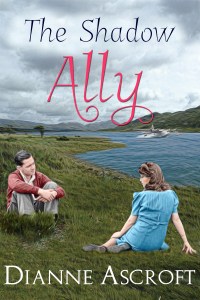 Italian-American civilian contractor, Frank Long, who is staying at her family’s hotel in Irvinestown, County Fermanagh, Northern Ireland. Serious and reserved, he is nothing like the friendly, outgoing British and Canadian servicemen she knows. Nor, she discovers, does he even use his real surname.

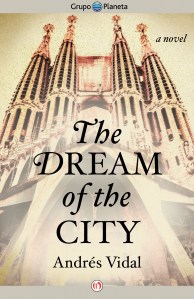 imagine walking around a building site of four magnificent towers that rise to the sky and belong to a temple just in the beginning of its construction. And try to imagine the life of one of the stonecutters, a well-off woman with singular personality, who will encounter an ambitious man related to her jeweler family. Many things could happen, no?
 About the author: Andrés Vidal is the pseudonym of Marius Molla. He is the author of two other novels that were successes in Spain: Inheriting the Earth (2010) and The Dream (2012). By training the author is an industrial engineer in Barcelona.







 dianneascroft.com